

ADVERTISEMENT

Smoke from Canadian wildfires brings unhealthy air to large swaths of the Midwest

Published Aug 3, 2025 08:20 am
Smoke from Canadian wildfires hovered over several Midwestern states Saturday, bringing warnings of unhealthy air for at least the third day.
Air quality alerts were in effect in Iowa, Minnesota, Wisconsin and Michigan, as well as eastern Nebraska and parts of Indiana and Illinois. Forecasters said the smoky skies would remain for much of the day.
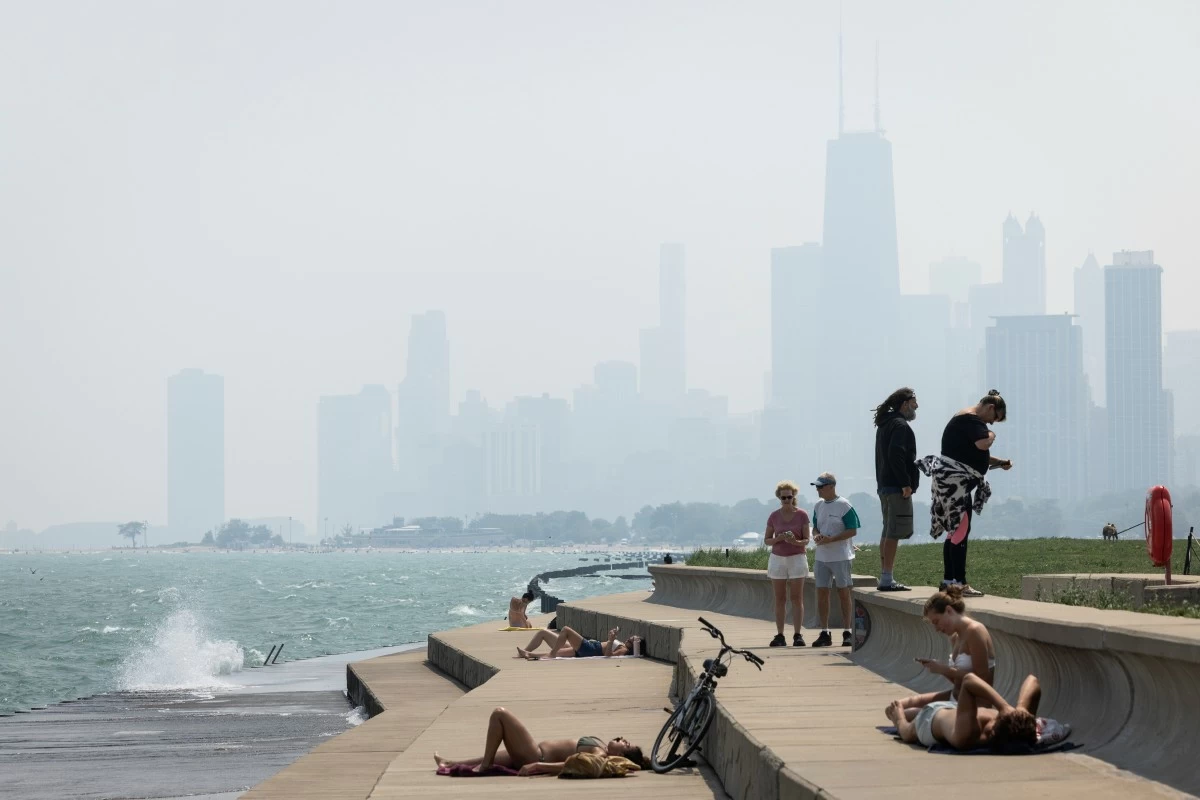
People sun tan on the Lakefront Trail on the North Side as a haze of Canadian wildfire smoke blankets the Chicago area and creates poor air quality, Thursday, July 31, 2025.  (Ashlee Rezin/Chicago Sun-Times via AP)
People sun tan on the Lakefront Trail on the North Side as a haze of Canadian wildfire smoke blankets the Chicago area and creates poor air quality, Thursday, July 31, 2025. (Ashlee Rezin/Chicago Sun-Times via AP)
Canadian environmental officials said smoke from the forest fires would persist into Sunday for some areas.
The Switzerland-based air quality monitoring database IQAir, which assesses air quality in real time, listed the city of Minneapolis as having some of the worst air pollution in the world since Friday. The Air Quality Index (AQI) was expected to reach the red or unhealthy category in a large swath of Minnesota.
AQI is a system used to communicate how much air pollution is in the air. It breaks pollution down into six categories and colors, along with advice on what is and is not safe to do. They range from "good" (the color green) to "hazardous" (maroon).
People with lung disease, heart disease, children, older adults and pregnant women are most susceptible to the poor breathing conditions.
"What's been unique in this go-around is that we've had this prolonged stretch of smoke particulates towards the surface, so that's where we've really had the air quality in the red here for the past few days," said Joe Strus, meteorologist with the National Weather Service in the Minneapolis–Saint Paul area in Minnesota.
"We've sort of been dealing with this, day in and day out, where you walk outside and you can taste the smoke, you can smell it," Strus said. "Sometimes we've been in higher concentrations than others. Other times it's just looked a little hazy out there."
The air was improving Saturday, he said, specifically across the Twin Cities and southwestern Minnesota, but state health officials warned that conditions could remain unhealthy for sensitive groups through Monday.
Officials said the smoke could spread as far south as Tennessee and Missouri.
The EPA's Air Quality Index converts all pollutant levels into a single number. The lower the number, the better. Anything below 50 is classified as "healthy." Fifty to 100 is "moderate" while 100-150 is unhealthy for "sensitive groups." Anything above 150 is bad for everyone. Parts of Minnesota exceeded that number on Saturday.
Health officials advise people with asthma and other lung disease, heart disease, children and older adults to avoid prolonged exposure to smoke and limit strenuous activities. They said to avoid burning things that could make the air pollution worse and to keep windows and doors closed.
"This is something that's become part of our summer here the last few years," Strus said, "and I think a lot of us are just looking forward to seeing a little more movement in the atmospheric winds and we'll be able to hopefully disperse some of the smoke out of here in the next few days."

Related Tags

World news
ADVERTISEMENT
.most-popular .layout-ratio{ padding-bottom: 79.13%; } @media (min-width: 768px) and (max-width: 1024px) { .widget-title { font-size: 15px !important; } }

{{ articles_filter_1561_widget.title }}

.most-popular .layout-ratio{ padding-bottom: 79.13%; } @media (min-width: 768px) and (max-width: 1024px) { .widget-title { font-size: 15px !important; } }

{{ articles_filter_1562_widget.title }}

.most-popular .layout-ratio{ padding-bottom: 79.13%; } @media (min-width: 768px) and (max-width: 1024px) { .widget-title { font-size: 15px !important; } }

{{ articles_filter_1563_widget.title }}

{{ articles_filter_1564_widget.title }}

.mb-article-details { position: relative; } .mb-article-details .article-body-preview, .mb-article-details .article-body-summary{ font-size: 17px; line-height: 30px; font-family: "Libre Caslon Text", serif; color: #000; } .mb-article-details .article-body-preview iframe , .mb-article-details .article-body-summary iframe{ width: 100%; margin: auto; } .read-more-background { background: linear-gradient(180deg, color(display-p3 1.000 1.000 1.000 / 0) 13.75%, color(display-p3 1.000 1.000 1.000 / 0.8) 30.79%, color(display-p3 1.000 1.000 1.000) 72.5%); position: absolute; height: 200px; width: 100%; bottom: 0; display: flex; justify-content: center; align-items: center; padding: 0; } .read-more-background a{ color: #000; } .read-more-btn { padding: 17px 45px; font-family: Inter; font-weight: 700; font-size: 18px; line-height: 16px; text-align: center; vertical-align: middle; border: 1px solid black; background-color: white; } .hidden { display: none; }
function initializeAllSwipers() { // Get all hidden inputs with cms_article_id document.querySelectorAll('[id^="cms_article_id_"]').forEach(function (input) { const cmsArticleId = input.value; const articleSelector = '#article-' + cmsArticleId + ' .body_images'; const swiperElement = document.querySelector(articleSelector); if (swiperElement && !swiperElement.classList.contains('swiper-initialized')) { new Swiper(articleSelector, { loop: true, pagination: false, navigation: { nextEl: '#article-' + cmsArticleId + ' .swiper-button-next', prevEl: '#article-' + cmsArticleId + ' .swiper-button-prev', }, }); } }); } setTimeout(initializeAllSwipers, 3000); const intersectionObserver = new IntersectionObserver( (entries) => { entries.forEach((entry) => { if (entry.isIntersecting) { const newUrl = entry.target.getAttribute("data-url"); if (newUrl) { history.pushState(null, null, newUrl); let article = entry.target; // Extract metadata const author = article.querySelector('.author-section').textContent.replace('By', '').trim(); const section = article.querySelector('.section-info ').textContent.replace(' ', ' '); const title = article.querySelector('.article-title h1').textContent; // Parse URL for Chartbeat path format const parsedUrl = new URL(newUrl, window.location.origin); const cleanUrl = parsedUrl.host + parsedUrl.pathname; // Update Chartbeat configuration if (typeof window._sf_async_config !== 'undefined') { window._sf_async_config.path = cleanUrl; window._sf_async_config.sections = section; window._sf_async_config.authors = author; } // Track virtual page view with Chartbeat if (typeof pSUPERFLY !== 'undefined' && typeof pSUPERFLY.virtualPage === 'function') { try { pSUPERFLY.virtualPage({ path: cleanUrl, title: title, sections: section, authors: author }); } catch (error) { console.error('ping error', error); } } // Optional: Update document title if (title && title !== document.title) { document.title = title; } } } }); }, { threshold: 0.1 } ); function showArticleBody(button) { const article = button.closest("article"); const summary = article.querySelector(".article-body-summary"); const body = article.querySelector(".article-body-preview"); const readMoreSection = article.querySelector(".read-more-background"); // Hide summary and read-more section summary.style.display = "none"; readMoreSection.style.display = "none"; // Show the full article body body.classList.remove("hidden"); } document.addEventListener("DOMContentLoaded", () => { let loadCount = 0; // Track how many times articles are loaded const offset = [1, 2, 3, 4, 5, 6, 7, 8, 9, 10]; // Offset values const currentUrl = window.location.pathname.substring(1); let isLoading = false; // Prevent multiple calls if (!currentUrl) { console.log("Current URL is invalid."); return; } const sentinel = document.getElementById("load-more-sentinel"); if (!sentinel) { console.log("Sentinel element not found."); return; } function isSentinelVisible() { const rect = sentinel.getBoundingClientRect(); return ( rect.top < window.innerHeight && rect.bottom >= 0 ); } function onScroll() { if (isLoading) return; if (isSentinelVisible()) { if (loadCount >= offset.length) { console.log("Maximum load attempts reached."); window.removeEventListener("scroll", onScroll); return; } isLoading = true; const currentOffset = offset[loadCount]; window.loadMoreItems().then(() => { let article = document.querySelector('#widget_1690 > div:nth-last-of-type(2) article'); intersectionObserver.observe(article) loadCount++; }).catch(error => { console.error("Error loading more items:", error); }).finally(() => { isLoading = false; }); } } window.addEventListener("scroll", onScroll); });

Sign up by email to receive news.