






Manila Bulletin
 Philippines
National
INSIDE LOOK: West PH Sea documentary 'Food Delivery' vows to persevere despite 'adversities'
Philippines
National
INSIDE LOOK: West PH Sea documentary 'Food Delivery' vows to persevere despite 'adversities'
Philippines
National
INSIDE LOOK: West PH Sea documentary 'Food Delivery' vows to persevere despite 'adversities'
INSIDE LOOK: West PH Sea documentary 'Food Delivery' vows to persevere despite 'adversities'
Published Aug 3, 2025 11:25 am
|
Updated Aug 3, 2025 02:36 pm


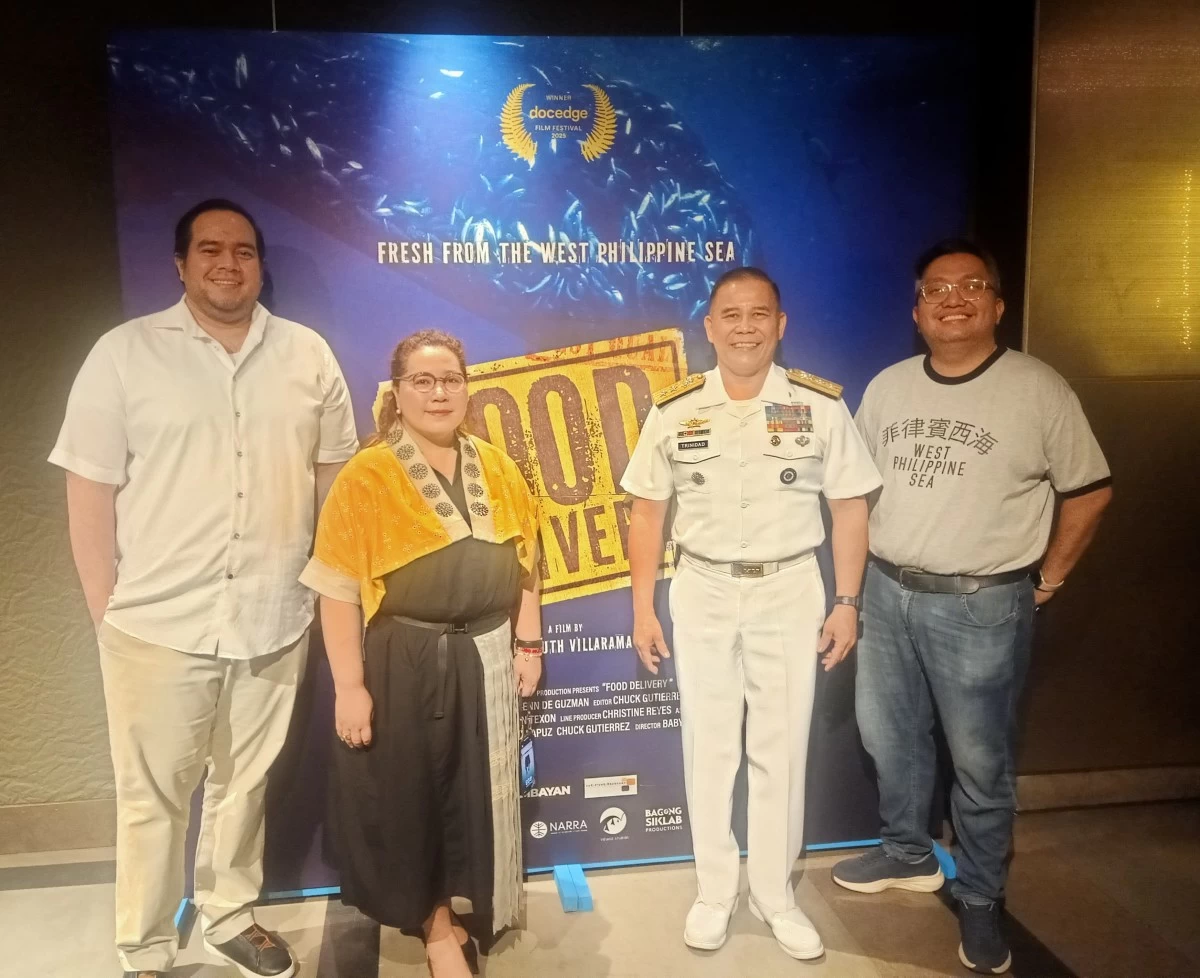
(L-R) Mr. Michel Andre P. Del Rosario, executive director of Center for Information Resilience and Integrity Studies (CIRIS); Food Delivery director Baby Ruth Villarama; Armed Forces of the Philippines (AFP) spokesperson for West Philippine Sea, Rear Adm. Roy Vincent Trinidad; and producer Chuck Gutierrez pose for a snap during a block screening of the documentary Food Delivery: Fresh from the West Philippine Sea in Makati City on Aug. 2, 2025. (Martin A. Sadongdong/MANILA BULLETIN)
Braving censorship, storms, both literal and political, and the vastness of contested waters, the independent documentary “Food Delivery: Fresh from the West Philippine Sea” has finally found its way to Filipino audiences.
Directed by award-winning filmmaker Baby Ruth Villarama, the film tells the story of ordinary people such as fishermen, soldiers, and their families, doing extraordinary things as their lives unfold daily in the nation’s frontline waters.
Among the subjects of the film was Arnel Satam, a fisherman who was chased by Chinese forces in the Scarborough Shoal, locally known as Bajo de Masinloc or Panatag Shoal.
The 55-year-old native of Subic, Zambales narrated how he and his fellow fishermen were now blocked from their traditional fishing ground in Scarborough Shoal by Chinese coast guard and military vessels, even if the area is within the 200-nautical mile exclusive economic zone (EEZ) of the Philippines. As a result, their catch and income had been greatly reduced.
The film also featured the difficulty of resupply missions being conducted by the Armed Forces of the Philippines (AFP) to bring food and other provisions to troops guarding the features occupied by Philippines in the WPS. Some of the troopers had to endure being away from their families, others had to deal with debts and other personal problems, and one even shared the story about how the lack of signal in the WPS makes it hard for him to send money to his family for the tuition of his sister. Despite this, the troops still perform their duty every day to defend the country’s sovereign rights in the WPS.
Food Delivery also narrated the Philippine Coast Guard and local fisherfolk’s continuing efforts to search for four fishermen who went missing on Nov. 27, 2024 in an area tightly guarded by Chinese vessels in Scarborough Shoal. Brothers Richard and Reymond Recalde, Daniel Sabido, and Anthony Tadeo were crew members of fishing boat (FB) “Reincris”. They went on a fishing expedition in the Scarborough Shoal on Nov. 20, 2024 and after a week, they never returned home.
The Manila Bulletin joined a block screening of Food Delivery in Makati City on Saturday, Aug. 2, and we had the rare opportunity to talk to Villarama, who promised to fight for the film even as external forces are trying to suppress it.
Censorship
The film Food Delivery endured two attempts at censorship, according to Villarama. First was in March when it was withdrawn from Puregold’s CinePanalo Film Festival in Quezon City, and the second in June when the Chinese consulate in New Zealand wrote to the event organizers of the Doc Edge Festival to pull out the film, although the organizers stood their ground and rejected the call.
The film won the Best Picture Award under the Tides of Change Category at the internationally renowned Doc Edge Festival 2025 in New Zealand, an Oscar-qualifying documentary film festival.
“The film has gone through a lot because certain forces externally are trying to block it from being seen by the Filipino people,” Villarama told the Manila Bulletin. “Even now, I’m sure forces are at work doing or reaching out to decision-makers behind the scene to make sure the film stays within the parameters of its echo chamber.”
She revealed that the film has not yet been part of the commercial ecosystem of cinemas in the Philippines and it’s only because of civic groups organizing block screenings that Food Delivery is being shown to the public.
Saturday’s block screening was sponsored by the Philippine Military Academy (PMA) “Sambisig” Class of 1991, led by Rear Admiral Roy Vincent Trinidad, who serves as the AFP spokesperson for WPS.
“It’s still a challenge because we’re not yet part of the commercial ecosystem of the cinemas. They’re still reviewing the audience turnout and how the film would be received, not just on the ground but also politically by people with different interests,” Villarama said.
“We’re just showing [to] everyone that this film means no harm. It’s an invitation for everyone to see it because it’s our simple contribution to… you know, the courage of our Filipino fishermen, and for it to become hopefully a platform for dialogue,” she added.
Motivation
According to the filmmaker, she was motivated to create the film after witnessing Filipino journalists, fishermen, and soldiers get chased, water cannoned, and rammed by Chinese vessels in the WPS.
“The motivation has always been because I am a Filipino and as a Filipino story-teller, you always ask the question ‘How can you help? How can you contribute when you’re witnessing first-hand that your fellow journalists, kababayan, fisherfolk are being chased by Chinese vessels within our own territorial waters?” Villarama said.
She said the film was “not born from politics or policy”, stressing that the goal of Food Delivery was to become a platform for dialogue to address the territorial dispute in the WPS.
“With our little God’s gifted talent, we thought maybe there’s something that we can do if we can find common ground for people to come together and discuss. And maybe food is something that can connect us, and the ocean is also a character, as we call it, it’s a part of the story, and the ocean should connect us, not divide us,” she continued.
Fighting DMMI
Rear Admiral Trinidad lauded the film as a truthful depiction of life on the frontlines.
“The Philippine Navy and the Armed Forces support all efforts to show what’s really happening in the West Philippine Sea,” he told the Manila Bulletin. “We believe that the Filipino people must see and must know what the truth is.”
Mr. Michel Andre P. Del Rosario, executive director of Center for Information Resilience and Integrity Studies (CIRIS), said the documentary has become a target of foreign digital manipulation and censorship. He said the film is a powerful tool that can be used to fight disinformation, misinformation, and malign influence (DMMI) surrounding the WPS issue.
“Mayroon tayong domestic brand of DMMI pero ang kadalasan, ang mas delikado is foreign type of DMMI,” he said.
“There are still ongoing attempts to censor or suppress not only Food Delivery but products and media like Food Delivery or similar to Food Delivery here in our country and elsewhere,” he added, citing the Chinese government’s sanction on former senator Francis Tolentino, barring him from entering the mainland China, Hong Kong and Macau for speaking out very firmly and strongly against China’s aggression and coercion “not just in the WPS but here in our very shores.”
Despite limited resources and ongoing external pressure, Food Delivery has emerged as a platform for dialogue and unity and Villarama hopes it becomes a bridge, especially in the face of geopolitical tensions and complex diplomatic missions.
“There were efforts to cancel it, you may have heard about it, to erase this film, but we remain under the radar of forces bigger than us. As wise fisherman told us when the sea turns rough, ‘walang bagyong hindi natatapos.’ Every storm ends. No matter how vast or contested our waters become, I trust that with you onboard, truth will always find its way to shore,” she concluded.