







The riotous past, and ominous present
Published Aug 2, 2025 11:38 am


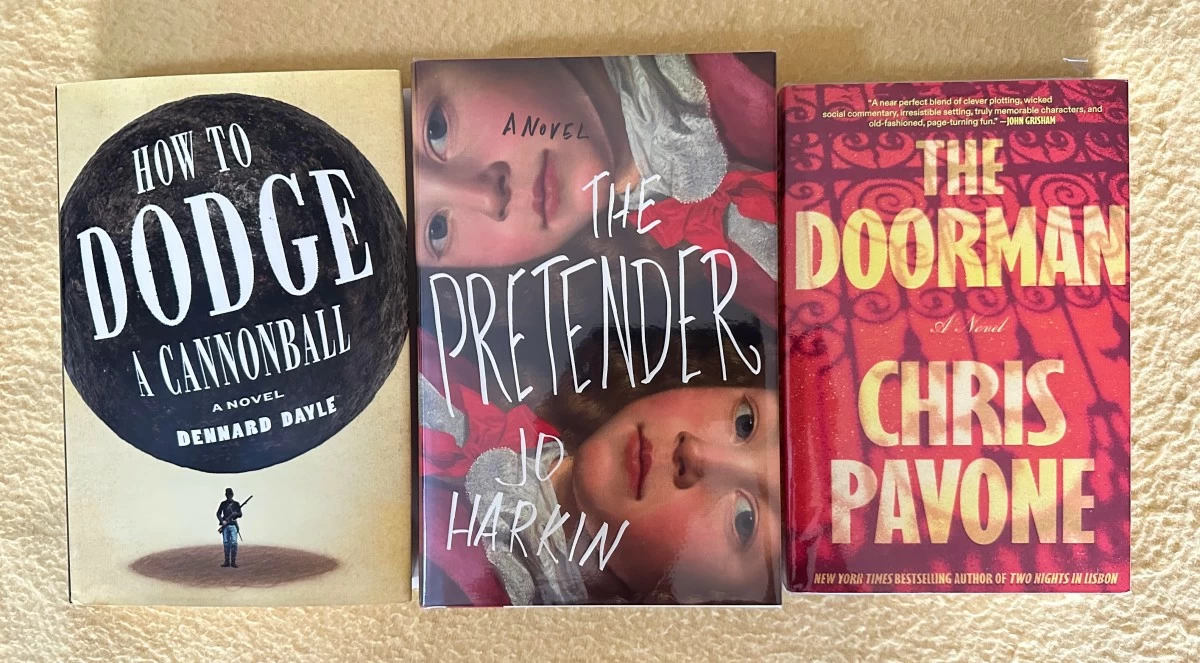
Today, we have two stories from the distant past that utilize recorded history as a springboard for scathing humor and social commentary - one is set during the US Civil War, and the other, by way of England, during the reign of the Tudors. Then, the third is a cautionary tale set in present-day Manhattan.
"How To Dodge A Connonball" by Dennard Dayle
It may be instructional to know that Dayle once aspired to be a stand-up comedian. A Jamaican-American, he’s certainly adept at skewering race, identity, and history in the course of this hilarious first novel. Set during the American Civil War, our protagonist is Anders, an idealistic teenager who’s an octaroon (defined as 1/8 Black), and with a violently insane mother. She literally branded him with a half star, to represent dashed dreams and half-baked aspirations. He enlists to help shape the American future, and ends up a Union flag twirler. Captured during a skirmish, he readily transforms into a turncoat and becomes a diehard Confederate. To rack up the absurdity, at Gettysburg, he steals a uniform and joins a Black Union regiment, and this forms the main body of the novel’s narrative - his misadventures while with this colored regiment.
Anders’ new friends in the regiment include a SciFi playwright, a double agent from Haiti, and a girl soldier who dresses up as a male, depending on the occasion. There’s a Caucasian arms agent who deals with both the North and the South, and the inside joke is that while he’s named Slade Jefferson, he’s probably the only descendant of Thomas Jefferson who’s in the book - and is white. There’s a set piece towards the end of the novel that speaks of trying to establish American royalty and a kingdom in the Midwest, and how that’s squashed. This is a satire with bite, asking questions like who and what is American, and it’s been described by some critics as the Catch 22 of the Civil War. The main thrust of the narrative, that is successfully pulled off by Dayle, is how humanity and absurdity often travel hand in hand and become our concept of history.
"The Pretender" by Jo Harkin
Set in England in the 15th century, this is historical fiction made irreverent, contemporary, educational, and most of all, fun. Inspired by the story of Lambert Simnel, a footnote in the history of the era that saw the ascent of the Tudors, there’s a wonderful sense of time and place that Harkin conjures up. Simnel was believed to be the true heir to the throne occupied by Henry VII, but he was raised in obscurity as a peasant boy named John Collan in order to keep him safe. Recorded history will relate how he was briefly crowned, at the age of 13, as Edward VI, the last Plantagenet King. Set in 1483, there’s a distinct tone to how Harkin writes this novel. Reminiscent of Chaucer and his Canterbury Tales, there’s a lot of ribald dialogue, coarse humor, and sexual innuendos. It’s historical fiction, but with a silly, self-mocking grin plastered on its face.
Removed from obscurity in said village, there is a stint in Oxford under a tutor, and then Lambert is brought to Ireland. Meanwhile, swirling around Lambert are the political events of the time, none more impactful than Henry taking the throne from Richard. It’s in Ireland that Edward meets Joan, daughter of Kildare, who is protecting Lambert/Edward. Joan is a wonderful character conjured up by Harkin. As Joan explains, her life has two paths: marry a man picked by her father, or be a nun. And as Kildare frequently mentions, Joan is the son he should have had, and would be so proud of. His coronation, the invasion of England, and his being brought to Henry as the pretender prisoner all keep us turning the pages of this lively history lesson. That it’s also an unrequited love story spread across decades only enhances the reading value of this fine novel.
"The Doorman" by Chris Pavone
Chicky Diaz is the doorman at the Bohemia. Located on Central Park West, think Dakota of the West Side, near the Museum of Natural History; as it's also the home to celebrities, the cultural elite of Manhattan, and of financiers and money people. On a night when there’s unrest in the city and violent demonstrations over a black man who’s been killed by the police, Chicky is doing what’s strictly forbidden as the regular doorman; he’s carrying a piece. Then we meet some of the people who reside in Bohemia. There’s Emily Longworth on 11C-D, married to Whit, an overbearing billionaire who she knows she’s not in love with. He’s an arms dealer with no conscience, and if not for the ironclad prenup, she’d be out the door. And there’s Julian Sonnenberg on the 2nd floor, co-owner of an art gallery, and he’s had dealings with Emily and her husband.
The whys of Chicky bringing a revolver to work are just one of the interesting narrative strands of this novel. With themes of race, of class, of social justice, identity, and the power of money, this NYC novel aspires to be placed on a shelf beside Tom Wolfe’s Bonfire of the Vanities and Jay McInerney’s Bright Lights, Big City. It’s written like a thriller, but does deliver as a social satire and commentary box. From the high, mighty, and entitled, down to the blue collar, desperate, and compromised, we’re given a snapshot of what living in Manhattan today can be like, and what makes people from different backgrounds tick. As the rioting spills over onto Park Avenue and Fifth, the basic fear of all those with money surfaces, whether Republican or Democrat. The last 100 pages are white knuckle suspense territory, and their resolution will have you flabbergasted and picking sides. Stirring read!