






Manila Bulletin
 Philippines
National
Sulu Province moved to Region IX; Marcos ensures uninterrupted services
Philippines
National
Sulu Province moved to Region IX; Marcos ensures uninterrupted services
Philippines
National
Sulu Province moved to Region IX; Marcos ensures uninterrupted services
Sulu Province moved to Region IX; Marcos ensures uninterrupted services
Published Aug 2, 2025 07:28 am
|
Updated Aug 2, 2025 04:54 pm


At A Glance
- Executive Order (EO) No. 91, dated July 30, 2025, implements the High Court's decision affirming the result of the 2001 plebiscite, in which the people of Sulu voted against joining the now-defunct Autonomous Region in Muslim Mindanao (ARMM), the predecessor of BARMM.
President Marcos has ordered the continued delivery of government services to the Province of Sulu, as he signed an executive order transferring it from the Bangsamoro Autonomous Region in Muslim Mindanao (BARMM) to Region IX, also known as the Zamboanga Peninsula, in compliance with a Supreme Court ruling.
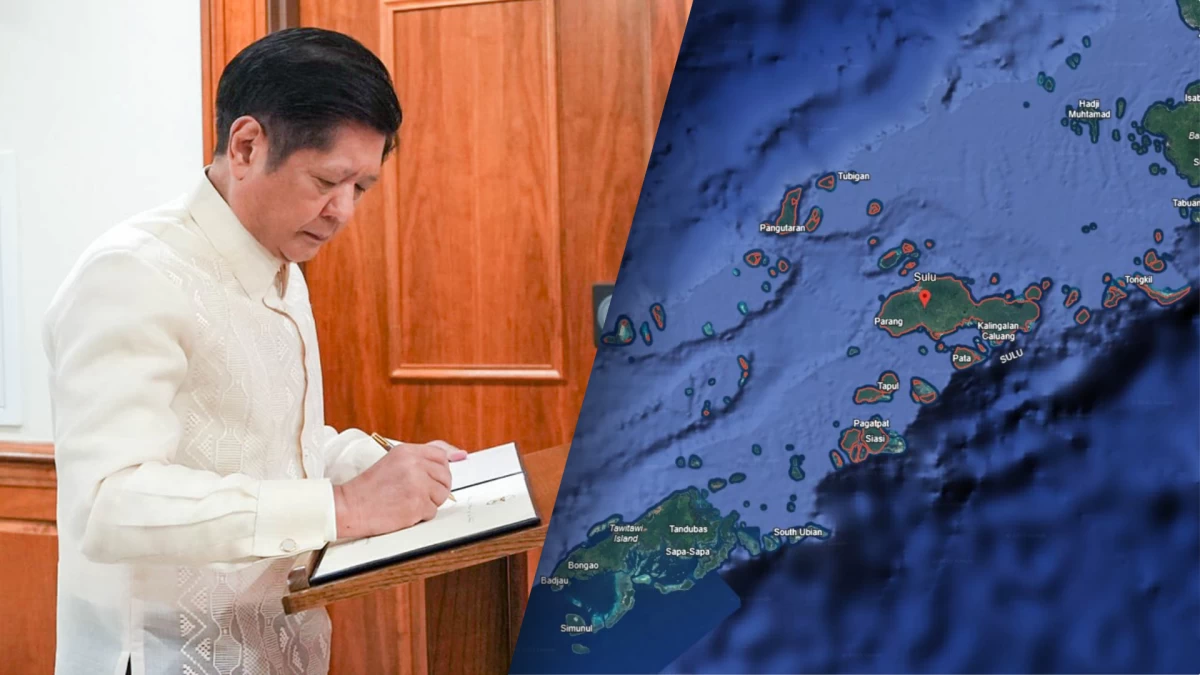
President Ferdinand 'Bongbong' Marcos Jr. (File Photos, Google Earth)
Executive Order (EO) No. 91, dated July 30, 2025, implements the High Court’s decision affirming the result of the 2001 plebiscite, in which the people of Sulu voted against joining the now-defunct Autonomous Region in Muslim Mindanao (ARMM), the predecessor of BARMM.
In his EO, President Marcos said the realignment was necessary to ensure continued public service in Sulu and to uphold the voice of its people.
“There exists an urgent need to effectively implement and address the effects of the Supreme Court Decision and Resolution on the operations of NGAs and the delivery of public services in the Province of Sulu,” he said.
The EO applies to the Province of Sulu and its component local government units (LGUs), all departments, agencies, and instrumentalities of the Executive Branch, and their respective counterparts located within the province.
The Sulu provincial government, LGUs, and relevant national government agencies (NGAs) are instructed to "make all reasonable efforts" to facilitate a phased and seamless transition.
Meanwhile, the Bangsamoro and Sulu Province governments may enter into appropriate institutional arrangements or mechanisms to sustain the implementation and financing of programs, activities, and projects (PAPs) and ensure the continuity and uninterrupted delivery of government services to their constituents. Effective Fiscal Year 2026, all PAPs in Sulu shall be implemented by the NGAs concerned.
Affected personnel
Affected personnel with permanent appointments who would opt to retire or be separated from the services are entitled to retirement benefits or separation incentives. However, they must have rendered a minimum of five years of government service for them to qualify for the incentives.
In addition to statutory benefits, the retired or separated personnel shall receive a refund of their Pag-IBIG contributions and a commutation of unused vacation and sick leave credits.
Those who would be retired or separated from the service are prohibited from reemployment in any agency of the Executive Branch for five years, except as teaching or medical staff and educational institutions and hospitals.
“If they are reemployed within this period, they shall refund their retirement/separation benefits and additional separation incentives on a pro-rated basis,” the EO read.
Technical working group
To ensure a smooth transition, Marcos formed a technical working group (TWG) chaired by the Executive Secretary and co-chaired by the Secretaries of Budget and Management, Interior and Local Government, and National Defense.
The TWG has 15 days from the effectivity of the EO to convene and determine actions to be taken, including the issuance of rules for budget realignment, staffing adjustments, and program transfers.
The TWG is directed to submit an annual report to the President on the implementation of the EO and make recommendations for further improvement.
The executive order takes effect immediately upon publication in the Official Gazette or a newspaper of general circulation.