ADVERTISEMENT

Indonesian volcano erupts, belches giant ash plumes miles away

Published Aug 2, 2025 02:37 pm
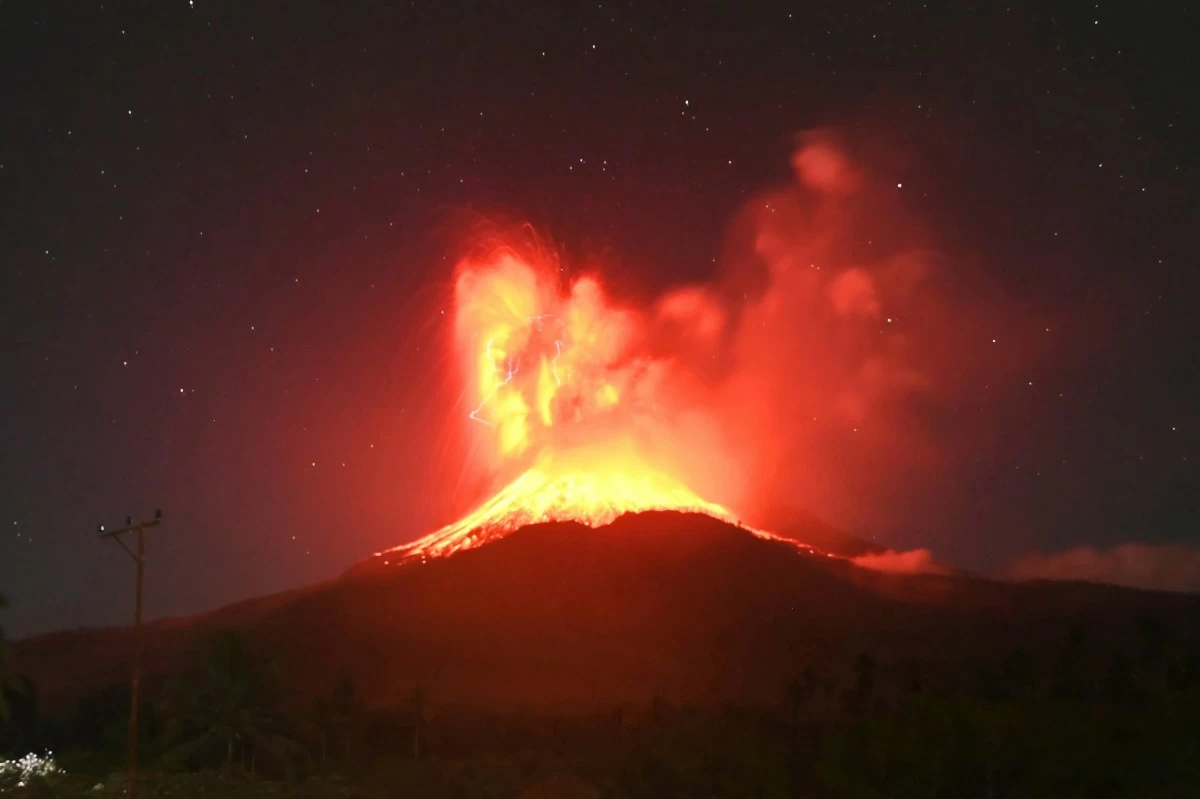
LAVA glows on the slope of Mount Lewotobi Laki-Laki during an eruption in East Flores, Indonesia, Friday, Aug. 1, 2025. (Badan Geologi via AP)
JAKARTA, Indonesia (AP) – Mount Lewotobi Laki Laki, one of Indonesia’s most active volcanoes, erupted for a second straight day, sending a column of volcanic materials and ash up to 18 kilometers (11 miles) into the sky early Saturday and blanketing villages with debris. No casualties were immediately reported.
Another eruption Friday evening had sent clouds of ash up to 10 kilometers (6.2 miles) high and had lit up the night sky with glowing lava and bolts of lightning. The two eruptions happened in a span of less than five hours.
Indonesia’s Geology Agency recorded an avalanche of searing gas clouds mixed with rocks and lava traveling up to five kilometers (three miles) down the slopes of the mountain. Drone observations showed deep movement of magma, setting off tremors that registered on seismic monitors.
Volcanic material, including hot thumb-sized gravel, was thrown up to eight kilometers (five miles) from the crater, covering nearby villages and towns with thick volcanic residue, the agency said. It asked residents to be vigilant about heavy rainfall that could trigger lava flows in rivers originating from the volcano.
Saturday's eruption was one of Indonesia’s largest since 2010 when Mount Merapi, the country’s most volatile volcano, erupted on the densely populated island of Java. That eruption killed more than 350 people and forced hundreds of thousands to evacuate.
It also came less than a month after a major eruption on July 7 forced the delay or cancelation of dozens of flights at Bali's Ngurah Rai airport, and covered roads and rice fields with thick, gray mud and rocks.
Lewotobi Laki Laki, a 1,584-meter (5,197-foot) volcano on the remote island of Flores, has been at the highest alert level since it erupted on June 18, and an exclusion zone has been doubled to a seven-kilometer (4.3-mile) radius as eruptions became more frequent.
The Indonesian government has permanently relocated thousands of residents after a series of eruptions there killed nine people and destroyed thousands of homes in November.
Indonesia is an archipelago of more than 280 million people with frequent seismic activity. It has 120 active volcanoes and sits along the “Ring of Fire,” a horseshoe-shaped series of seismic fault lines encircling the Pacific Basin.

Related Tags

World news
ADVERTISEMENT
.most-popular .layout-ratio{ padding-bottom: 79.13%; } @media (min-width: 768px) and (max-width: 1024px) { .widget-title { font-size: 15px !important; } }

{{ articles_filter_1561_widget.title }}

.most-popular .layout-ratio{ padding-bottom: 79.13%; } @media (min-width: 768px) and (max-width: 1024px) { .widget-title { font-size: 15px !important; } }

{{ articles_filter_1562_widget.title }}

.most-popular .layout-ratio{ padding-bottom: 79.13%; } @media (min-width: 768px) and (max-width: 1024px) { .widget-title { font-size: 15px !important; } }

{{ articles_filter_1563_widget.title }}

{{ articles_filter_1564_widget.title }}

.mb-article-details { position: relative; } .mb-article-details .article-body-preview, .mb-article-details .article-body-summary{ font-size: 17px; line-height: 30px; font-family: "Libre Caslon Text", serif; color: #000; } .mb-article-details .article-body-preview iframe , .mb-article-details .article-body-summary iframe{ width: 100%; margin: auto; } .read-more-background { background: linear-gradient(180deg, color(display-p3 1.000 1.000 1.000 / 0) 13.75%, color(display-p3 1.000 1.000 1.000 / 0.8) 30.79%, color(display-p3 1.000 1.000 1.000) 72.5%); position: absolute; height: 200px; width: 100%; bottom: 0; display: flex; justify-content: center; align-items: center; padding: 0; } .read-more-background a{ color: #000; } .read-more-btn { padding: 17px 45px; font-family: Inter; font-weight: 700; font-size: 18px; line-height: 16px; text-align: center; vertical-align: middle; border: 1px solid black; background-color: white; } .hidden { display: none; }
function initializeAllSwipers() { // Get all hidden inputs with cms_article_id document.querySelectorAll('[id^="cms_article_id_"]').forEach(function (input) { const cmsArticleId = input.value; const articleSelector = '#article-' + cmsArticleId + ' .body_images'; const swiperElement = document.querySelector(articleSelector); if (swiperElement && !swiperElement.classList.contains('swiper-initialized')) { new Swiper(articleSelector, { loop: true, pagination: false, navigation: { nextEl: '#article-' + cmsArticleId + ' .swiper-button-next', prevEl: '#article-' + cmsArticleId + ' .swiper-button-prev', }, }); } }); } setTimeout(initializeAllSwipers, 3000); const intersectionObserver = new IntersectionObserver( (entries) => { entries.forEach((entry) => { if (entry.isIntersecting) { const newUrl = entry.target.getAttribute("data-url"); if (newUrl) { history.pushState(null, null, newUrl); let article = entry.target; // Extract metadata const author = article.querySelector('.author-section').textContent.replace('By', '').trim(); const section = article.querySelector('.section-info ').textContent.replace(' ', ' '); const title = article.querySelector('.article-title h1').textContent; // Parse URL for Chartbeat path format const parsedUrl = new URL(newUrl, window.location.origin); const cleanUrl = parsedUrl.host + parsedUrl.pathname; // Update Chartbeat configuration if (typeof window._sf_async_config !== 'undefined') { window._sf_async_config.path = cleanUrl; window._sf_async_config.sections = section; window._sf_async_config.authors = author; } // Track virtual page view with Chartbeat if (typeof pSUPERFLY !== 'undefined' && typeof pSUPERFLY.virtualPage === 'function') { try { pSUPERFLY.virtualPage({ path: cleanUrl, title: title, sections: section, authors: author }); } catch (error) { console.error('ping error', error); } } // Optional: Update document title if (title && title !== document.title) { document.title = title; } } } }); }, { threshold: 0.1 } ); function showArticleBody(button) { const article = button.closest("article"); const summary = article.querySelector(".article-body-summary"); const body = article.querySelector(".article-body-preview"); const readMoreSection = article.querySelector(".read-more-background"); // Hide summary and read-more section summary.style.display = "none"; readMoreSection.style.display = "none"; // Show the full article body body.classList.remove("hidden"); } document.addEventListener("DOMContentLoaded", () => { let loadCount = 0; // Track how many times articles are loaded const offset = [1, 2, 3, 4, 5, 6, 7, 8, 9, 10]; // Offset values const currentUrl = window.location.pathname.substring(1); let isLoading = false; // Prevent multiple calls if (!currentUrl) { console.log("Current URL is invalid."); return; } const sentinel = document.getElementById("load-more-sentinel"); if (!sentinel) { console.log("Sentinel element not found."); return; } function isSentinelVisible() { const rect = sentinel.getBoundingClientRect(); return ( rect.top < window.innerHeight && rect.bottom >= 0 ); } function onScroll() { if (isLoading) return; if (isSentinelVisible()) { if (loadCount >= offset.length) { console.log("Maximum load attempts reached."); window.removeEventListener("scroll", onScroll); return; } isLoading = true; const currentOffset = offset[loadCount]; window.loadMoreItems().then(() => { let article = document.querySelector('#widget_1690 > div:nth-last-of-type(2) article'); intersectionObserver.observe(article) loadCount++; }).catch(error => { console.error("Error loading more items:", error); }).finally(() => { isLoading = false; }); } } window.addEventListener("scroll", onScroll); });

Sign up by email to receive news.