






Manila Bulletin
 Philippines
National
PH, India to hold 1st joint sail in WPS as officials reject 'troublemaker' tag by China
Philippines
National
PH, India to hold 1st joint sail in WPS as officials reject 'troublemaker' tag by China
Philippines
National
PH, India to hold 1st joint sail in WPS as officials reject 'troublemaker' tag by China
PH, India to hold 1st joint sail in WPS as officials reject 'troublemaker' tag by China
Published Aug 1, 2025 04:00 pm


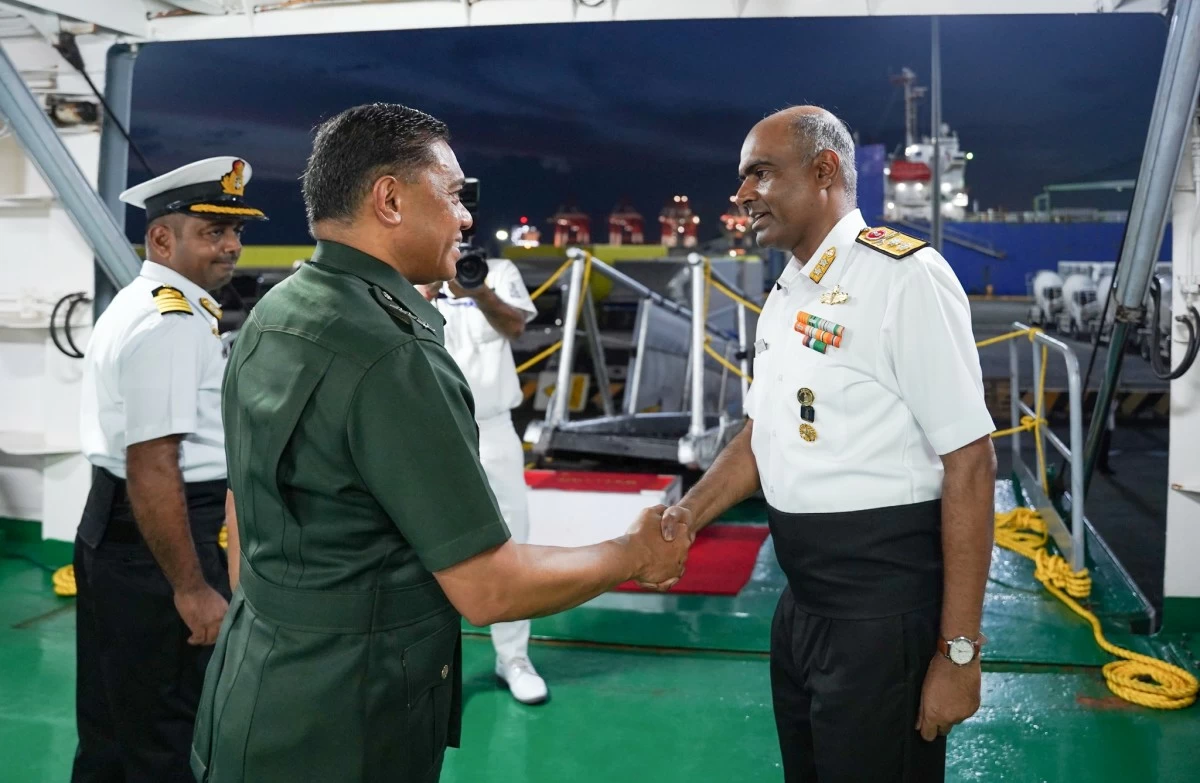
Armed Forces of the Philippines (AFP) Chief of Staff General Romeo S. Brawner Jr. (left) shakes the hand of Rear Admiral Susheel Menon, Flag Officer Commanding Eastern Fleet of the Indian Navy, as he boards Indian Navy Ship (INS) Shakti during its port call in Manila on July 31, 2025. (Photo: AFP)
For the very first time, India will join the Armed Forces of the Philippines (AFP) in a joint sail in the West Philippine Sea (WPS) this weekend just as China called the Philippines a “troublemaker” in the South China Sea for rallying up nations to supposedly gang up on them, an accusation denied by top security and military officials.
AFP Chief, General Romeo Brawner Jr. said the inaugural maritime cooperative activity (MCA) between the Philippine Navy and Indian Navy will take place on Aug. 3 to 4 off Masinloc, Zambales to Cabra Island in Lubang, Occidental Mindoro, areas that are frequently intruded by Chinese ships.
Indian Navy ships INS Delhi (D61), a guided-missile destroyer; INS Shakti (A57), a replenishment oiler; and INS Kiltan (P30), an anti-submarine warfare (ASW) corvette, docked in Manila on Wednesday, ahead of the joint sail. They will be accompanied by INS Sandhayak, a hydrographic survey ship.
Meanwhile, the PN will deploy two guided-missile frigates for the patrol, the BRP Jose Rizal (FF150) and BRP Miguel Malvar (FFG06).
Brawner revealed that the joint sail with India was a result of his discussion with Indian Armed Forces chief General Anil Chauhan during the Raisina Dialogue 2025 in New Delhi in March, and the Shangri-la Dialogue in Singapore in June.
This will also take place as President Marcos Jr. will visit India from Aug. 4 to 8 to meet with Indian Prime Minister Narendra Modi.
“This is very important because, as China said, it’s supposedly a show of force, but I disagree. This is a show of unity, a show of solidarity among like-minded nations because we share the same values. And what value is that? We value a free and open Indo-Pacific,” Brawner told reporters aboard INS Shakti on Thursday night, July 31.
Brawner said Marcos and Modi will hold a strategic dialogue on defense and security cooperation which is expected to produce a “strategic agreement”.
‘PH is no troublemaker’
The planned patrol came after Chinese Ministry of Defense spokesperson Zhang Xiaogang said the Philippines “is a genuine troublemaker and a creator of danger in the South China Sea.” The Chinese official pointed out that Manila is strengthening its defense cooperation with the United States, Australia, Japan, and India to provoke Beijing.
However, Brawner emphasized that the country is not the source of instability in the region, contrary to China’s claims.
“We are not the source of tension in the West Philippine Sea. In fact, what we are doing is we are strengthening the Armed Forces of the Philippines so that we can establish a credible deterrent because we do not want war. That’s why we need to have a strong deterrence. And the way to achieve that is by modernizing the AFP and partnering with like-minded nations, and that’s exactly what we are doing with India,” he said.
Relatedly, National Security Adviser (NSA) rejected China’s labeling of the Philippines as a “troublemaker,” asserting that only China has made such a claim.
“The allegation that we are a troublemaker, I think no other country has ever said that or confirm that except PRC [People’s Republic of China] because as you can see, we are really putting a lot of restraint and we do not want to escalate the tension. We are just asserting our sovereign rights and protecting our territory,” he said.
Año said the Philippines’ decision to shift its defense strategy from internal security operations to external defense is not targeted at a particular country. “We are not pertaining to any country or trying to pinpoint any country. Our defense capability build-up will always serve our national interest,” he noted.
This was echoed by Brawner, who urged China not to meddle with the military affairs of Manila.
“Tayo nga hindi tayo nakikialam sa armed forces nila. Huwag rin silang makialam sa atin dahil karapatan ng bawat bansa na palakasin ang kanyang armed forces (We don’t interfere with their armed forces so they shouldn’t interfere with ours. Every country has the right to strengthen its own armed forces),” he said.
Indian Ambassador to the Philippines Shri Harsh K. Jain said his country will support the Philippines’ position in the WPS through more collaborations between their militaries and other government agencies.
“We support a free, open Indo-Pacific,” he said. “We look forward to supporting the Philippines in areas where there is a possibility or areas where they look forward to asking for support.”
When asked about potential Chinese reactions, he responded: “You have to ask that question to China.”
“We do [joint patrol] with many friendly countries and the armed forces of friendly nations. [We] engage into such kind of joint cooperative activities,” he noted.
Modernization
Brawner said that the AFP will also buy defense equipment with India to strengthen the AFP. He said the AFP is awaiting the delivery of two sets of BrahMos supersonic cruise missile systems from India. The first BrahMos batteries were delivered in April 2024.
He mentioned that the Philippine Army also sources its vests and helmets from India while the Philippine Navy acquires some of its weapon systems from the country.
“We found out na ‘yung gawang India ay napakaganda, high quality at hindi masyadong mahal (We found out that products made in India are really good, high quality, and not too expensive),” the military chief said.
Brawner lauded the deepening defense ties between the two nations and reaffirmed the shared commitment to maritime security, regional stability, and a rules-based international order in one of the world's most geopolitically sensitive regions.