







Subway project pushes for early opening of major stations
Published Jul 30, 2025 06:25 pm


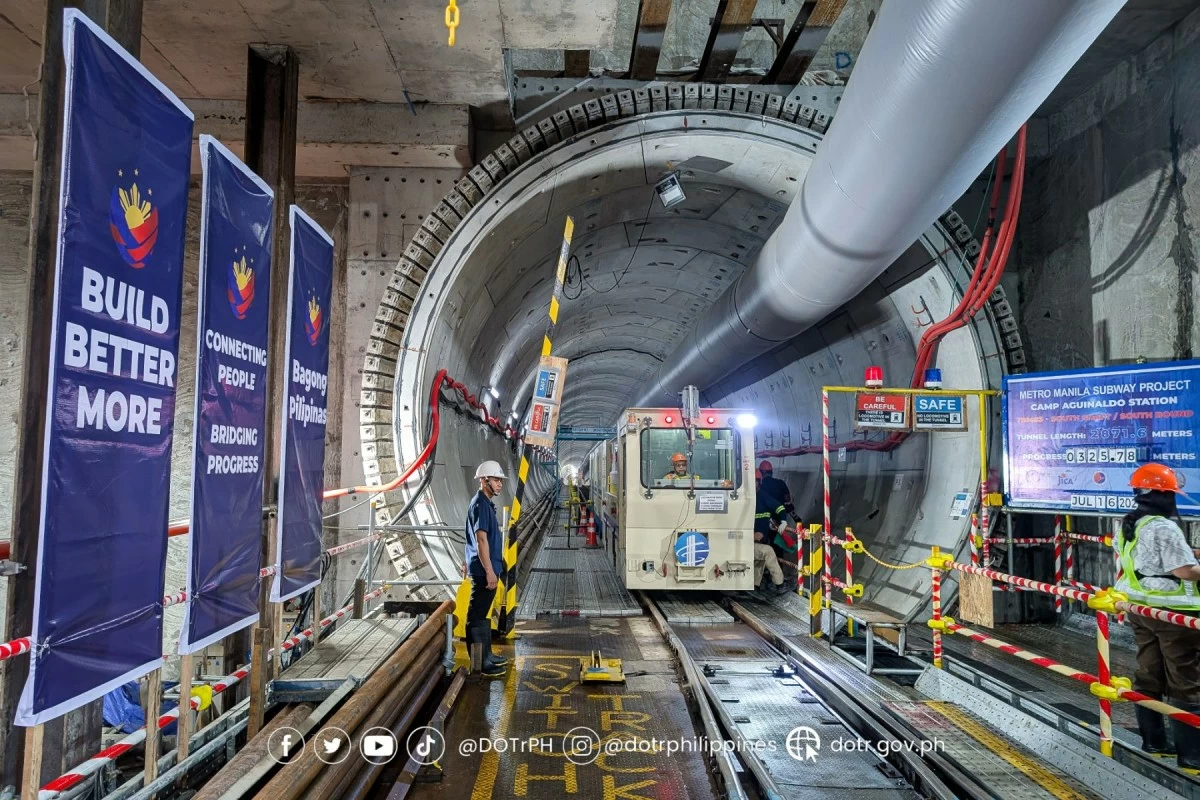
(DOTr photo)
The Department of Transportation (DOTr) aims to complete at least three stations of the long-delayed Metro Manila Subway Project (MMSP) before President Marcos’ term ends in 2028.
Transportation Secretary Vince Dizon said he is confident that the DOTr will finish the construction of the first two MMSP stations by 2028, and potentially even a third station.
Dizon said this covers the stations of East Valenzuela, Quirino Highway, and North Avenue.
He said the plan is to start partial operations of the MMSP in 2028, but this has yet to be finalized.
“We want to do partial, but we have to discuss it with the Japanese,” he said, referring to the Japanese joint venture tapped to build the said stations.
Since Dizon assumed office in February, he has long lamented issues in the acquisition of right of way (ROW) for delaying the project.
“No, we're not on track. The subway is really delayed,” he told reporters.
Originally slated for partial operations in 2022, the country’s first underground rail system has faced a seemingly endless stream of postponements thanks in large part due to ROW issues.
Dizon has since fast-tracked efforts to complete ROW acquisition, with only the Ortigas station still facing issues.
To address the last remaining hurdle, the DOTr chief teamed up with Pasig City Mayor Vico Sotto to inspect the site on Wednesday morning, July 30, in hopes of crafting a solution.
Dizon said he is now optimistic that the station will finally begin construction in a few weeks.
President Marcos earlier ordered the DOTr to expedite the completion of flagship infrastructure projects, such as the MMSP, to ease the commuting experience of Filipinos.
The subway project has 17 stations, stretching 33 kilometers from Valenzuela to Parañaque, and a spur line to Ninoy Aquino International Airport (NAIA) Terminal 3 in Pasay.
The rail line is expected to cut travel time between Valenzuela and the airport from one and a half hours to just 35 minutes.
Estimates of passenger volume vary, ranging from as low as 300,000 to over 500,000 passengers.