







Marcos: PH now more peaceful, more humane
Published Jul 28, 2025 06:41 pm


At A Glance
- He acknowledged, however, that falling crime rates do not always erase the fear or trauma felt by crime victims.
President Marcos declared that the Philippines has become more peaceful and more respectful of human rights under his administration, citing improved law enforcement, declining insurgency, and a whole-of-government approach to crime and drug enforcement.
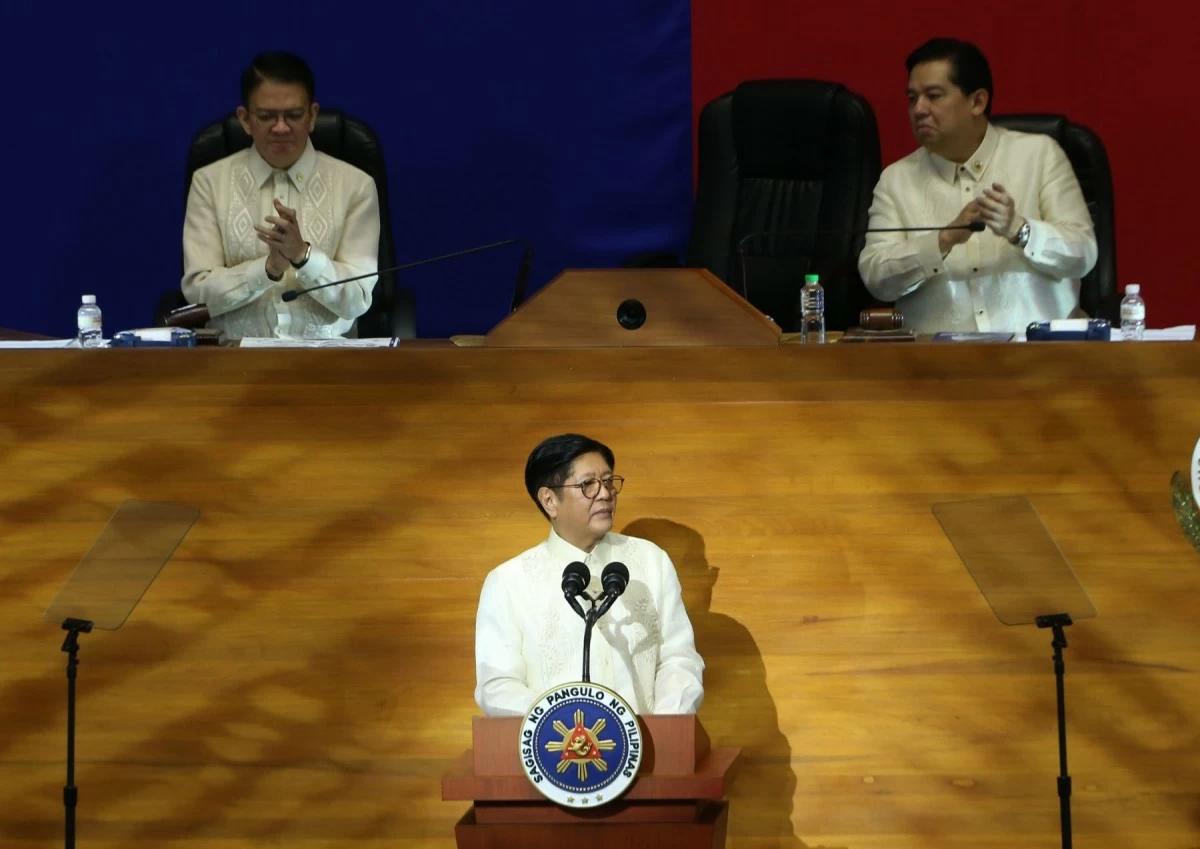
President Ferdinand 'Bongbong' Marcos Jr. delivers his fourth State of the Nation Address (SONA) at Batasang Pambansa, Quezon City, on July 28, 2025. Behind him are Senate President Francis Escudero and House Speaker Martin Romualdez. (Mark Balmores)
“Ang kapayapaan ay mahalagang pundasyon ng Bagong Pilipinas, kaya pinapatatag natin ito kasabay ng ating pag-unlad (The foundation of Bagong Pilipinas is peace. That is why we are strengthening it as we pursue progress),” Marcos said in his fourth State of the Nation Address (SONA) on Monday, July 28.
End of insurgency, stronger state presence
In his 70-minute speech, the President said the government has not only armed and modernized the military and police but also invested in former rebels and their communities.
“Ang libo-libong mga nag-alsa dati laban sa pamahalaan, na nagbagong-buhay at nagbalik-loob na, ay tinataguyod natin kasama ang kanilang pamilya (The thousands who once rebelled against the government but have returned and reformed are now being supported, along with their families),” he said.
Marcos also said former rebels, the Armed Forces of the Philippines (AFP), and the Philippine National Police (PNP) now work together to maintain order in the Bangsamoro Autonomous Region in Muslim Mindanao. (BARMM).
“At sa wakas, wala na ring nalalabing grupong gerilya sa bansa, at titiyakin ng pamahalaan na wala nang mabubuo muli (At last, there are no remaining guerrilla groups in the country, and the government will ensure that none will ever rise again),” he said.
“Ipaparamdam natin sa mga salarin ang bigat ng parusa sa karumal-dumal na krimen na mga ito (We will make perpetrators of heinous crimes feel the full weight of justice),” he added.
Services reach conflict-affected areas
President Marcos said peacebuilding went beyond military solutions and included infrastructure, education, and livelihood programs.
“Bukod sa mga programang panghanapbuhay, nagpagawa tayo ng mga (In addition to livelihood programs, we are building) health stations, classrooms, water systems, at (and) streetlights health stations, classrooms, water systems, and streetlights,” he said. He claimed these programs are now benefiting more than 13 million Filipinos who were once vulnerable to conflict.
He added that the government, in partnership with the private sector, is improving roads and irrigation and providing dignified livelihoods in rebel-affected areas.
Human rights protection stressed
With all these government initiatives, Marcos said the country is not only more peaceful but also more humane.
“Kaya naman, ang lipunan natin ngayon ay mas mapayapa. Mas mapangalaga rin sa karapatang-pantao, anuman ang edad, kasarian, kundisyon, o pangkat (That is why our society today is more peaceful. It also better protects human rights—regardless of age, gender, condition, or group),” he said.
He acknowledged, however, that falling crime rates do not always erase the fear or trauma felt by crime victims.
“Ngunit kahit pa sinasabing bumababa ang antas ng krimen sa bansa, walang ibang magpapalubag ng pangamba at pagkabahala, lalo na sa mga naging biktima mismo ng kriminalidad (Even if we say crime rates are declining, nothing can ease the fear and worry, especially for those who have been victims themselves),” Marcos said.
Faster police response, tougher crime crackdown
To boost public confidence in law enforcement, President Marcos said police forces are under instruction to respond within five minutes to emergency calls.
“Kaya ang puwersa ng ating kapulisan ay nagbabantay at rumuronda para nararamdaman ng taumbayan (Our police are patrolling and on alert so that people feel their presence),” he said.
“Sila ay reresponde sa tawag ng tungkulin sa loob lamang ng limang minuto. They will respond to calls of duty within five minutes),” he added.
The President also vowed to pursue syndicates behind missing persons linked to illegal online gambling, especially in “the dark world of cockfighting.”
“Hahabulin at pananagutin natin ang mga utak at mga sangkot, sibilyan man o opisyal (We will go after and hold accountable the masterminds and those involved, whether civilians or officials),” he said.
“Kahit malakas, mabigat, o mayaman, hindi sila mangi-ngibabaw sa batas (No matter how powerful, influential, or wealthy, they will not be above the law),” he added.
Drug war continues with broader targets
Meanwhile, Marcos reported that over P82.9 billion worth of illegal drugs had been seized through coordinated raids and interdictions nationwide. Recently, large drug shipments were intercepted in Zambales, Pangasinan, Cagayan, Tondo, Muntinlupa, Ilocos Sur, Ilocos Norte, Cebu, Batangas, Rizal, and Cavite.
He also cited the destruction of nearly 1.5 tons of confiscated shabu and the arrest of 153,000 individuals, including over 9,600 high-value targets. Of those arrested, more than 670 were government personnel, including over 100 elected officials and 50 police officers.
“Sa tatlong taon lamang, halos mapantayan na ang kabuuang huli noong nakaraang administrasyon (In just three years, we have almost equaled the total arrests during the previous administration),” Marcos emphasized.
However, he admitted that drug peddlers seem to be returning, prompting continued operations even against small-time dealers.
“Kaya, patuloy ang ating mga operasyon laban sa mga drug dealer, big-time man o small-time (That’s why our operations continue, whether they target big-time or small-time drug dealers),” he said.
The Marcos administration has shifted its approach to national security by emphasizing community development and reintegration, while continuing operations against criminality and illegal drugs. Human rights advocates have urged the government to ensure accountability in both police and military actions.