

ADVERTISEMENT

Russia scales down celebrations honoring its navy as Ukraine launches more drone attacks

Published Jul 27, 2025 11:44 pm
Russia on Sunday scaled down the festivities honoring its navy citing security concerns as continuing Ukrainian drone attacks posed a challenge to the Kremlin.
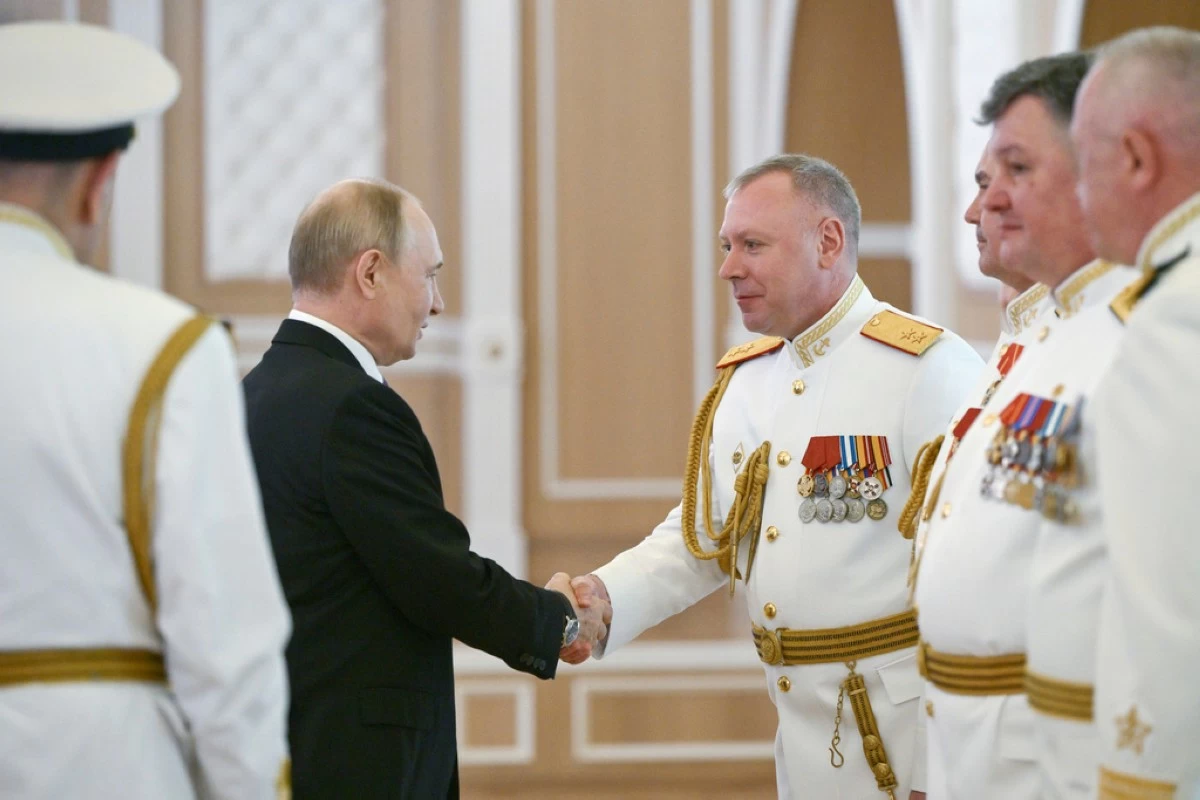
Russian President Vladimir Putin, left, shakes hands with Russian Navy officers during his visit to St. Petersburg on Navy Day, Russia, on Sunday, July 27, 2025. (Alexei Danichev, Sputnik, Kremlin Pool Photo via AP)
Russian authorities canceled the parades of warships in St. Petersburg, in the Kaliningrad region on the Baltic and in the far-eastern port of Vladivostok that are usually held to mark the annual Navy Day celebrations.
Asked about the reason for the cancellation of the parade in St. Petersburg even as President Vladimir Putin arrived in his home city to visit the navy headquarters, Kremlin spokesman Dmitry Peskov told reporters that "it's linked to the overall situation, security reasons, which are above all else.”
The Russian Defense Ministry said that air defenses downed 99 Ukrainian drones over several regions overnight. Later in the day, officials reported more drones shot down near St. Petersburg. A woman was injured by drone fragments in the Lomonosov region, according to the local authorities.
St. Petersburg's Pulkovo airport suspended dozens of flights early Sunday because of the drone threat.
On a trip to St. Petersburg, Putin visited the historic Admiralty building to receive reports on four-day naval maneuvers that wrapped up Sunday. The July Storm exercise involved 150 warships from the Baltics to the Pacific.
Putin vowed to build more warships and intensify the navy's training, adding that “the navy's strike power and combat capability will rise to a qualitatively new level.”
He also visited the Admiral Grigorovich frigate of the Baltic Fleet at the Kronstadt naval base just west of St. Petersburg to hail its crew for fending off a Ukrainian drone attack in the region earlier in the day.
Reducing the scale of the Navy Day celebrations reflects Moscow's worries about Ukraine's sweeping drone attacks across the country.
In a series of strikes earlier in the war now in its fourth year, Ukraine sank several Russian warships in the Blacks Sea, crippling Moscow's naval capability and forcing it to redeploy its fleet from Russia-occupied Crimea to Novorossiysk.
And in an audacious June 1 attack codenamed “Spiderweb,” Ukraine used drones to hit several Russian airbases hosting long-range bombers across Russia, from the Arctic Kola Peninsula to Siberia. The drones were launched from trucks covertly placed near the bases, taking the Russian military by surprise in a humiliating blow to the Kremlin.
The raid destroyed or damaged many of the bombers that had been used by Moscow to launch aerial attacks on Ukraine, providing a major morale boost for Kyiv at a time when Kyiv’s undermanned and under-gunned forces are facing Russian attacks along the 1,000-kilometer (600-mile) front line.
Russia continued to batter Ukraine with drone and missile strikes Sunday.
In Sumy in Ukraine’s northeast, a drone attack damaged civil infrastructure objects, an administrative building and non-residential premises, leaving three people wounded. Elsewhere in the region, two men died after being blown up by a landmine and another woman was injured from a drone attack on another community in the region, the regional military administration said.
French President Emmanuel Macron had a phone call with Ukrainian President Volodymyr Zelenskyy on Sunday and said later on X that he reaffirmed France's support for Kyiv and vowed to raise pressure on Moscow to force it to “agree to a ceasefire that paves the way for talks leading to a solid and lasting peace, with full European involvement.”

Related Tags

World news
ADVERTISEMENT
.most-popular .layout-ratio{ padding-bottom: 79.13%; } @media (min-width: 768px) and (max-width: 1024px) { .widget-title { font-size: 15px !important; } }

{{ articles_filter_1561_widget.title }}

.most-popular .layout-ratio{ padding-bottom: 79.13%; } @media (min-width: 768px) and (max-width: 1024px) { .widget-title { font-size: 15px !important; } }

{{ articles_filter_1562_widget.title }}

.most-popular .layout-ratio{ padding-bottom: 79.13%; } @media (min-width: 768px) and (max-width: 1024px) { .widget-title { font-size: 15px !important; } }

{{ articles_filter_1563_widget.title }}

{{ articles_filter_1564_widget.title }}

.mb-article-details { position: relative; } .mb-article-details .article-body-preview, .mb-article-details .article-body-summary{ font-size: 17px; line-height: 30px; font-family: "Libre Caslon Text", serif; color: #000; } .mb-article-details .article-body-preview iframe , .mb-article-details .article-body-summary iframe{ width: 100%; margin: auto; } .read-more-background { background: linear-gradient(180deg, color(display-p3 1.000 1.000 1.000 / 0) 13.75%, color(display-p3 1.000 1.000 1.000 / 0.8) 30.79%, color(display-p3 1.000 1.000 1.000) 72.5%); position: absolute; height: 200px; width: 100%; bottom: 0; display: flex; justify-content: center; align-items: center; padding: 0; } .read-more-background a{ color: #000; } .read-more-btn { padding: 17px 45px; font-family: Inter; font-weight: 700; font-size: 18px; line-height: 16px; text-align: center; vertical-align: middle; border: 1px solid black; background-color: white; } .hidden { display: none; }
function initializeAllSwipers() { // Get all hidden inputs with cms_article_id document.querySelectorAll('[id^="cms_article_id_"]').forEach(function (input) { const cmsArticleId = input.value; const articleSelector = '#article-' + cmsArticleId + ' .body_images'; const swiperElement = document.querySelector(articleSelector); if (swiperElement && !swiperElement.classList.contains('swiper-initialized')) { new Swiper(articleSelector, { loop: true, pagination: false, navigation: { nextEl: '#article-' + cmsArticleId + ' .swiper-button-next', prevEl: '#article-' + cmsArticleId + ' .swiper-button-prev', }, }); } }); } setTimeout(initializeAllSwipers, 3000); const intersectionObserver = new IntersectionObserver( (entries) => { entries.forEach((entry) => { if (entry.isIntersecting) { const newUrl = entry.target.getAttribute("data-url"); if (newUrl) { history.pushState(null, null, newUrl); let article = entry.target; // Extract metadata const author = article.querySelector('.author-section').textContent.replace('By', '').trim(); const section = article.querySelector('.section-info ').textContent.replace(' ', ' '); const title = article.querySelector('.article-title h1').textContent; // Parse URL for Chartbeat path format const parsedUrl = new URL(newUrl, window.location.origin); const cleanUrl = parsedUrl.host + parsedUrl.pathname; // Update Chartbeat configuration if (typeof window._sf_async_config !== 'undefined') { window._sf_async_config.path = cleanUrl; window._sf_async_config.sections = section; window._sf_async_config.authors = author; } // Track virtual page view with Chartbeat if (typeof pSUPERFLY !== 'undefined' && typeof pSUPERFLY.virtualPage === 'function') { try { pSUPERFLY.virtualPage({ path: cleanUrl, title: title, sections: section, authors: author }); } catch (error) { console.error('ping error', error); } } // Optional: Update document title if (title && title !== document.title) { document.title = title; } } } }); }, { threshold: 0.1 } ); function showArticleBody(button) { const article = button.closest("article"); const summary = article.querySelector(".article-body-summary"); const body = article.querySelector(".article-body-preview"); const readMoreSection = article.querySelector(".read-more-background"); // Hide summary and read-more section summary.style.display = "none"; readMoreSection.style.display = "none"; // Show the full article body body.classList.remove("hidden"); } document.addEventListener("DOMContentLoaded", () => { let loadCount = 0; // Track how many times articles are loaded const offset = [1, 2, 3, 4, 5, 6, 7, 8, 9, 10]; // Offset values const currentUrl = window.location.pathname.substring(1); let isLoading = false; // Prevent multiple calls if (!currentUrl) { console.log("Current URL is invalid."); return; } const sentinel = document.getElementById("load-more-sentinel"); if (!sentinel) { console.log("Sentinel element not found."); return; } function isSentinelVisible() { const rect = sentinel.getBoundingClientRect(); return ( rect.top < window.innerHeight && rect.bottom >= 0 ); } function onScroll() { if (isLoading) return; if (isSentinelVisible()) { if (loadCount >= offset.length) { console.log("Maximum load attempts reached."); window.removeEventListener("scroll", onScroll); return; } isLoading = true; const currentOffset = offset[loadCount]; window.loadMoreItems().then(() => { let article = document.querySelector('#widget_1690 > div:nth-last-of-type(2) article'); intersectionObserver.observe(article) loadCount++; }).catch(error => { console.error("Error loading more items:", error); }).finally(() => { isLoading = false; }); } } window.addEventListener("scroll", onScroll); });

Sign up by email to receive news.