






Manila Bulletin
 Philippines
National
Only Batanes remains under Signal No. 1 as 'Emong' moves away from the Philippines
Philippines
National
Only Batanes remains under Signal No. 1 as 'Emong' moves away from the Philippines
Philippines
National
Only Batanes remains under Signal No. 1 as 'Emong' moves away from the Philippines
Only Batanes remains under Signal No. 1 as 'Emong' moves away from the Philippines
Published Jul 25, 2025 11:44 pm


PAGASA
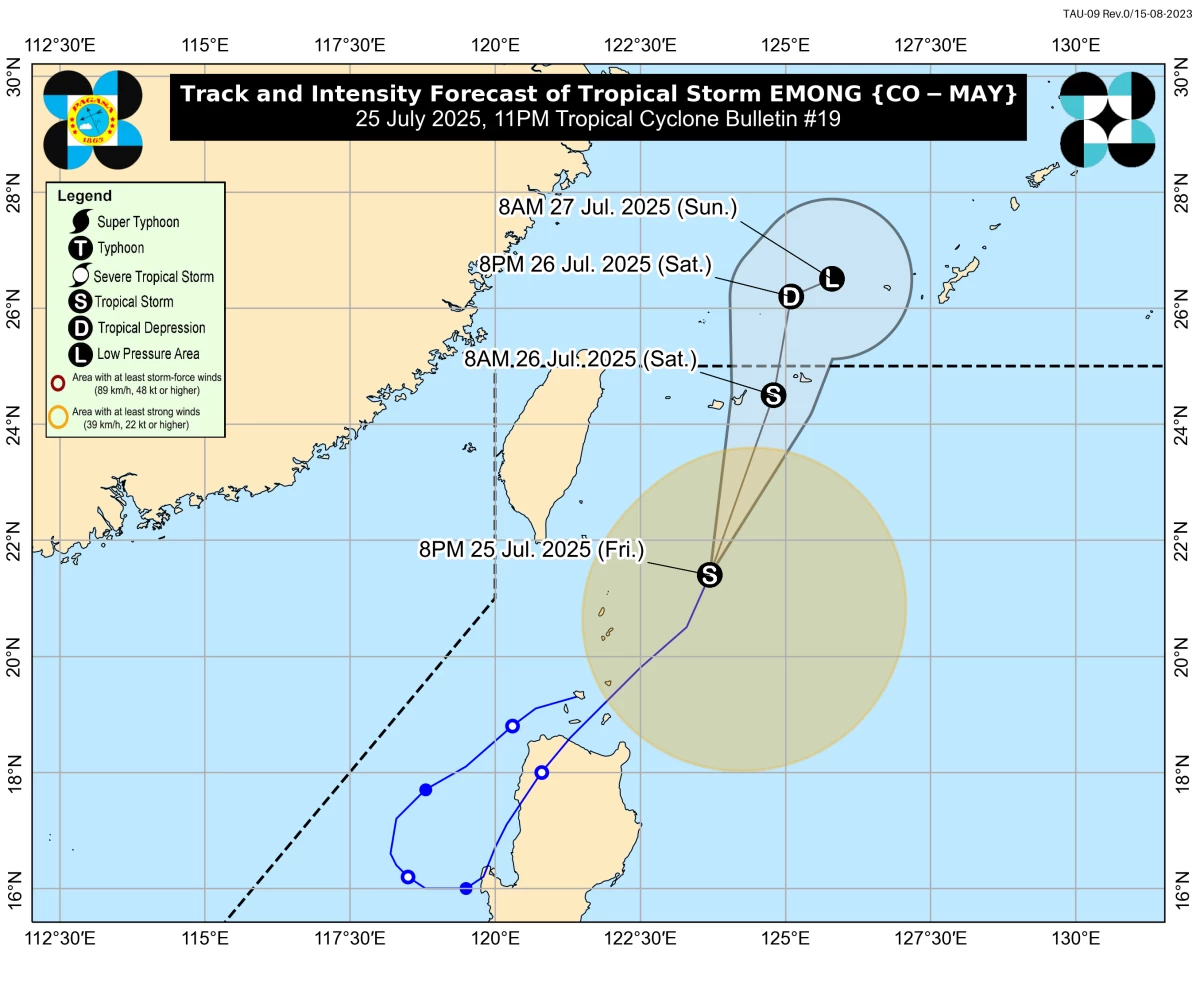
Tropical Storm Emong (international name: Co-may) slightly weakened as it continued to move away from Batanes late Friday, July 25, said the Philippine Atmospheric, Geophysical and Astronomical Services Administration (PAGASA).
In its 11 p.m. bulletin, PAGASA said Emong was located 260 kilometers east-northeast of Itbayat, Batanes, moving northeastward at 35 kilometers per hour (kph).
Previously classified as a typhoon when it made landfall over Agno, Pangasinan and Candon City, Ilocos Sur, with maximum sustained winds of 120 kph maximum sustained winds and gusts of up to 160 kph, Emong has since weakened into a tropical storm.
It now has maximum sustained winds of 75 kph and gusts of up to 90 kph.
The storm is expected to accelerate further as it continues moving northeastward and is likely to exit the Philippine Area of Responsibility by Saturday morning, July 26.
As of Friday evening, Batanes remains the only area under Tropical Cyclone Wind Signal No. 1.
In a separate advisory issued at 5 p.m., PAGASA warned that heavy to intense rainfall caused by Emong and the enhanced southwest monsoon (habagat) may continue to affect Batanes, Ilocos Norte, Ilocos Sur, Abra, Benguet, La Union, Pangasinan, Zambales, Bataan, Cavite, Batangas, Laguna, and Occidental Mindoro.
Moderate to heavy rainfall may also persist in Cagayan, Apayao, Kalinga, Ifugao, Mountain Province, Nueva Vizcaya, Nueva Ecija, Metro Manila, Pampanga, Tarlac, Bulacan, Rizal, Quezon, Oriental Mindoro, Palawan, Marinduque, Romblon, and Antique.
Residents in low-lying and mountainous areas are advised to remain vigilant against possible flash floods and landslides.