






Manila Bulletin
 Philippines
National
'Gov't now in 21st Century': Marcos launches eGovPH Super App, one‑stop service hub
Philippines
National
'Gov't now in 21st Century': Marcos launches eGovPH Super App, one‑stop service hub
Philippines
National
'Gov't now in 21st Century': Marcos launches eGovPH Super App, one‑stop service hub
'Gov't now in 21st Century': Marcos launches eGovPH Super App, one‑stop service hub
Published Jul 18, 2025 11:08 am


At A Glance
- The eGovPH Super App is a secure mobile "one‑stop online shop" that integrates frontline national and local government services in a single platform, led by the Department of Information and Communications Technology (DICT) with support from the Office of the President.
President Marcos said the Philippine government has finally moved into the 21st Century as government services go digital and converge under one roof following the launch of the Bagong Pilipinas eGovPH Serbisyo Hub and its companion eGovPH Super App in San Juan City on Friday, July 18.
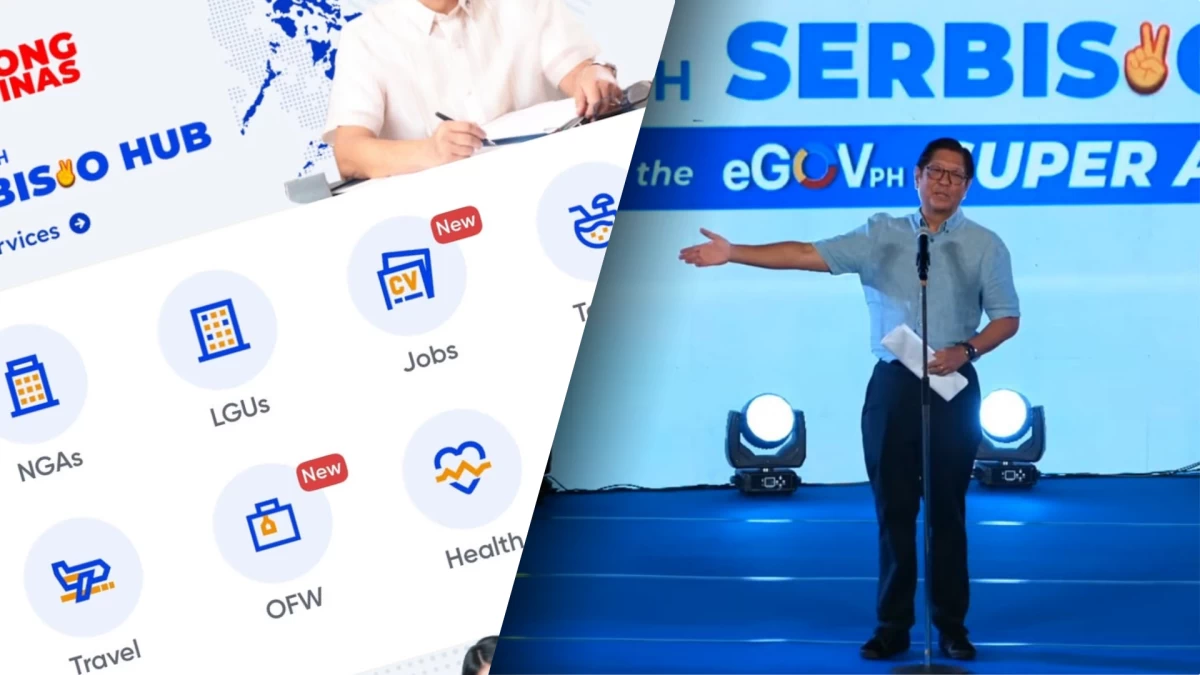
eGov app, RTVM screenshots
In his speech, the President urged the public to download and try the eGovPH app, calling it “an enormous step” in making things more convenient for our people.
“We have now taken it even a step further. Government of the Philippines has finally moved into the 21st Century,” he said.
“You can all do that (transactions) in the comfort of your own home, in your office, or while you're playing Candy Crush. If you have five minutes, do the paperwork that you need to do over the internet,” he added.
Marcos said the goal is a genuine “one‑stop shop” experience that ends the long-standing ordeal of lining up at multiple offices just to complete a single transaction.
“Matagal na natin naririnig yung term na one‑stop shop, ngunit kung minsan matagal ang nararanasan ng mga kababayan natin (We’ve long heard the term one‑stop shop, but our countrymen have often had to wait a long time before they actually experience it),” he said.
He recounted the familiar grind—queueing for hours in one office, being told to get another signature elsewhere, then discovering more missing clearances as the workday ends.
“That is impossible for an ordinary citizen,” he said, noting the lost income, childcare hassles, and repeat trips that have defined many dealings with the government.
“That is what we are trying to fix,” he added.
Anticipating hesitation from older or first‑time users, Marcos encouraged families to help one another onboard.
“Yung anak niyo, yung apo niyo, kayang‑kaya ‘yan (Your children or grandchildren can easily do that),” he said, noting that the interface was designed to be “very intuitive” even for those who are uneasy about using a smartphone.
How the eGovPH ecosystem works
The eGovPH Super App is a secure mobile “one‑stop online shop” that integrates frontline national and local government services in a single platform, led by the Department of Information and Communications Technology (DICT) with support from the Office of the President.
With a smartphone and connectivity, citizens can apply for permits, renew licenses, settle fees, and, eventually, pay taxes and government charges via electronic banking without visiting multiple offices. Digital IDs such as National IDs and PhilHealth IDs are also incorporated in the app.
The government’s eTravel platform for those entering and leaving the country is also in the application.
The eGovPH Serbisyo Hub, on the other hand, is a physical service center model that brings several agencies together in one location for citizens who still need or prefer face‑to‑face assistance. Transactions at the hub are digitally enabled and linked to the Super App.
Marcos said the model launched in San Juan will be replicated nationwide.
“Hindi lamang sa San Juan… sa buong Pilipinas ‘yan ang ating ginagawa (This isn’t just for San Juan… we’re doing this across the entire Philippines),” he said.
With structures in place, the President said the priority now is mass adoption. He asked agencies to promote the platform on their websites or hand out flyers to walk‑in clients so they know they “hindi na kailangan pumunta rito (no longer need to come here)” for many transactions.
However, for a wider adoption to roll out smoothly, President Marcos reiterated his order to DICT Secretary Henry Aguda to ensure a reliable internet connection in geographically isolated and disadvantaged areas.
“Kailangan lahat ng Pilipino may connectivity (Every Filipino must have connectivity),” he said.
Cutting red tape, curbing corruption
The President linked digital government to his anti‑fixer push.
“Ang aking instruction sa kanila, walang korapsyon, walang fixer, walang pila (My instruction to them: no corruption, no fixers, no lines,” he said.
He added that by collapsing processes and digitizing payments, the system removes opportunities for petty graft and informal middlemen.
According to Marcos, almost half of all government transactions are already digital, and the Super App will accelerate the shift.
“Eventually, all the payments that you make to government, you can do it now over the eGov app,” he said.