






Manila Bulletin
 Philippines
National
PAGASA: 'Crising' maintains strength, may make landfall in Cagayan on July 18
Philippines
National
PAGASA: 'Crising' maintains strength, may make landfall in Cagayan on July 18
Philippines
National
PAGASA: 'Crising' maintains strength, may make landfall in Cagayan on July 18
PAGASA: 'Crising' maintains strength, may make landfall in Cagayan on July 18
Published Jul 17, 2025 11:48 am


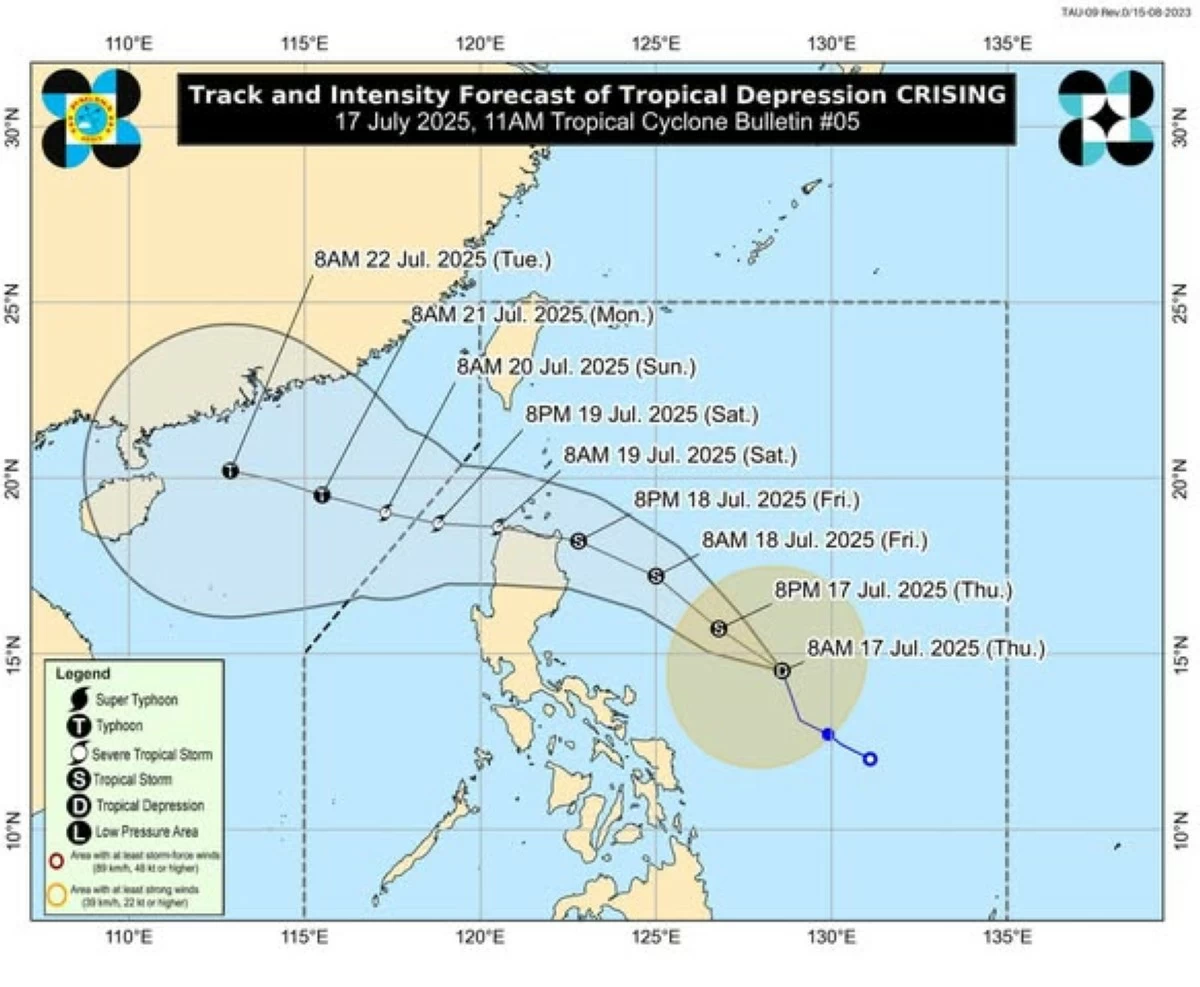
PAGASA
Tropical Depression Crising continues to strengthen as it moves north-northwestward over the waters east of Catanduanes, bringing threats of heavy rains, strong winds, and coastal inundation, according to the Philippine Atmospheric, Geophysical and Astronomical Services Administration (PAGASA).
In its 11 a.m. bulletin on Thursday, July 17, PAGASA said “Crising” is forecast to make landfall over mainland Cagayan between Friday evening, July 18, and early Saturday morning, July 19.
PAGASA said the weather system may reach tropical storm category later today and could intensify further into a severe tropical storm before approaching Northern Luzon.
TD Crising’s current location, movement
As of 10 a.m., PAGASA said the center of “Crising” was estimated at 520 km east-northeast of Juban, Sorsogon, or 470 km east-northeast of Virac, Catanduanes.
It is moving north-northwestward at 25 km/h, with maximum sustained winds of 55 km/h near the center and gustiness of up to 70 km/h.
Forecast track, intensity outlook
PAGASA said that Tropical Depression “Crising” is expected to traverse the following path:
By 8:00 p.m. on July 17, it will be located approximately 555 kilometers east of Baler, Aurora.
By 8:00 a.m. on July 18, it will be about 350 kilometers east of Tuguegarao City, Cagayan.
By that evening, around 8:00 p.m., it is forecast to be 125 kilometers east of Aparri, Cagayan.
On the morning of July 19 at 8:00 a.m., “Crising” will be 45 kilometers north of Laoag City, Ilocos Norte, and by 8:00 p.m. the same day, it will move to about 190 kilometers west-northwest of Laoag City.
By Sunday, July 20, the tropical depression is expected to exit the Philippine Area of Responsibility (PAR).
Areas under Wind Signal
PAGASA has placed parts of Luzon under Tropical Cyclone Wind Signal (TCWS) No. 1, warning residents of possible minimal to minor wind damage and light to moderate structural impacts.
These include the southern portion of Batanes (Sabtang, Ivana, Uyugan, Mahatao, Basco), Cagayan including the Babuyan Islands, Isabela, Quirino, the northeastern portion of Nueva Vizcaya (Kasibu, Quezon, Bagabag, Diadi, Bayombong, Solano, Ambaguio, Villaverde), the northern portion of Aurora (Dilasag, Casiguran, Dinalungan, Dipaculao), Apayao, Abra, Kalinga, Mountain Province, Ifugao, Ilocos Norte, the northern portion of Ilocos Sur (City of Vigan, Santa, Caoayan, Bantay, Nagbukel, Narvacan, Cabugao, San Juan, Sinait, Magsingal, San Ildefonso, Santo Domingo, San Vicente, Santa Catalina), and the northern and eastern portions of Catanduanes (Pandan, Bagamanoc, Panganiban, Viga, Gigmoto).
No areas in the Visayas or Mindanao are currently under wind signal warnings, PAGASA said.
Heavy rainfall, monsoon enhancement
PAGASA said “Crising”, together with the southwest monsoon (habagat), will bring heavy to torrential rainfall and gusty conditions over several regions.
The weather bureau advised residents in flood-prone and landslide-prone areas to be vigilant.
PAGASA said on July 17 that gusty winds are likely to affect several areas, including Batangas, Quezon, the Bicol Region, MIMAROPA, the Visayas, Zamboanga del Norte, Camiguin, Surigao del Norte, Dinagat Islands, Davao Occidental, Davao Oriental, and Sarangani.
By Friday, July 18, these conditions are expected to impact Bataan, Metro Manila, CALABARZON, the Bicol Region, the Visayas, the Zamboanga Peninsula, and parts of Mindanao.
On Saturday, July 19, gusty winds will continue to persist over Northern and Central Luzon, as well as parts of the Visayas and Mindanao.
READ:
https://mb.com.ph/2025/07/17/td-crising-habagat-to-bring-torrential-rainfall-across-the-philippines-pagasa
Storm surge, coastal hazards
PAGASA noted that there is a minimal to moderate risk of life-threatening storm surge, with wave heights reaching up to 2.0 meters along low-lying coastal areas in Cagayan, including the Babuyan Islands and Isabela.
Mariners of small seacrafts and motorbancas are strongly advised not to venture out to sea, particularly in the following areas: up to 3.0 meters in the eastern seaboards of Batanes, the Babuyan Islands, mainland Cagayan, Isabela, northern Aurora, and the western coast of Palawan; up to 2.5 meters in Zamboanga del Norte, Camiguin, Palawan, and several Visayan coastal provinces; and up to 2.0 meters in Occidental Mindoro, Romblon, Masbate, Catanduanes, and Eastern Samar.