

ADVERTISEMENT

Fauja Singh, world's oldest marathon runner, dies at 114 after being hit by a car

Published Jul 16, 2025 08:49 am

At A Glance

  • LONDON (AP) — Fauja Singh, an Indian-born runner nicknamed the Turbaned Torpedo who was believed to be the world's oldest marathon runner, has died after being hit by a car. He was 114.
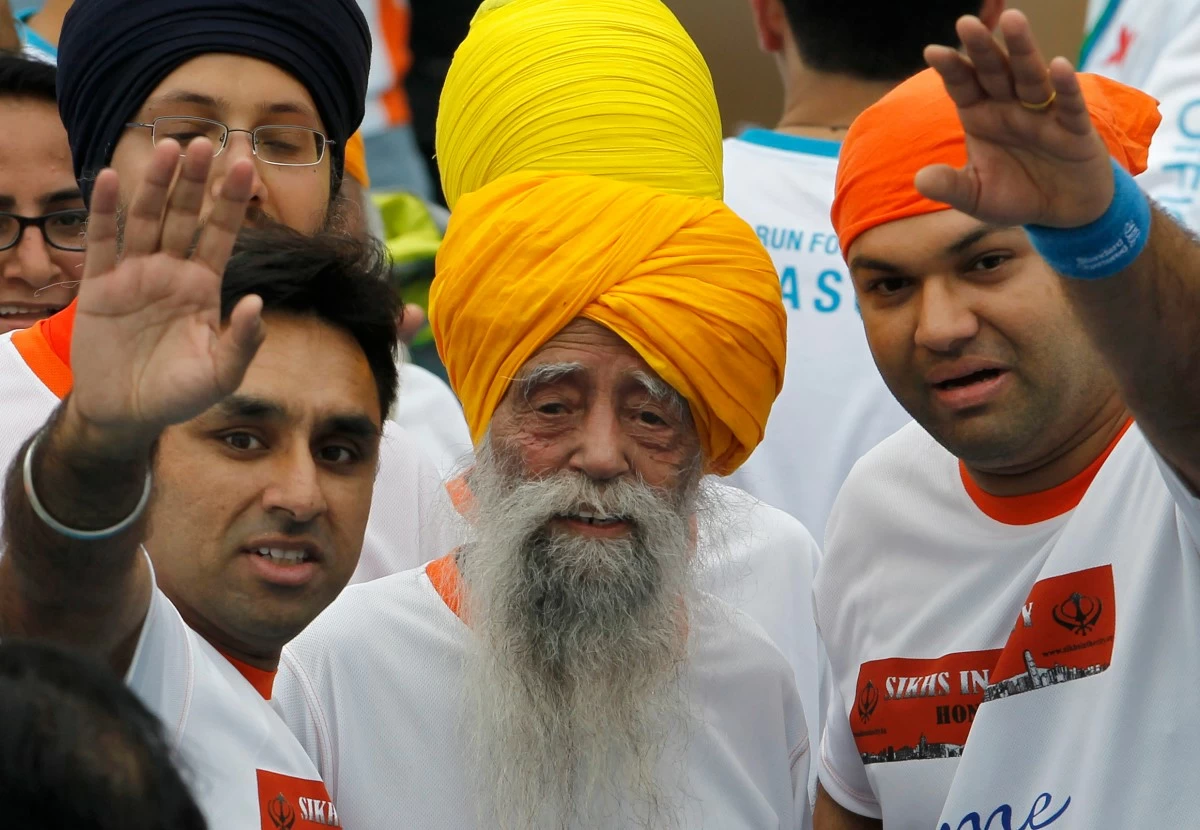
FILE - Centenarian marathon runner Fauja Singh, center, smiles after finishing a 10-kilometer race, held as part of the annual Hong Kong Marathon, in Hong Kong, Feb. 24, 2013. (AP Photo/Vincent Yu, file)
LONDON (AP) — Fauja Singh, an Indian-born runner nicknamed the Turbaned Torpedo who was believed to be the world’s oldest marathon runner, has died after being hit by a car. He was 114.
Local media in India reported that Singh sustained severe head injuries in a hit-and-run accident on Monday, July 15, while he was crossing the road at his native village near Jalandhar in Punjab. He was taken to the hospital where he later died. His London-based running club and charity, Sikhs In The City, confirmed his death.
India’s Prime minister Narendra Modi paid tribute to Singh, saying he was “extraordinary because of his unique persona and the manner in which he inspired the youth of India on a very important topic of fitness.”
Singh became the oldest man to run a full marathon in 2011 at the age of 100 in Toronto. His accomplishment was not recognized by Guinness World Records because he did not have a birth certificate to prove his age. Singh had a British passport that showed his date of birth as April 1, 1911, while a letter from Indian government officials stated that birth records were not kept in 1911.
A torchbearer for the 2012 London Olympics, Singh took up running at the age of 89 as a way to get over depression after his wife and son died in quick succession in India. The death in 1994 of his son took a particularly hard toll on him because of its grisly nature.
Singh and his son, Kuldip, both farmers, were checking on their fields in the middle of a storm when a piece of corrugated metal blown by the wind decapitated Kuldip in front of his father’s eyes.
Singh, whose five other children had emigrated, was left all alone.
“He didn’t think his life was worth living without his son” following the traumatic incident, his coach Harmander Singh said.
He went to live with his youngest son in London. That’s where sports enthusiast Singh attended tournaments organized by the Sikh community and took part in sprints. He met some Sikh marathon runners who encouraged him to take up long-distance running. One day he saw a marathon on television for the first time and decided that’s what he wanted to do.
At the age of 89 in 2000 he ran the London Marathon, his first, and went on to do eight more. His best time was 5 hours and 40 minutes at the 2003 Toronto Marathon.
“From a tragedy has come a lot of success and happiness,” Singh said.
Singh ran his last competitive race in 2013 at the age of 101, finishing the Hong Kong Marathon’s 10-kilometer (6.25-mile) race in 1 hour, 32 minutes, 28 seconds.
Following his retirement from racing, he said he hoped “people will remember me and not forget me.” He also wanted people to continue to invite him to events “rather than forget me altogether just because I don’t run anymore.”
“He was an exceptional athlete with incredible determination,” Modi said. “Pained by his passing away. My thoughts are with his family and countless admirers around the world.”
ADVERTISEMENT
.most-popular .layout-ratio{ padding-bottom: 79.13%; } @media (min-width: 768px) and (max-width: 1024px) { .widget-title { font-size: 15px !important; } }

{{ articles_filter_1561_widget.title }}

.most-popular .layout-ratio{ padding-bottom: 79.13%; } @media (min-width: 768px) and (max-width: 1024px) { .widget-title { font-size: 15px !important; } }

{{ articles_filter_1562_widget.title }}

.most-popular .layout-ratio{ padding-bottom: 79.13%; } @media (min-width: 768px) and (max-width: 1024px) { .widget-title { font-size: 15px !important; } }

{{ articles_filter_1563_widget.title }}

{{ articles_filter_1564_widget.title }}

.mb-article-details { position: relative; } .mb-article-details .article-body-preview, .mb-article-details .article-body-summary{ font-size: 17px; line-height: 30px; font-family: "Libre Caslon Text", serif; color: #000; } .mb-article-details .article-body-preview iframe , .mb-article-details .article-body-summary iframe{ width: 100%; margin: auto; } .read-more-background { background: linear-gradient(180deg, color(display-p3 1.000 1.000 1.000 / 0) 13.75%, color(display-p3 1.000 1.000 1.000 / 0.8) 30.79%, color(display-p3 1.000 1.000 1.000) 72.5%); position: absolute; height: 200px; width: 100%; bottom: 0; display: flex; justify-content: center; align-items: center; padding: 0; } .read-more-background a{ color: #000; } .read-more-btn { padding: 17px 45px; font-family: Inter; font-weight: 700; font-size: 18px; line-height: 16px; text-align: center; vertical-align: middle; border: 1px solid black; background-color: white; } .hidden { display: none; }
function initializeAllSwipers() { // Get all hidden inputs with cms_article_id document.querySelectorAll('[id^="cms_article_id_"]').forEach(function (input) { const cmsArticleId = input.value; const articleSelector = '#article-' + cmsArticleId + ' .body_images'; const swiperElement = document.querySelector(articleSelector); if (swiperElement && !swiperElement.classList.contains('swiper-initialized')) { new Swiper(articleSelector, { loop: true, pagination: false, navigation: { nextEl: '#article-' + cmsArticleId + ' .swiper-button-next', prevEl: '#article-' + cmsArticleId + ' .swiper-button-prev', }, }); } }); } setTimeout(initializeAllSwipers, 3000); const intersectionObserver = new IntersectionObserver( (entries) => { entries.forEach((entry) => { if (entry.isIntersecting) { const newUrl = entry.target.getAttribute("data-url"); if (newUrl) { history.pushState(null, null, newUrl); let article = entry.target; // Extract metadata const author = article.querySelector('.author-section').textContent.replace('By', '').trim(); const section = article.querySelector('.section-info ').textContent.replace(' ', ' '); const title = article.querySelector('.article-title h1').textContent; // Parse URL for Chartbeat path format const parsedUrl = new URL(newUrl, window.location.origin); const cleanUrl = parsedUrl.host + parsedUrl.pathname; // Update Chartbeat configuration if (typeof window._sf_async_config !== 'undefined') { window._sf_async_config.path = cleanUrl; window._sf_async_config.sections = section; window._sf_async_config.authors = author; } // Track virtual page view with Chartbeat if (typeof pSUPERFLY !== 'undefined' && typeof pSUPERFLY.virtualPage === 'function') { try { pSUPERFLY.virtualPage({ path: cleanUrl, title: title, sections: section, authors: author }); } catch (error) { console.error('ping error', error); } } // Optional: Update document title if (title && title !== document.title) { document.title = title; } } } }); }, { threshold: 0.1 } ); function showArticleBody(button) { const article = button.closest("article"); const summary = article.querySelector(".article-body-summary"); const body = article.querySelector(".article-body-preview"); const readMoreSection = article.querySelector(".read-more-background"); // Hide summary and read-more section summary.style.display = "none"; readMoreSection.style.display = "none"; // Show the full article body body.classList.remove("hidden"); } document.addEventListener("DOMContentLoaded", () => { let loadCount = 0; // Track how many times articles are loaded const offset = [1, 2, 3, 4, 5, 6, 7, 8, 9, 10]; // Offset values const currentUrl = window.location.pathname.substring(1); let isLoading = false; // Prevent multiple calls if (!currentUrl) { console.log("Current URL is invalid."); return; } const sentinel = document.getElementById("load-more-sentinel"); if (!sentinel) { console.log("Sentinel element not found."); return; } function isSentinelVisible() { const rect = sentinel.getBoundingClientRect(); return ( rect.top < window.innerHeight && rect.bottom >= 0 ); } function onScroll() { if (isLoading) return; if (isSentinelVisible()) { if (loadCount >= offset.length) { console.log("Maximum load attempts reached."); window.removeEventListener("scroll", onScroll); return; } isLoading = true; const currentOffset = offset[loadCount]; window.loadMoreItems().then(() => { let article = document.querySelector('#widget_1690 > div:nth-last-of-type(2) article'); intersectionObserver.observe(article) loadCount++; }).catch(error => { console.error("Error loading more items:", error); }).finally(() => { isLoading = false; }); } } window.addEventListener("scroll", onScroll); });

Sign up by email to receive news.