







1990 killer quake: Remembering volunteerism and kindness
Published Jul 16, 2025 05:44 pm


I was at my office at 4:26 p.m. on July 16, 1990 when the lights flickered on and off a couple of times. Then suddenly, the whole building shook and rattled. I could hear screams and shrieks from the staff and visitors. As soon as it stopped, I scrambled out and barked orders to my secretary, Flor, and our security personnel to inform the police chief, all stations, and all barangay captains to go around the city and check for collapsed structures—particularly the public markets, the main gate of the base, and any possible casualties in and around the city.
I also told them to check on both Americans and Filipinos at the U.S. Naval Facility in Subic. Of course, I checked on my mother, my mother’s home, and my wife Kate and the kids. Mercifully, everyone was alright. We monitored all media channels, and the initial reports said a major earthquake had struck in the North—probably Baguio—and was felt all the way from Central Luzon to Manila.
That night, I began receiving calls from major media outlets asking if we were badly hit and whether I could use my influence in Subic Bay to help Baguio and Nueva Ecija. Jun Ricafrente from DZMM called and asked if we could assist, given the gravity of the situation. Joe Taruc of DZRH, who was from Nueva Ecija, also reached out. Louie Beltran asked if we could help, too.
So, I mobilized our team from ESMO—the Environmental and Sanitation Management Office. We had new trucks, always kept clean, and able-bodied men we called sanitary technicians (others might call them garbage collectors). Our engineering staff also pitched in to help with rescue. We collected spades, shovels, barretas (digging bars), and acetylene torches and bottles. We had no jackhammers.
I contacted friends from restaurants and the public market, including Johnny Susi (head of the Public Market Vendors Association), and asked them to prepare ready-to-eat meals and provide water. I also called my boyhood friend, the late Albert Chi, who owned the largest hardware store in Olongapo. He immediately sent more shovels and spades and reminded me—importantly—to make sure our people wore gloves to protect their hands from blisters caused by constant digging.
My mother ensured we had first aid kits, extra food, and blood supplies stored in iceboxes.
Later that night, I sent Dante Ramos, my sanitary engineer (formerly with the health department), ahead to Cabanatuan. He arrived in the dead of night and went straight to the epicenter—a pancaked building then known as Liwag (later called Christian College). There, he found policemen, soldiers, and bodies—some decapitated, some dismembered. He was shocked.
That morning, we set out at about 8:30 a.m. and arrived between 10 and 11 a.m.. Outside the city limits, I noticed one piece of graffiti that read: “US Bases Out.” I grew worried, because I had asked the U.S. Navy to send equipment and personnel to assist.
We couldn’t enter the site immediately, as President Corazon Aquino was still there. By the time we got in, I was able to briefly speak with then-Secretary of National Defense, Fidel V. Ramos.
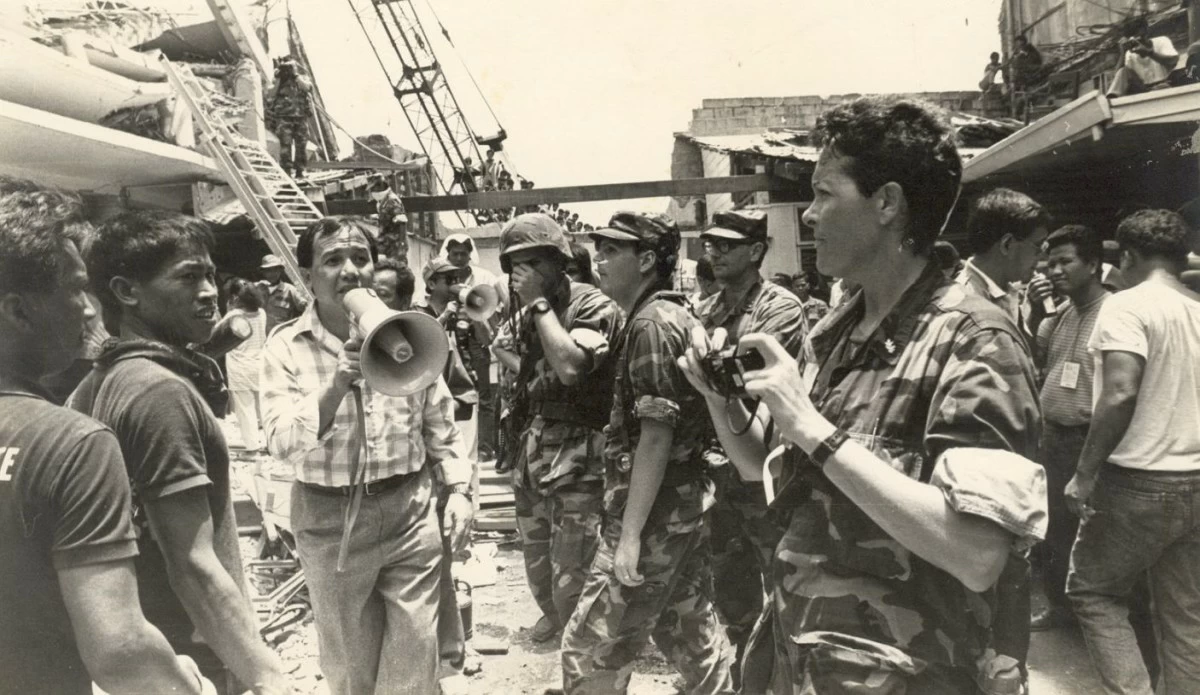
Shortly thereafter, U.S. Navy rescue personnel started arriving. I met them and helped preposition their equipment. I then approached Nueva Ecija Governor Narciso S. Nario and Cabanatuan Mayor Honorato Perez. I offered Governor Nario the bullhorn to help establish order. I was taken aback when the Governor made a caustic remark: “Eto si Mayor Perez ang punong-abala (host). Eto si Dick Gordon ang punong abâla (meddler).”
In the Philippines, there’s this unfortunate cultural instinct to treat help as interference. I merely smiled and ignored it, thinking—perhaps he was joking.
Several Rotarians and civic leaders approached me and said, “Mayor, why don't you take charge?” So, I did. I took the bullhorn and began instructing military and police to clear the area of bystanders.
I quickly called a meeting with both American and Filipino contingents, including soldiers. I told them we’d go in groups: one American, one Filipino who could speak both Tagalog and Ilocano, and someone familiar with the building—preferably someone small enough to fit into tight crevices. Teams were formed and they worked efficiently, extracting people from the rubble.
The building had pancaked. From high above, you could see clumps of hair from dead students lying in rows across the collapsed floors. We began retrieving them—some alive, many grievously injured, and many more already dead.
Amid the chaos, one man stood out — Rodrigo Robiso, whom I nicknamed Lindol. Small and fearless, he crawled through tight spaces to lead us to survivors, driven by the hope of finding his crush. When the rescue ended, he disappeared.
The late Louis Beltran called him Sto. Niño, the miracle boy, and began a public search. We later found him pushing a cart in the market. I offered him a job at Olongapo City Hall, where he served with quiet dedication for 25 years. Beloved by all, he stood by us through triumphs and trials — until his passing.
Then a commotion broke out on one side. I went over and saw some Americans and Filipinos trying to rescue a boy. Only his eyes were moving.
I asked, “Ilan kayo diyan?”
A young boy answered, “Anim po kami.”
(There are six of us.)
I replied, “Don’t worry. Ililigtas namin kayo.”
(We’ll get you out.)
Rosella de Leon was trapped under the rubble. She saw herself surrounded by bodies and thought it was the end—until she heard a voice from above saying, “Gordon’s here! Gordon’s here! Gordon’s here!” Then a team of rescuers pulled her out and she rejoined the world of the living. She did not meet Gordon then; nineteen years later, she finally met him, and they had an emotional reunion.
The Americans brought in a jackhammer and used it heroically—working upward instead of downward, which is far more difficult. They were exhausted and kept getting thirsty, so I kept yelling for water. After hours of effort, they were only able to retrieve one boy.
We continued rescue efforts well into the following day. Then a second group of Americans arrived—the Seabees—with generators and more jackhammers.
One young American lieutenant, Greg Wilderman, approached me and asked, “Are you in charge?”
I replied, “I think so, but I’m helping out.”
He asked, “Can I be sure the equipment I brought won’t be stolen?”
I bristled. “How long have you been here?”
“Two months,” he said.
“Have a little humility,” I told him. “You’re here to help. Don’t be arrogant. I’m the Mayor of Olongapo. Nobody’s going to steal your equipment.”
He sheepishly apologized. Later on, that same young man, Lieutenant Greg Wilderman, married Annie Mariano—my City Planning and Development Officer—and they eventually settled in Washington, D.C.
Meanwhile, we pleaded with local authorities to transfer the badly injured boy, Ray Agapito, from Paulino Garcia Hospital to Cubi Naval Hospital in Subic. I was later told that all rescued individuals could only be brought to government hospitals.
When I visited Ray in Subic, he would regain consciousness every so often and say, “Sir, we can’t afford this. We’re just squatters in the market.”
I said, “Don’t worry, you’re in the U.S. Navy Hospital. No one will charge you.”
When he needed blood, American soldiers lined up to donate. I was deeply touched. They even tried raising money to support the boy’s future—if he survived. The doctors tried valiantly to save him, but eventually, he passed away.
We were crushed.
Dr. Navarro, the Commanding Officer of the Navy Hospital in Cubi, came to me and said, “Mayor, can you walk with me to my house?”
We did. He poured us drinks and said something I’ll never forget:
“This is not my country anymore, Mayor. I’m a Filipino who joined the U.S. Navy. I stuck my neck out to my superiors and recommended bringing in an emergency medical tent. But nobody came. Maybe it was politics. Maybe it was because of the negotiations.”
I told him, “You did a good thing. You’re a humanitarian. God knows what you did.”
Still, I went home feeling heavy—that politics had again gotten in the way. And it wouldn’t be the last time.
At the beginning of the earthquake, both Naguillan and Kennon Roads were closed. The day before, we had already sent Red Cross volunteers and relief supplies via U.S. Navy helicopters from Subic. The Hyatt Terraces Baguio Hotel and Nevada Hotel had collapsed, and other buildings were damaged.
I decided to go to Baguio and borrowed a U.S. Navy helicopter—but had to fly to Manila first to pick up a Red Cross operations officer and collect more supplies. As we flew out of Manila, the pilot said:
“Sir, we have been ordered to go back to Clark to change helicopters because the U.S. Ambassador will be using this one.”
They flew me back to Subic. I knew then that something was amiss. Adm. Roger Rich met me at the Subic helipad, put his hands around my shoulders, and said:
“Dick, I’m sorry. I’ve been told all helicopter requests must now go through the Office of the President.”
Once again, I was crestfallen—not knowing whether to feel bad for my country or for not making it to Baguio.
We offloaded the supplies and sent the Red Cross officer by land. Meanwhile, parents from Olongapo whose children studied in Baguio came to me for help. I called Cleto de los Santos, President of the Jeepney Association, and asked him to send as many blue jeepneys as possible to the Cork Room in Baguio, which we used as a meeting point for Olongapo students. Hundreds of students from Olongapo rode back to get out of Baguio through our jeepneys. There were still hundreds of strong aftershocks in Baguio.
As the jeepneys began descending, they were stopped by the Philippine Constabulary—but they pleaded and they were eventually allowed through.
On the way down from Baguio, my mother Amelia—an experienced Red Cross volunteer—was waiting in Naguilian, La Union, with hot meals and Victory Liner buses. The kids rode the Victory Liner buses back home, some disembarking in Pangasinan, Tarlac, and Pampanga. In Olongapo, parents waited at my home to receive them.
Those jeepneys went back and forth several more times. Our response in the earthquake eventually became the template for us to help other cities and provinces during succeeding disasters. We extended help to Cebu, Silay, Bohol, Quezon—even Cagayan during disasters.
To this day, people still come up to me and say, “You restored power in Silay.” I’m proud of that.
These experiences taught me that, despite everything, there remains a deep well of volunteerism and kindness in the Filipino heart and in the hearts of most people, irrespective of nationality.
That’s what I learned from my parents and neighbors—and what I continue to teach my children and fellow Red Cross volunteers.
It must be remembered though, when we save lives, politics must be completely set aside.