






Manila Bulletin
 Philippines
Luzon
Residents reminded to be on alert as 5.5-quake shakes Ilocos region
Philippines
Luzon
Residents reminded to be on alert as 5.5-quake shakes Ilocos region
Philippines
Luzon
Residents reminded to be on alert as 5.5-quake shakes Ilocos region
Residents reminded to be on alert as 5.5-quake shakes Ilocos region
Published Jul 15, 2025 11:56 am


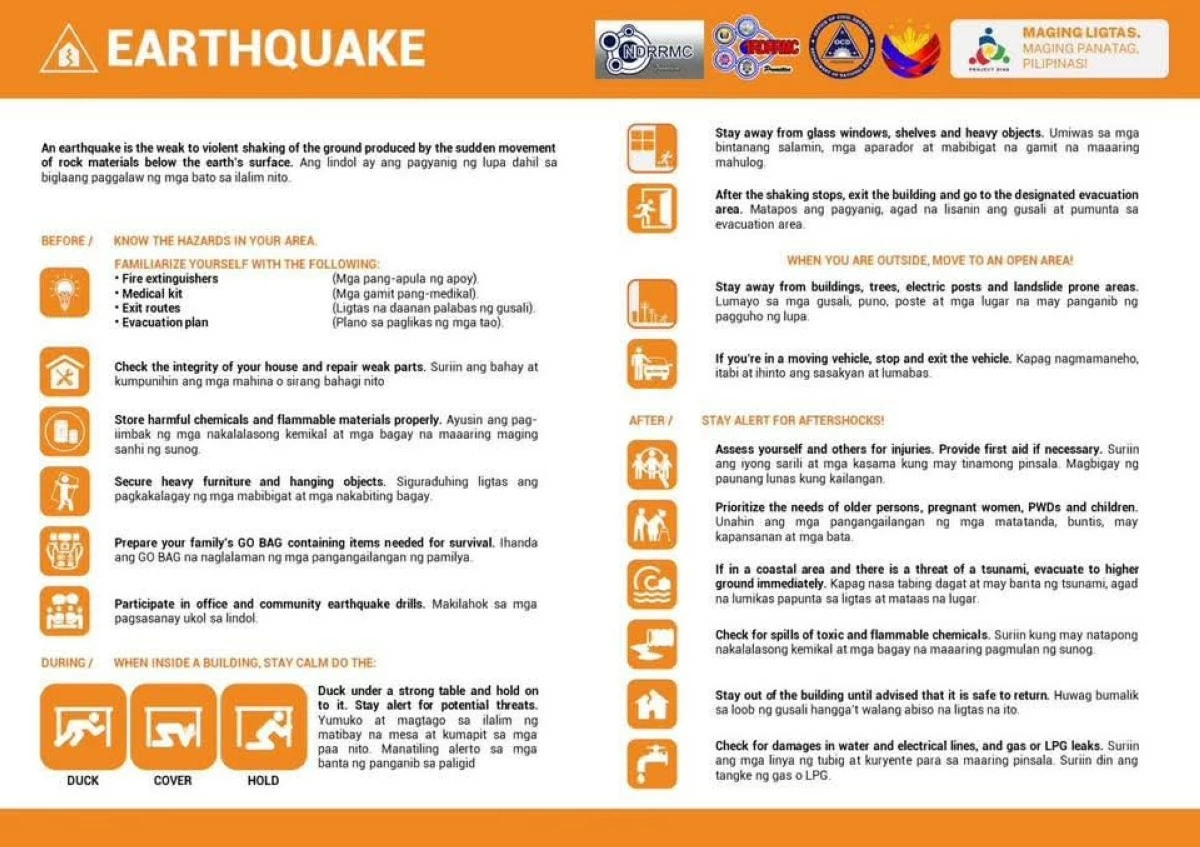
The Office of Civil Defense reminded residents of the Ilocos region to be on alert following a magnitude-5.5 earthquake on Tuesday morning, July 15.
The agency, in an advisory, advised people to be prepared for possible aftershocks.
The Philippine Institute of Volcanology and Seismology said the earthquake struck at 10:38 a.m., with epicenter west of Pasuquin, Ilocos Norte.
The OCD-Ilocos advised the people on what to do in case of an earthquake on its Facebook page.
No damages, fatalities, or injuries were reported as of posting time.
The towns of Sarrat and Pasuquin in Ilocos Norte suspended classes following the earthquake.
Work on all levels were also suspended in Pasuquin.
Local government units and schools in other parts of the province later on cancelled classes and work.
The provincial government of Ilocos Sur urged the people to stay vigilant.
The earthquake occurred on the eve of the 35th anniversary of the magnitude-7.8 temblor that rocked Luzon on July 16, 1990.
The Philippine Institute of Volcanology and Seismology said the tremor struck at 4:26 p.m.
More than 1,200 persons were killed and infrastructure damage was pegged at P10 billion.
The epicenter was in Rizal, Nueva Ecija, northeast of Cabanatuan City.
Strong shaking was widely felt and resulted to damaged structures in Baguio City, Cabanatuan City, Dagupan City and San Fernando City, La Union, Phivolcs said.
The earthquake was also felt in Metro Manila and caused damage to several buildings.
Considered as one of the most destructive earthquakes in the Philippines, it generated a 120-kilometer-long surface rupture along the Digdig segment of the Philippine Fault. The Phivolcs recorded other geologic impacts such as liquefaction and earthquake-induced landslides.
The Baguio City Public Information Office said in a Facebook post:
"It was just a regular day in the city on July 16, 1990, when a magnitude-7.8 earthquake struck in Luzon at 4:26 in the afternoon. The epicenter of the massive and destructive quake was recorded in Rizal, Nueva Ecija. There were numerous aftershocks that followed, and the strongest was recorded at 3:15 a.m. on July 18, 1990, which measured 5.3 magnitude."
"A lot of establishments, hotels, government buildings, and residences were heavily damaged. An estimate of 1,600 people have died in the incident. Thousands of residents in the city slept outdoors and on the streets. Most roads were not passable due to the landslides and critically impacted the delivery of needed aid in the city," it recalled.
"On this day, we remember the "killer earthquake," the lives we have lost yet remember dearly, and the city that was once devastated but continued to strive."
Netizens urged the people to remember and pray for the hundreds of fatalities in the earthquake.