ADVERTISEMENT

Chinese vessel damages 464 sqm of coral reef near Pag-asa Island after anchoring; P11-M penalty sought

Published Jul 14, 2025 04:19 pm
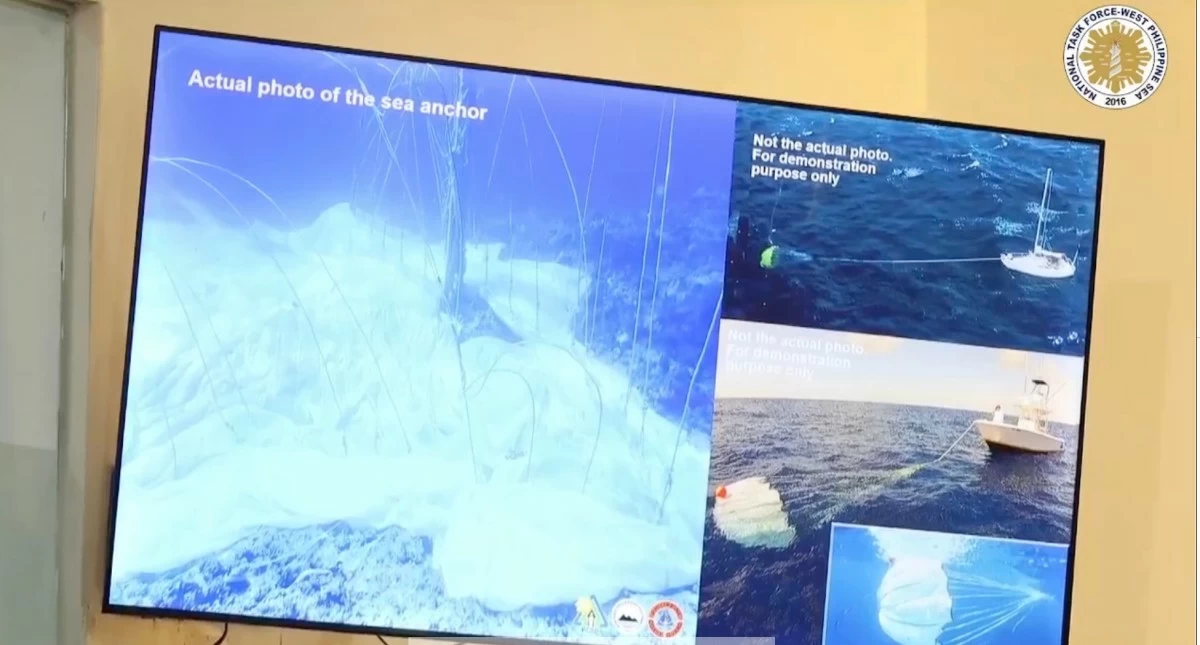
This photo made public during a press conference on July 14, 2025 shows a parachute anchor abandoned by a Chinese militia that anchored at Pag-asa Cay 1 in the West Philippine Sea on June 7, 2025. The anchoring activity of the Chinese vessel damaged 464 square kilomteres of coral reef near Pag-asa Island, according to marine scientists from the Palawan Council for Sustainable Development (PCSD). (Courtesy of NTF-WPS press briefing)
A total of 464 square meters of coral reef were damaged when a Chinese fishing militia anchored at a cay near Pag-asa (Thitu) Island in the West Philippine Sea (WPS) in June.
This was the revelation made by marine scientists from the Palawan Council for Sustainable Development (PCSD) and the National Task Force for West Philippine Sea (NTF-WPS) on Monday, July 14, as they seek to impose a penalty amounting to P11,159,040 from the operator of the Chinese vessel.
The Chinese vessel was identified as a fishing militia with a bow number “16868”.
It was previously reported by the Philippine Navy (PN) that the Chinese vessel ran aground approximately 2.6 kilometers east of Pag-asa Island on June 7, 2025, before freeing itself after three hours with the help of a China Coast Guard (CCG) ship and two other Chinese vessels.
However, Mr. Mark Ace Dela Cruz, chief of the Habitat Management System of the PCSD, said the Chinese militia did not run aground but anchored on Pag-asa Cay 1.
He said the six-man diving team that conducted an environmental damage assessment on Pag-asa Cay 1 found out that the Chinese vessel abandoned a sea or parachute anchor in the area.
The parachute anchor, a device used to stabilize a vessel and limit its drift in the water, was spotted at a depth of nine meters and was covering an area of 307 square meters of coral reef, which is now “considered as damaged.”
“The absence of flattened reef structures indicates the vessel did not run aground on the reef, instead the observed damages such as broken fragments of branching hard and soft corals and massive corals were caused by the dragging of the sea anchor and/or anchor line. The actual damage in the impacted area is estimated at 30 percent,” he said.
Environmental catastrophe
The diving team attempted to retrieve the parachute anchor but it was too heavy to be floated.
Dr. Benjamin Gonzales, the lead marine scientist who conducted environmental assessment on Pag-asa Cay 1, said the parachute will continue to cover the corals, denying them access to sunlight and eventually causing their death.
He warned that this may spark a series of unfortunate events that may lead to an environmental catastrophe.
He said the parachute may move during a strong surge or typhoon, which may cause more damage to the coral reef.
If the coral reef near Pag-asa Island is destroyed, around 4,000 to 6,000 species of fish and other marine organisms such as lobsters, giant clams, eels, snakes, octopuses, and shrimps will have no shelter, spawning ground, and feeding area, which may result in a massive loss of marine life.
He cited a study that coral reef produces 32 tons of fish per year.
“This has implication sa ating mga fishermen who fish in the West Philippine Sea. Kung wala ng corals, wala na ring fish (This has implications for our fishermen who fish in the West Philippine Sea. If there are no more corals, there will be no more fish either),” he said.
Further, Gonzales said the contact between the nylon rods as well as other parachute materials with the corals will produce microplastic waste, which may end up in the intestines of the fish and other marine organisms, and possibly humans who will consume them later on.
The death of corals will also contribute to stronger surges in coastal communities in Palawan as Gonzales said corals function as the first line of defense for surges.
The PCSD recommended the imposition of the collection of the computed penalties amounting to P11 million to the foreign vessel, including environmental damages within the Philippines’ territorial waters.
Meanwhile, PCG spokesperson for WPS Commodore Jay Tarriela said the NTF-WPS supports the PCSD’s recommendation to rehabilitate the coral reef near Pag-asa Island and the enforcement of environmental accountability under Philippine law.
“We remain committed to safeguarding the West Philippine Sea, preserving our marine ecosystems, and upholding the well-being of the communities that depend on them,” he said.

Related Tags

Palawan Council for Sustainable Development Chinese militia Pag-asa Island WPS PCG NTF-WPS
ADVERTISEMENT
.most-popular .layout-ratio{ padding-bottom: 79.13%; } @media (min-width: 768px) and (max-width: 1024px) { .widget-title { font-size: 15px !important; } }

{{ articles_filter_1561_widget.title }}

.most-popular .layout-ratio{ padding-bottom: 79.13%; } @media (min-width: 768px) and (max-width: 1024px) { .widget-title { font-size: 15px !important; } }

{{ articles_filter_1562_widget.title }}

.most-popular .layout-ratio{ padding-bottom: 79.13%; } @media (min-width: 768px) and (max-width: 1024px) { .widget-title { font-size: 15px !important; } }

{{ articles_filter_1563_widget.title }}

{{ articles_filter_1564_widget.title }}

.mb-article-details { position: relative; } .mb-article-details .article-body-preview, .mb-article-details .article-body-summary{ font-size: 17px; line-height: 30px; font-family: "Libre Caslon Text", serif; color: #000; } .mb-article-details .article-body-preview iframe , .mb-article-details .article-body-summary iframe{ width: 100%; margin: auto; } .read-more-background { background: linear-gradient(180deg, color(display-p3 1.000 1.000 1.000 / 0) 13.75%, color(display-p3 1.000 1.000 1.000 / 0.8) 30.79%, color(display-p3 1.000 1.000 1.000) 72.5%); position: absolute; height: 200px; width: 100%; bottom: 0; display: flex; justify-content: center; align-items: center; padding: 0; } .read-more-background a{ color: #000; } .read-more-btn { padding: 17px 45px; font-family: Inter; font-weight: 700; font-size: 18px; line-height: 16px; text-align: center; vertical-align: middle; border: 1px solid black; background-color: white; } .hidden { display: none; }
function initializeAllSwipers() { // Get all hidden inputs with cms_article_id document.querySelectorAll('[id^="cms_article_id_"]').forEach(function (input) { const cmsArticleId = input.value; const articleSelector = '#article-' + cmsArticleId + ' .body_images'; const swiperElement = document.querySelector(articleSelector); if (swiperElement && !swiperElement.classList.contains('swiper-initialized')) { new Swiper(articleSelector, { loop: true, pagination: false, navigation: { nextEl: '#article-' + cmsArticleId + ' .swiper-button-next', prevEl: '#article-' + cmsArticleId + ' .swiper-button-prev', }, }); } }); } setTimeout(initializeAllSwipers, 3000); const intersectionObserver = new IntersectionObserver( (entries) => { entries.forEach((entry) => { if (entry.isIntersecting) { const newUrl = entry.target.getAttribute("data-url"); if (newUrl) { history.pushState(null, null, newUrl); let article = entry.target; // Extract metadata const author = article.querySelector('.author-section').textContent.replace('By', '').trim(); const section = article.querySelector('.section-info ').textContent.replace(' ', ' '); const title = article.querySelector('.article-title h1').textContent; // Parse URL for Chartbeat path format const parsedUrl = new URL(newUrl, window.location.origin); const cleanUrl = parsedUrl.host + parsedUrl.pathname; // Update Chartbeat configuration if (typeof window._sf_async_config !== 'undefined') { window._sf_async_config.path = cleanUrl; window._sf_async_config.sections = section; window._sf_async_config.authors = author; } // Track virtual page view with Chartbeat if (typeof pSUPERFLY !== 'undefined' && typeof pSUPERFLY.virtualPage === 'function') { try { pSUPERFLY.virtualPage({ path: cleanUrl, title: title, sections: section, authors: author }); } catch (error) { console.error('ping error', error); } } // Optional: Update document title if (title && title !== document.title) { document.title = title; } } } }); }, { threshold: 0.1 } ); function showArticleBody(button) { const article = button.closest("article"); const summary = article.querySelector(".article-body-summary"); const body = article.querySelector(".article-body-preview"); const readMoreSection = article.querySelector(".read-more-background"); // Hide summary and read-more section summary.style.display = "none"; readMoreSection.style.display = "none"; // Show the full article body body.classList.remove("hidden"); } document.addEventListener("DOMContentLoaded", () => { let loadCount = 0; // Track how many times articles are loaded const offset = [1, 2, 3, 4, 5, 6, 7, 8, 9, 10]; // Offset values const currentUrl = window.location.pathname.substring(1); let isLoading = false; // Prevent multiple calls if (!currentUrl) { console.log("Current URL is invalid."); return; } const sentinel = document.getElementById("load-more-sentinel"); if (!sentinel) { console.log("Sentinel element not found."); return; } function isSentinelVisible() { const rect = sentinel.getBoundingClientRect(); return ( rect.top < window.innerHeight && rect.bottom >= 0 ); } function onScroll() { if (isLoading) return; if (isSentinelVisible()) { if (loadCount >= offset.length) { console.log("Maximum load attempts reached."); window.removeEventListener("scroll", onScroll); return; } isLoading = true; const currentOffset = offset[loadCount]; window.loadMoreItems().then(() => { let article = document.querySelector('#widget_1690 > div:nth-last-of-type(2) article'); intersectionObserver.observe(article) loadCount++; }).catch(error => { console.error("Error loading more items:", error); }).finally(() => { isLoading = false; }); } } window.addEventListener("scroll", onScroll); });

Sign up by email to receive news.