

ADVERTISEMENT

Russia warns US, South Korea and Japan against forming security alliance targeting North Korea

Published Jul 13, 2025 09:14 am

At A Glance

  • Relations between Russia and North Korea have been flourishing in recent years, with North Korea supplying troops and ammunition to support Russia's war against Ukraine in return for military and economic assistance.
SEOUL, South Korea (AP) — Russia's foreign minister warned the U.S., South Korea and Japan against forming a security partnership targeting North Korea as he visited his country's ally for talks on further solidifying their booming military and other cooperation.
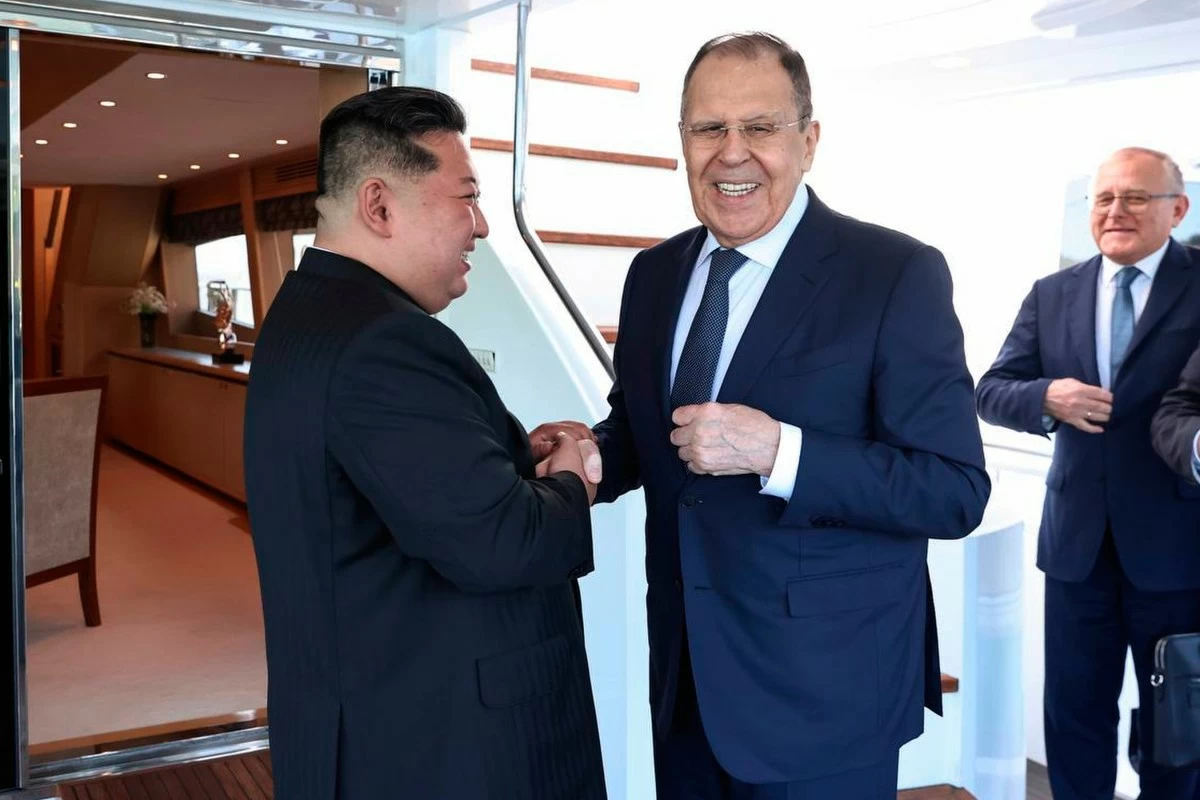
In this photo released by Russian Foreign Ministry Press Service, Russian Foreign Minister Sergey Lavrov, right, and North Korea's leader Kim Jong Un shake hands during their meeting in Wonsan, North Korea, on Saturday, July 12, 2025. (Russian Foreign Ministry Press Service via AP)
Russian Foreign Minister Sergey Lavrov spoke Saturday at North Korea's eastern Wonsan city, where he met the country's leader, Kim Jong Un, and conveyed greetings from President Vladimir Putin.
Kim during the meeting reaffirmed his government's commitment to "unconditionally support and encourage all measures" taken by Russia in its conflict with Ukraine.
He said Pyongyang and Moscow share identical views on "all strategic issues in conformity with the level of alliance," according to North Korea's official Korean Central News Agency.
Lavrov called for the two countries to further strengthen their "strategic and tactical cooperation and intensify concerted action" in international affairs, KCNA reported.
Relations between Russia and North Korea have been flourishing in recent years, with North Korea supplying troops and ammunition to support Russia's war against Ukraine in return for military and economic assistance.
That has raised concerns among South Korea, the U.S. and others that Russia might also transfer sensitive technologies to North Korea that can increase the danger of its nuclear and missile programs.
Speaking with reporters after a meeting with his North Korean counterpart Choe Son Hui, Lavrov accused the U.S., South Korea and Japan of what he called military buildups around North Korea.
"We warn against exploiting these ties to build alliances directed against anyone, including North Korea and, of course, Russia," he said, according to Russia's state Tass news agency.
The U.S., South Korea and Japan have expanded or restored their trilateral military exercises in response to North Korea's advancing nuclear program. The three countries held a joint air drill Friday involving U.S. nuclear-capable bombers near the Korean Peninsula as their top military officers met in Seoul and urged North Korea to cease all unlawful activities threatening regional security.
North Korea views major U.S.-led military drills as invasion rehearsals and has long argued it is forced to develop nuclear weapons to defend itself from U.S. military threats.
Russia understands North Korea's decision to seek nuclear weapons, Lavrov said.
"The technologies used by North Korea are the result of the work of its own scientists. We respect North Korea's aspirations and understand the reasons why it is pursuing nuclear development," Lavrov said, according to Tass.
During their meeting, Choe reiterated North Korea "unconditionally" supports Russia's fight against Ukraine, as Lavrov repeated Russia's gratitude for the contribution North Korean troops made in efforts to repel a Ukrainian incursion into Russia's Kursk border region.
North Korea recently opened a mammoth beach resort in Wonsan city, the meeting venue, that it says can accommodate nearly 20,000 people.
In his comments at the start of his meeting with Choe, Lavrov said, "I am sure that Russian tourists will be increasingly eager to come here. We will do everything we can to facilitate this, creating conditions for this, including air travel," according to the Russian Foreign Ministry.
The Wonsan-Kalma tourist zone is at the center of Kim's push to boost tourism to improve his country's troubled economy. However, prospects for the tourist complex aren't clear as North Korea appears unlikely to fully reopen its borders and embrace Western tourists anytime soon.

Related Tags

World news
ADVERTISEMENT
.most-popular .layout-ratio{ padding-bottom: 79.13%; } @media (min-width: 768px) and (max-width: 1024px) { .widget-title { font-size: 15px !important; } }

{{ articles_filter_1561_widget.title }}

.most-popular .layout-ratio{ padding-bottom: 79.13%; } @media (min-width: 768px) and (max-width: 1024px) { .widget-title { font-size: 15px !important; } }

{{ articles_filter_1562_widget.title }}

.most-popular .layout-ratio{ padding-bottom: 79.13%; } @media (min-width: 768px) and (max-width: 1024px) { .widget-title { font-size: 15px !important; } }

{{ articles_filter_1563_widget.title }}

{{ articles_filter_1564_widget.title }}

.mb-article-details { position: relative; } .mb-article-details .article-body-preview, .mb-article-details .article-body-summary{ font-size: 17px; line-height: 30px; font-family: "Libre Caslon Text", serif; color: #000; } .mb-article-details .article-body-preview iframe , .mb-article-details .article-body-summary iframe{ width: 100%; margin: auto; } .read-more-background { background: linear-gradient(180deg, color(display-p3 1.000 1.000 1.000 / 0) 13.75%, color(display-p3 1.000 1.000 1.000 / 0.8) 30.79%, color(display-p3 1.000 1.000 1.000) 72.5%); position: absolute; height: 200px; width: 100%; bottom: 0; display: flex; justify-content: center; align-items: center; padding: 0; } .read-more-background a{ color: #000; } .read-more-btn { padding: 17px 45px; font-family: Inter; font-weight: 700; font-size: 18px; line-height: 16px; text-align: center; vertical-align: middle; border: 1px solid black; background-color: white; } .hidden { display: none; }
function initializeAllSwipers() { // Get all hidden inputs with cms_article_id document.querySelectorAll('[id^="cms_article_id_"]').forEach(function (input) { const cmsArticleId = input.value; const articleSelector = '#article-' + cmsArticleId + ' .body_images'; const swiperElement = document.querySelector(articleSelector); if (swiperElement && !swiperElement.classList.contains('swiper-initialized')) { new Swiper(articleSelector, { loop: true, pagination: false, navigation: { nextEl: '#article-' + cmsArticleId + ' .swiper-button-next', prevEl: '#article-' + cmsArticleId + ' .swiper-button-prev', }, }); } }); } setTimeout(initializeAllSwipers, 3000); const intersectionObserver = new IntersectionObserver( (entries) => { entries.forEach((entry) => { if (entry.isIntersecting) { const newUrl = entry.target.getAttribute("data-url"); if (newUrl) { history.pushState(null, null, newUrl); let article = entry.target; // Extract metadata const author = article.querySelector('.author-section').textContent.replace('By', '').trim(); const section = article.querySelector('.section-info ').textContent.replace(' ', ' '); const title = article.querySelector('.article-title h1').textContent; // Parse URL for Chartbeat path format const parsedUrl = new URL(newUrl, window.location.origin); const cleanUrl = parsedUrl.host + parsedUrl.pathname; // Update Chartbeat configuration if (typeof window._sf_async_config !== 'undefined') { window._sf_async_config.path = cleanUrl; window._sf_async_config.sections = section; window._sf_async_config.authors = author; } // Track virtual page view with Chartbeat if (typeof pSUPERFLY !== 'undefined' && typeof pSUPERFLY.virtualPage === 'function') { try { pSUPERFLY.virtualPage({ path: cleanUrl, title: title, sections: section, authors: author }); } catch (error) { console.error('ping error', error); } } // Optional: Update document title if (title && title !== document.title) { document.title = title; } } } }); }, { threshold: 0.1 } ); function showArticleBody(button) { const article = button.closest("article"); const summary = article.querySelector(".article-body-summary"); const body = article.querySelector(".article-body-preview"); const readMoreSection = article.querySelector(".read-more-background"); // Hide summary and read-more section summary.style.display = "none"; readMoreSection.style.display = "none"; // Show the full article body body.classList.remove("hidden"); } document.addEventListener("DOMContentLoaded", () => { let loadCount = 0; // Track how many times articles are loaded const offset = [1, 2, 3, 4, 5, 6, 7, 8, 9, 10]; // Offset values const currentUrl = window.location.pathname.substring(1); let isLoading = false; // Prevent multiple calls if (!currentUrl) { console.log("Current URL is invalid."); return; } const sentinel = document.getElementById("load-more-sentinel"); if (!sentinel) { console.log("Sentinel element not found."); return; } function isSentinelVisible() { const rect = sentinel.getBoundingClientRect(); return ( rect.top < window.innerHeight && rect.bottom >= 0 ); } function onScroll() { if (isLoading) return; if (isSentinelVisible()) { if (loadCount >= offset.length) { console.log("Maximum load attempts reached."); window.removeEventListener("scroll", onScroll); return; } isLoading = true; const currentOffset = offset[loadCount]; window.loadMoreItems().then(() => { let article = document.querySelector('#widget_1690 > div:nth-last-of-type(2) article'); intersectionObserver.observe(article) loadCount++; }).catch(error => { console.error("Error loading more items:", error); }).finally(() => { isLoading = false; }); } } window.addEventListener("scroll", onScroll); });

Sign up by email to receive news.