






The Philippines, United States, and Japan agreed that a free, stable, and secure Indo-Pacific region hinges on the economic development of the Philippines, as the three countries underscored the importance of their trilateral cooperation.
Manila Bulletin
 Philippines
National
PH, US, Japan agree to deepen economic cooperation for a more stable, secure Indo-Pacific
Philippines
National
PH, US, Japan agree to deepen economic cooperation for a more stable, secure Indo-Pacific
Philippines
National
PH, US, Japan agree to deepen economic cooperation for a more stable, secure Indo-Pacific
PH, US, Japan agree to deepen economic cooperation for a more stable, secure Indo-Pacific
Published Jul 12, 2025 01:55 pm


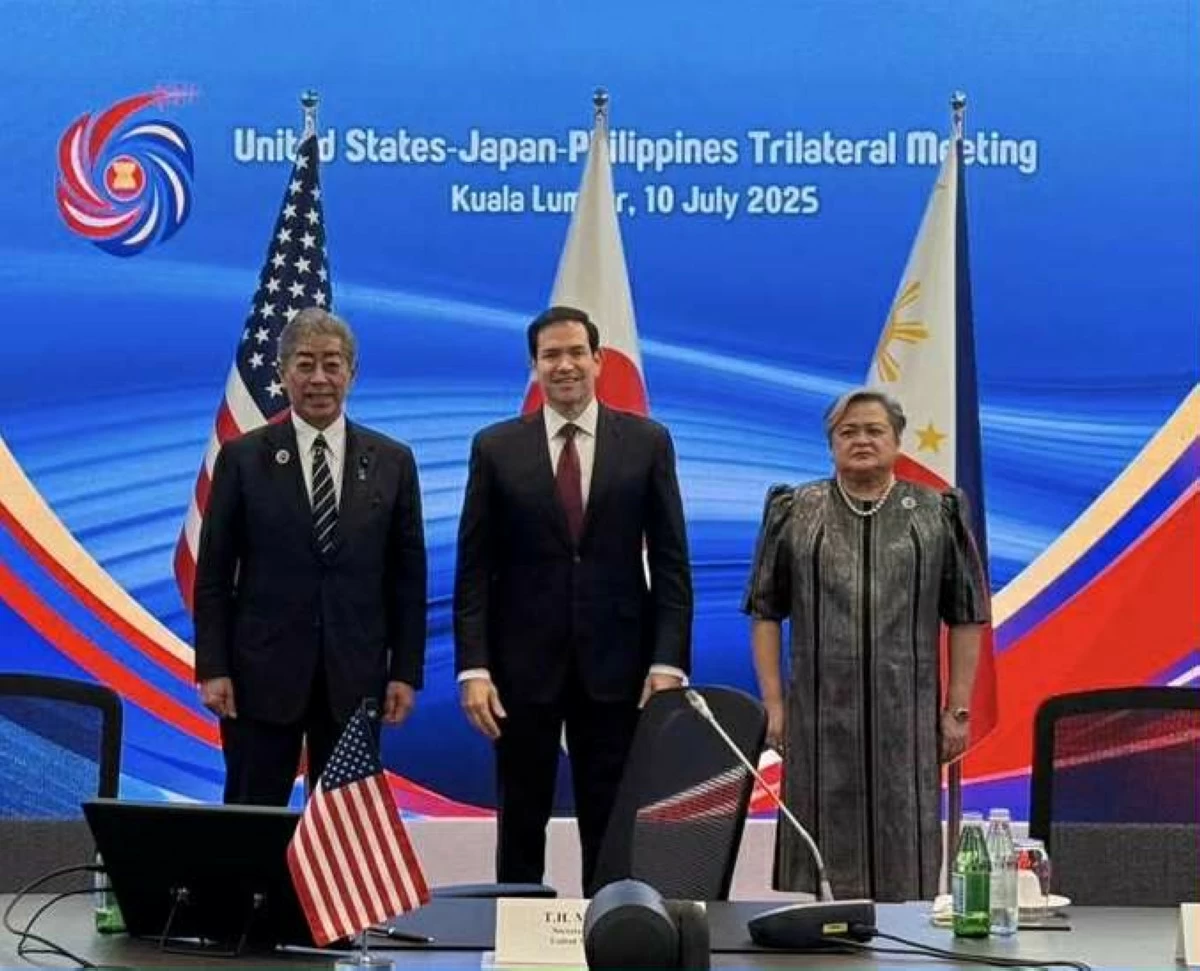
(From right) DFA Secretary Ma. Theresa Lazaro meets with United States Secretary of State Marco Rubio and Japanese Foreign Minister Iwaya Takeshi during the 58th ASEAN Foreign Ministers' Meeting in Kuala Lumpur on July 10, 2025 to further strengthen the trilateral partnership between the US, Japan, and the Philippines. (Photo from DFA)
In a statement about the trilateral meeting held on the sidelines of the 58th Association of Southeast Asian Nations (ASEAN) Ministerial Meeting in Kuala Lumpur on Friday, July 11, the Department of Foreign Affairs (DFA) said that DFA Secretary Ma. Theresa Lazaro met with US Secretary of State Marco Rubio and Japanese Foreign Minister Iwaya Takeshi.
During the meeting, the three senior officials “discussed strengthening security cooperation and reaffirmed commitment to safeguarding regional peace, stability and freedom of navigation in the South China Sea.”
But Lazaro also reminded both partners that “in order for us to be politically strong, we have to be economically strong,” something that US State Department spokesperson Tammy Bruce said that Rubio and Iwaya also agreed on.
“The Secretaries and Foreign Minister concurred on the need to grow our economic partnership in tandem with trilateral security ties, including by unlocking private sector investment in high impact infrastructure projects in the Luzon Economic Corridor,” a separate statement posted on the US State Department’s website said.
The statement furthered that the three officials “reaffirmed their shared interest in trilateral cooperation to advance a free and open Indo-Pacific.”
Lazaro also highlighted that “the Philippines continues to regard the United States and Japan as indispensable partners in enhancing the Philippines’ defense and security capabilities.”
The DFA chief also expressed appreciation for the US’ and Japan’s enduring support for the Philippines’ position in the South China Sea, as well as the United States’ steadfast commitment to the Mutual Defense Treaty.
To further advance their trilateral cooperation, the three officials said this would happen through the Luzon Economic Corridor (LEC), which connects Subic, Clark, Manila, and Batangas (SCMB).
The project aims to expand economic development beyond the National Capital Region, empowering the emergence of new growth hubs in Central and Southern Luzon.
The US was instrumental in making the project a reality, with a $3.8 million funding for the pre-feasibility study of the SCMB Freight Railway.
According to Bruce, they also “agreed to coordinate cooperation on maritime security, including through Maritime Cooperative Activities, trilateral military exercises, and capacity building and assistance for the Philippine Coast Guard and other Philippine maritime authorities.”
The trilateral cooperation between the three countries will also help the Philippines in the challenges it faces on cybersecurity, energy, and telecommunication networks.
To further advance their “shared desire for peace and security in the region,” there will also be sectoral trilateral discussions at the senior officials’ level in the coming months.