






Manila Bulletin
 Philippines
National
Advanced technologies to aid in search for missing sabungeros' remains
Philippines
National
Advanced technologies to aid in search for missing sabungeros' remains
Philippines
National
Advanced technologies to aid in search for missing sabungeros' remains
Advanced technologies to aid in search for missing sabungeros' remains
PCG divers find two suspicious sacks
Published Jul 12, 2025 01:02 pm


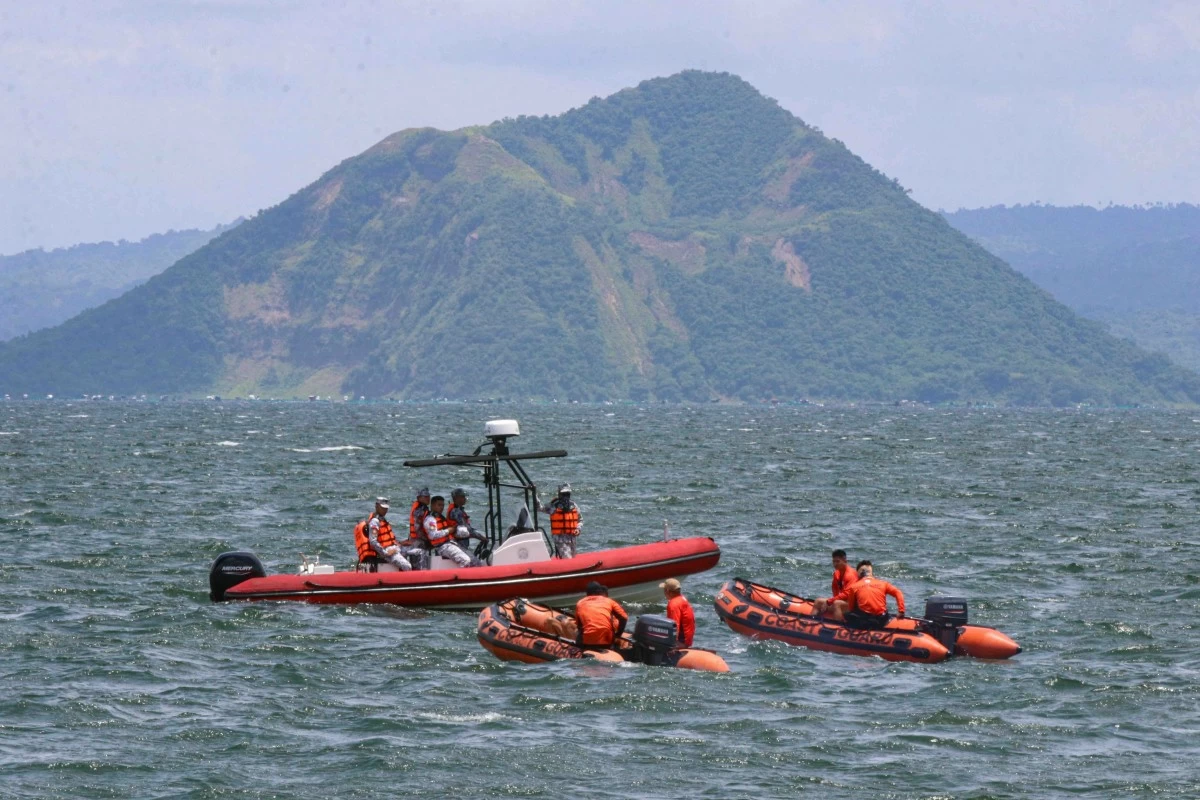
An inter-agency search and retrieval operation is conducted by the Philippine Coast Guard (PCG), Philippine National Police's Criminal Investigation and Detection Group (PNP-CIDG), and Department of Justice (DOJ) at the Taal Lake in Talisay, Batangas on July 10, 2025 to locate the remains of 34 missing sabungeros believed to have been killed and dumped in the lake. (Santi San Juan / MANILA BULLETIN)
(SECOND UPDATE)
The Philippine Coast Guard (PCG) will utilize specialized underwater and aerial technologies to intensify its search for the remains of the 34 missing cockfighting enthusiasts (sabungeros) believed to have been dumped in Taal Lake, Batangas, as divers found two more suspicious sacks during diving operations on Saturday, July 12.
A remotely operated vehicle (ROV) is expected to arrive at the dive site in Laurel, Batangas where technical divers from the PCG were conducting diving operations, on Sunday, July 13, or early next week.
Aside from the ROV, the PCG has also deployed unmanned aerial vehicles (UAVs) or drones for aerial search. The ROV and UAVs are operated by the PCG’s Coast Guard Fleet and Coast Guard Aviation.
The ROV is installed on BRP Teresa Magbanua (MRRV-9701), a 97-meter multi-role response vessel and one of the most advanced ships of the PCG, which will assist in the search and retrieval operation, said PCG spokesperson Captain Noemie Cayabyab.
“This is an asset owned by the PCG and it is currently installed in one of our 97-meter vessels. We expect that it will arrive this Sunday or Monday, and it will be delivered in a prompt way at the diving site in Batangas,” she said.
According to Cayabyab, the ROV can see or monitor things underwater up to 1,000 feet. It can also pick up items underwater. The PCG operates a control board that tracks the ROV’s movements, and the device is fitted with lights to improve visibility in deep or dark waters.
The PCG plans to initially deploy the ROV to scan for any suspicious objects and retrieve them to the surface, reducing the risks faced by the divers.
Cayabyab earlier mentioned that among the challenges being faced by the divers include the strong underwater current and the murky waters at the bottom of the lake which make it hard for them to see things.
“It was almost zero visibility at the bottom of the lake so they had to search by touch. We also wanted to maximize our resources and we also have to consider the safety of our technical divers. The area is big so the ROV is a huge help if it can identify an object and lift heavy materials. Before we deploy, at least to ensure the safety of our technical divers, we have this equipment to assist us,” she explained.
During the diving operations on Friday, PCG divers retrieved two suspicious sacks containing burned objects believed to be human bones. The sacks were immediately placed inside a fine mesh net to secure them and avoid disintegration.
"We had to use a flotation device to retrieve them. We put coordinates so we can extract them properly and have them documented," said Commodore Geornimo Tuvilla, commander of Coast Guard District Southern Tagalog.
The burned objects were turned over to the Philippine National Police - Scene of the Crime Operatives (PNP - SOCO) for forensic examination.
Meanwhile, the PCG welcomed the possibility that Japan would also lend an ROV to help in the search operations. The Department of Justice (DOJ) earlier disclosed that it had requested the government of Japan to conduct an underwater mapping of the lakebed and deployment of its ROV.
"That's a welcome development for the PCG. We are here to support the DOJ and PNP. If there are additional equipment or personnel that can be used to speed up the search, it would be a big help," Cayabyab said.
Suspicous sacks
Meanwhile, the PCG marked two locations within the diving site where two more suspicious sacks were found by the divers during their diving operations.
The first diving operation was conducted at 8 a.m. in Barangay Balakilong, Laurel, Batangas.
"We just moved southeast, about 20 meters from our previous location yesterday. The depth is almost the same, but this time, upon descent—unlike yesterday when divers could still see about a meter ahead near the bottom—now there's almost no visibility, practically zero, and they have to feel their way through," Tuvilla shared.
"We have one suspicious item, we're going to ask the diver for the details. Of course, once the diver surfaces, we’ll be able to ask about it," he added after the conduct of the first diving operation.
A buoy or flotation device was installed where the suspicious item was monitored. Divers retrieved it afterwards.
"They're carefully sweeping the area, slowly. Anything unusual they initially feel is marked. When SOCO, CIDG, and NBI arrive, we’ll retrieve those items carefully from the bottom so they can witness the recovery. This is because there are technical and safety considerations involved in retrieving items underwater," Tuvilla said.
During the second diving operation at 2 p.m., the divers found another suspicious sack with burned objects inside.
The sacks were tied to a weighted sandbag to keep them underwater.
With the discovery, a total of five sacks have already been recovered by the PCG divers since the operations began last Thursday, July 10.