






Manila Bulletin
 Entertainment
Music and Concerts
UP Diliman summa cum laude graduate's thesis focuses on BINI's music, modernity
Entertainment
Music and Concerts
UP Diliman summa cum laude graduate's thesis focuses on BINI's music, modernity
Entertainment
Music and Concerts
UP Diliman summa cum laude graduate's thesis focuses on BINI's music, modernity
UP Diliman summa cum laude graduate's thesis focuses on BINI's music, modernity
Published Jul 10, 2025 03:59 pm



BINI (BINI's X account)
Popular Filipino girl group BINI became the subject of a thesis of a University of the Philippines (UP) Diliman student who graduated summa cum laude.
Jose Alfonso Ignacio “Oey” Mirabueno graduated at UP Diliman recently with a degree of Bachelor of Music in Musicology.
He and another student became the first-ever graduates who earned summa cum laude honors under the Department of Musicology at UP Diliman’s College of Music.
Mirabueno graduated during UP Diliman’s 114th General Commencement Exercises on July 6 and was one of the 241 who graduated summa cum laude, granted to those with a weighted average grade of at least 1.20, according to the university.
Mirabueno’s thesis is titled “‘Lagi Nang Umaawit’: Articulations of Modernity in the Pop Music of BINI,” which explored “the various meanings of modernity and womanhood as expressed by BINI in their music and constructed collaboratively by them and the members of their music production team.”
His thesis on BINI received the UP Diliman College of Music Dean's Award for Outstanding Research.

Jose Alfonso Ignacio Mirabueno (left), who graduated summa cum laude at UP Diliman, chose BINI (right) as the subject of his thesis (Photos: Oey Mirabueno, BINI's X account)

BINI (BINI's X account)

BINI (BINI's X account)

BINI (BINI's X account)

BINI (BINI's X account)
In an interview with Manila Bulletin, Mirabueno talked about why he chose BINI as the subject of his thesis and what he found about the girl group.
He said the idea of BINI as a thesis subject started in an elective class where they were given a free hand of the subject of their paper.
“Ang pop music is a very valid topic naman po for research. Kasi it's still quite common sa, when people say musicology yung kurso ko, na it's usually about older music. Minsan classical music pa rin yun na iniisip ng mga tao kapag sinasabing music, or minsan naman indigenous music (Pop music is a very valid topic for research. Because it's still quite common, when people say musicology is my course, that it's usually about older music. Sometimes it's still classical music that people think of when they say music, or sometimes it's indigenous music),” he said.
He added, “Pero medyo malawak na rin po kasi ang... popular music study nito, so naisip ko, why not talk about pop music, and then why not talk about a very recent popular group, so doon nagsimula (But it's also quite broad because... popular music studies are so broad, so I thought, why not talk about pop music, and then why not talk about a very recent popular group, so that's where it started).”
He said he has been a fan of BINI since 2020 when they performed “Da Coconut Nut.” Since then, he looked forward to BINI’s songs.
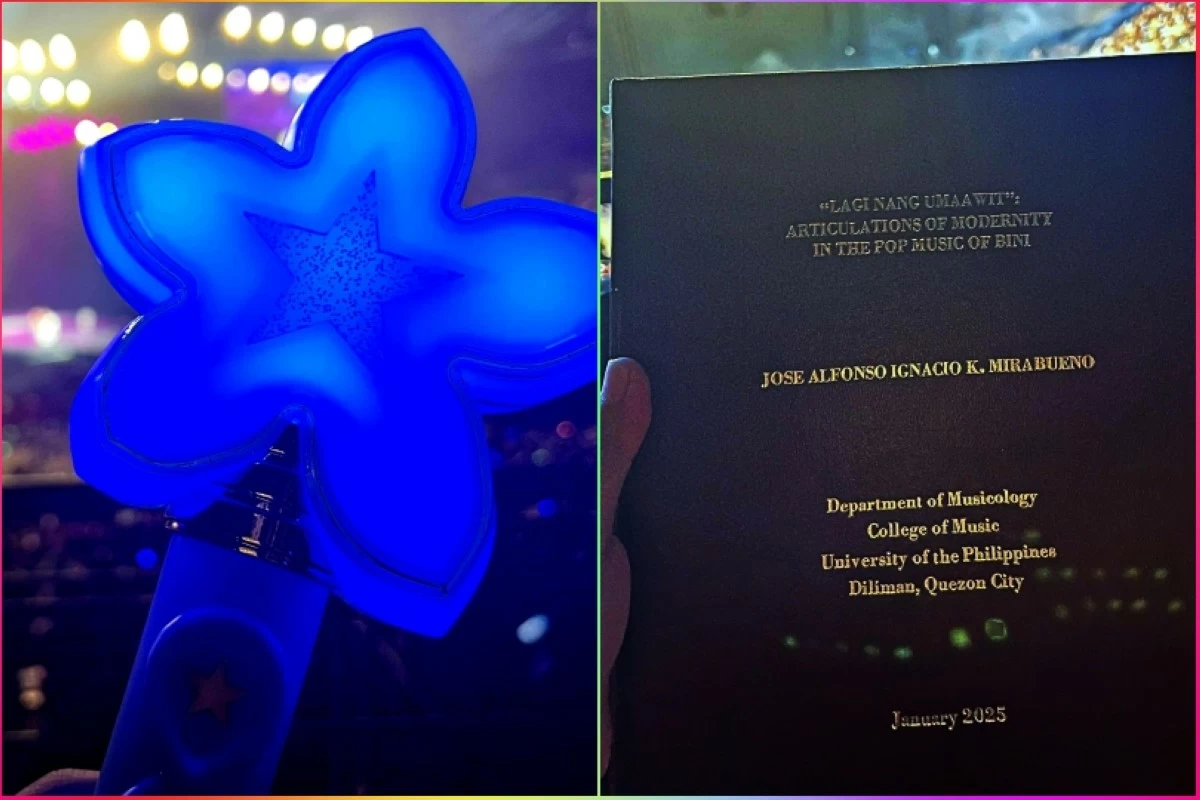
Jose Alfonso Ignacio Mirabueno showing his BINI thesis at BINI's concert at the Philippine Arena (Photos: Oey Mirabueno)
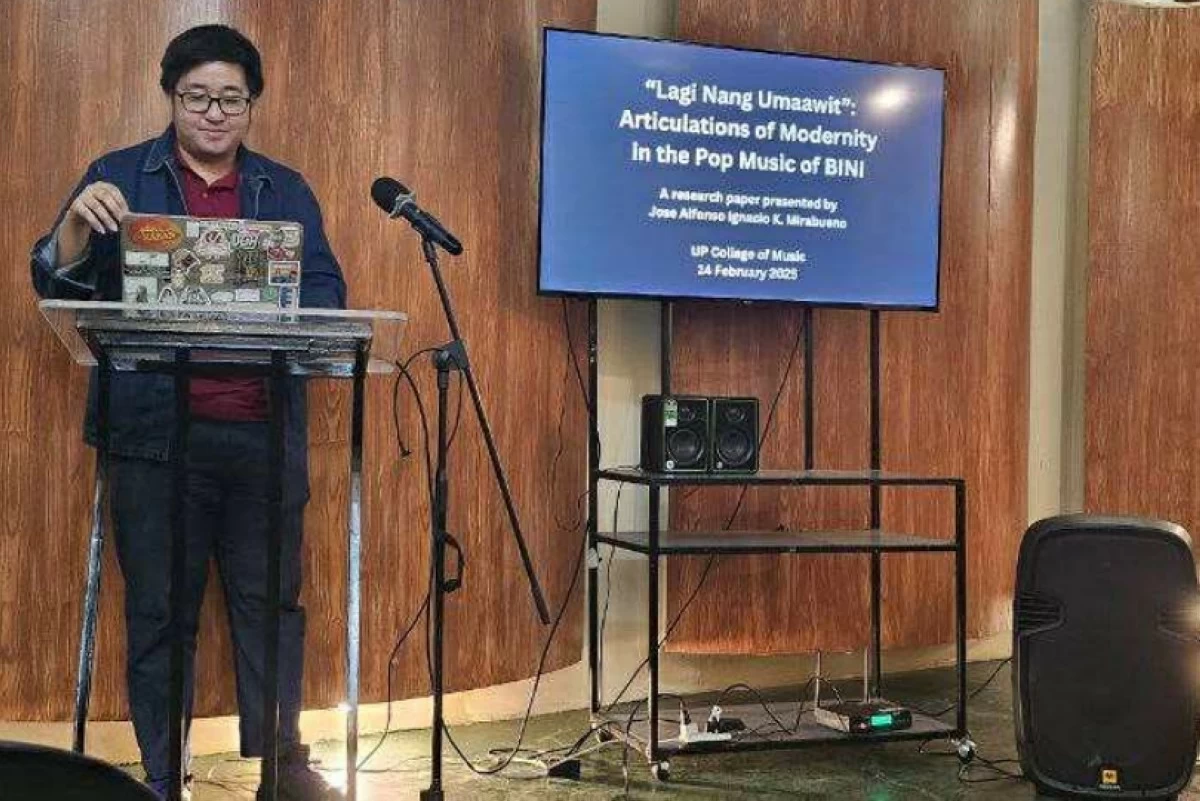
Jose Alfonso Ignacio Mirabueno at his thesis defense (Photo: Oey Mirabueno)
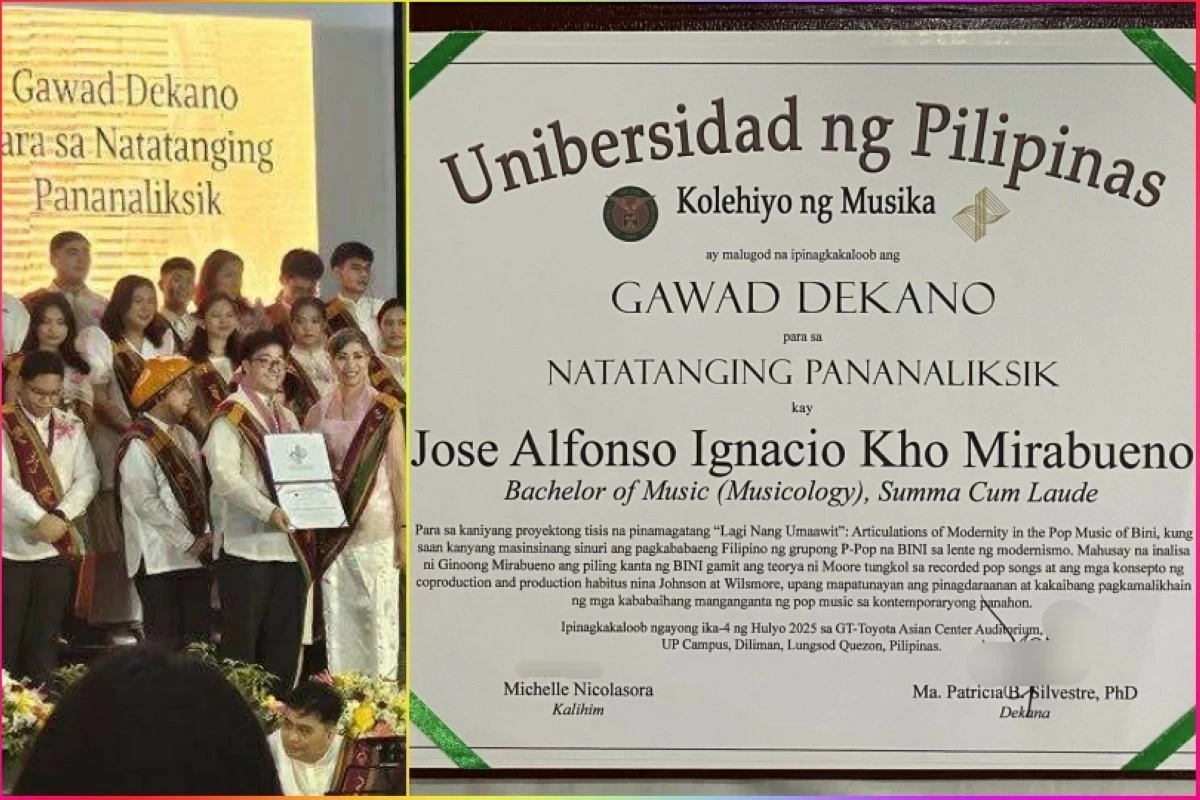
Jose Alfonso Ignacio Mirabueno receiving the UP Diliman College of Music Dean's Award for Outstanding Research for his thesis on BINI (Photos: Oey Mirabueno)

BINI (Photo: Oey Mirabueno)
BINI’s expression of modernity
Mirabueno said his thesis adviser, Associate Professor Arwin Tan, was very supportive when he proposed BINI as his topic for his thesis.
His thesis delved into how BINI members express the idea of modernity.
“Because doon sa kanilang description, they introduced themselves as young modern Filipinas. How do they express it? How do they express being modern sa kanilang music? So yun yung tinignan ko. And ang lumabas dun sa kanilang music was they do express a lot of modern values and modern na construction ng Filipino women na characterized by very fierce and brave expressions, very empowered and independent. And what was interesting dito was how yung ekspresyon na ito does have a very long history (Because in their description, they introduced themselves as young modern Filipinas. How do they express it? How do they express being modern in their music? So that's what I looked at. And what came out in their music was they do express a lot of modern values and modern construction of Filipino women characterized by very fierce and brave expressions, very empowered and independent. And what was interesting here was how this expression does have a very long history),” he explained.
Mirabuena said the Philippines has over a hundred years of popular music and in his thesis, he explored how the expression changed over time, “how we ended up with the modern empowered BINI.”
His study revealed that BINI’s messages of empowerment and modernity were not just confined in the lyrics but in their music itself.
“Nakita ko na lumabas din sya through the music mismo, yung kinds of genres na ginagamit nila, which is nga a combination of global styles (I saw that he also went into the music itself, the kinds of genres that they use, which is a combination of global styles),” he said.
Mirabueno said in terms of sound, BINI’s songs are close to bubblegum pop–which is characterized by being catchy and upbeat–but have deeper emotions.
“Though with BINI, even yung masayahin nilang songs have that edge na very expressive siya. Hindi lang sila happy, parang malalim yung pinaghuhugutan nung kanilang emotions, kahit pa happiness ito, or parang medyo madrama, medyo sawi, may certain, may malalim na authentic emotions yung kanilang bubblegum pop, which is, I think, a very Filipino thing (Though with BINI, even their cheerful songs have that edge that they are very expressive. They are not just happy, their emotions seem to be deeply rooted, even if it is happiness, or they seem a little dramatic, a little sad, their bubblegum pop has certain, deep authentic emotions, which is, I think, a very Filipino thing),” he said.
For his thesis, Mirabueno interviewed BINI songwriters Jonathan Manalo, Ramiru Mataro and Louie Canaria, and vocal coach Anna Graham.
In his conclusion in the thesis, he wrote, “It was found that BINI’s concise six-word description of the young, modern Filipina holds truth to various extents, grounded in histories of women’s self-determination and musical expressions of modernity.”
“Born to Win,” BINI’s debut single, “showed the characteristic of independence as linked to empowerment, but interestingly this empowerment was consistently grounded in solidarity with others, evoking the Filipino value of ‘kapwa,’” according to his thesis.
It added, “‘8’ further emphasized this connection through the personal narrative of BINI themselves. Being informed and aware were additionally manifested through BINI’s advocacy for mental health, publicly expressed through their music. Based on musical style, ‘Strings’ would be a fierce expression while ‘Karera’ would be sweet, though the public manner of their advocacy as popular artists is a fierce act in itself.”
“BINI being free to perform in such a wide variety of styles and sentiments is itself modernity,” according to the thesis.
Favorite
Mirabueno chose “Lagi,” written and composed by Canaria, as his favorite BINI song,
“On musical level, tuwang-tuwa ako with its simplicity, and yet at the same time, complexity. Gandang-ganda rin ako sa pagkakasulat nung lyrics, na it's very easy to listen to, it's very easy to follow (On a musical level, I'm really happy with its simplicity, and yet, at the same time, complexity. I also really like the way the lyrics were written, that it's very easy to listen to, it's very easy to follow),” he said.
He added, “Kasi I think na napansin ko sya in siguro certain songwriters na the way they write lyrics, especially kapag in Filipino yung lyrics medyo kailangan mo nang nababasa mo yung lyrics sa tabi para maintindihan yung words. Pero yung song na to, yung ‘Lagi,’ is so very clear. Ang linaw talaga nung words. It's really a sign ng napakagaling na songwriting. (Because I think I've noticed that with certain songwriters, the way they write lyrics, especially when the lyrics are in Filipino, you kind of have to read the lyrics on the side to understand the words. But this song, 'Lagi,' is so very clear. The words are really clear. It's really a sign of great songwriting).”
Mirabueno said he tried to get tickets for BINI’s shows but they would always get sold out. He was also busy with his studies. He finally got the chance to watch BINI at their Philippine Arena concert.
By that time, he had already finished his thesis after a year. Watching BINI’s concert was also a reward to himself for finishing the thesis. At the concert, he brought a hardbound copy of his thesis.
The music degree is Mirabueno’s second undergraduate course that he finished. Before this, he received his Bachelor of Science in Computer Science at the Ateneo de Manila University.
He took the second course for his love of music.
“Although, in a way na discover ko naman talaga na yun yung gusto kong gawin sa buhay habang nagka computer science (Although, in a way, I discovered that that's what I really wanted to do in life while studying computer science),” he said.
Right now, he has a few projects with the UP Diliman College of Music. He is aiming to apply to teach at the college.
Mirabueno hopes that he will have the chance to give BINI a copy of his thesis. (He already gave a copy to Graham).
“So, I definitely hope na pwede ko silang mabigyan ng kopya, and if mapa-autograph ko din yung kopya ko (So, I definitely hope I can give them a copy, and if I can get my copy autographed, too),” he said.