






Manila Bulletin
 Business
The Stock Market
Philippine office leasing surges as Metro Manila condo oversupply deepens in H1
Business
The Stock Market
Philippine office leasing surges as Metro Manila condo oversupply deepens in H1
Business
The Stock Market
Philippine office leasing surges as Metro Manila condo oversupply deepens in H1
Philippine office leasing surges as Metro Manila condo oversupply deepens in H1
Published Jul 10, 2025 02:51 pm



The Philippine office leasing market posted strong demand growth momentum in the first half of 2025 as the business process outsourcing (BPO) sector shifts from relocation to expansion mode, while the residential market saw an increase in unsold units despite efforts to reduce oversupply.
During Leechiu Property Consultants’ (LPC) second quarter 2025 briefing, LPC Director for Commercial Leasing Mikko Barranda said “the first half of the year has already clocked in 740,000 square meters of leasing activity. That is 67 percent of last year's number. That is a very big number.”

Mikko Barranda
For the second half, while there is some uncertainty due to United States (US) tariff issues, he noted that, “We didn't see any direct effect in the office sector. So, if everything goes well, we might just see this momentum carry over for the rest of the year.”
Barranda said the Information Technology-Business Process Management (IT-BPM) sector is the backbone of the office market, taking up the bulk of demand in January to June this year.
He noted that the BPO sector’s office take-up at end-June is already equivalent to 86 percent of full year 2024, although there have also been many transactions in the traditional office sector, which is already at 72 percent of full year 2024.
While some BPOs are still in hybrid work mode and not a complete return to office, Barranda said that there was a 365,000 square meter take-up in the first semester, and thus it is very promising that the office market might actually hit pre-pandemic numbers.
He also observed that, “for most of the years, it was a flight to quality, a lateral shift from an older building to a new building” by BPO companies.
“But, for the first six months of the year, we're seeing companies actually take space beyond what they already have, meaning growth. So some BPO companies are now saying, “we're preparing to take more space, and we're not going to contract the existing footprint we have,” said Barranda.
Meanwhile, PLC Head of Research Roy Golez said the residential market is experiencing tempered growth, driven by factors such as strong Philippine economic growth, higher remittances, BPO revenues, and tourism receipts, as well as easing interest rates.
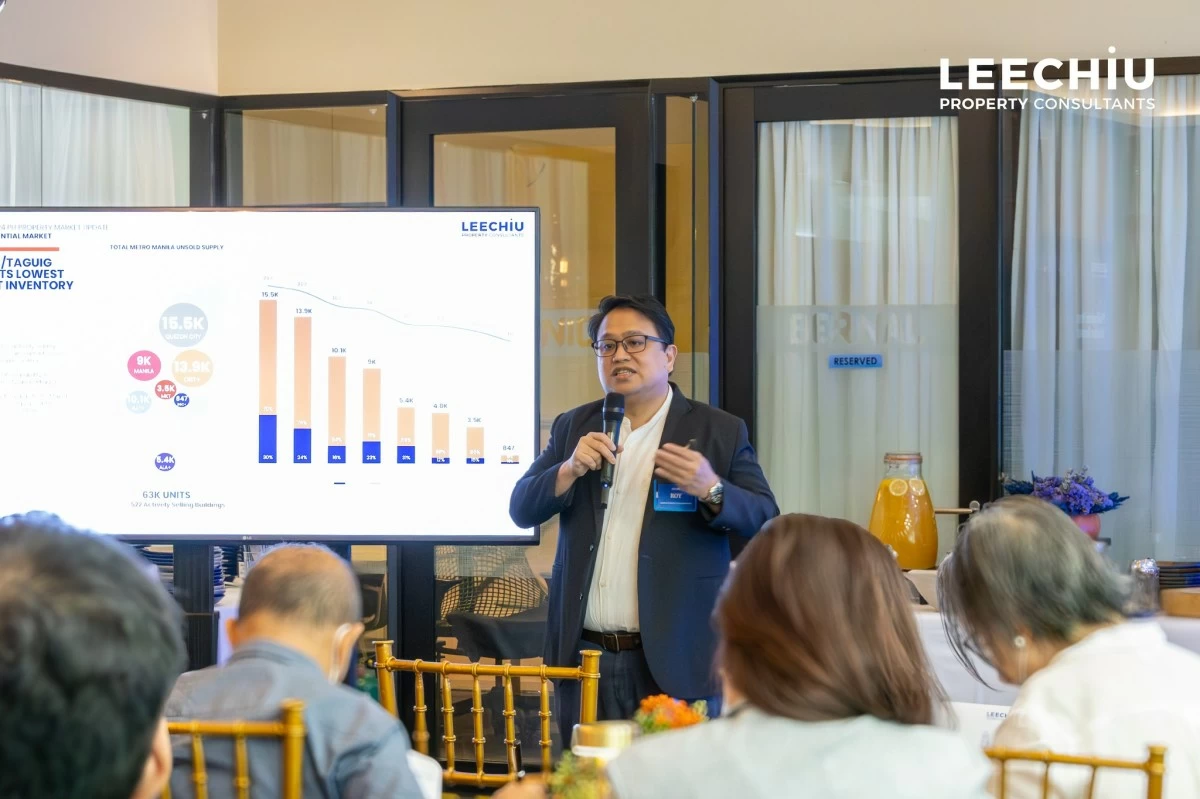
Roy Golez
This has resulted in a two percent quarter-on-quarter growth in demand for condominium units in Metro Manila, equivalent to 6,643 more units compared to the first quarter of 2025.
However, 1,761 units were launched in the second quarter, representing a 31 percent increase from the previous quarter. New launches, along with cancellations, resulted in a growth in available supply from 81,000 units in the first quarter to 82,800 units, equivalent to 37 months of supply.
The oversupply has resulted in a six percent drop in rental rates in the Bay Area, a four percent drop in Makati, and a two percent drop in Ortigas-Mandaluyong and Bonifacio Global City. Rates for the rest of Taguig were stable while Alabang saw a one percent growth.
Compared to 2020, the Bay Area saw a 50 percent drop in rental rates, 38 percent for Alabang-Muntinlupa, 24 percent in Ortigas-Mandaluyong, and 14 percent for Makati. Rates in Taguig are up by 24 percent and by four percent in BGC.
However, Golez said the upscale and high-end or luxury markets remain resilient and continue to see strong take-up, and there have thus been more launches in these segments as property developers are relying on them for sales.