ADVERTISEMENT

Philippines poised for trade advantage as new US tariffs hit Asian peers

Published Jul 9, 2025 11:52 am
With new tariffs turning out “worse than expected” for Asian economies, Dutch financial giant ING said the Philippines’ exclusion from the revised list could give the country a trade advantage, potentially allowing it to outperform its regional peers.
“Interestingly, countries like India, Singapore, and the Philippines, which are not on the new tariff list, may be closer to finalising trade deals with the US, potentially giving them a competitive edge,” Deepali Bhargava, regional head of research of ING Asia-Pacific, said in a commentary released on Tuesday, July 8.
Two days ago, US President Donald Trump reimposed the reciprocal tariffs it slapped on Asian exports on April 2. Trump imposed a 17 percent tariff on Philippine-made products going into the trade giant.
Trump later decided to pause the imposition of these tariffs across the board until Wednesday, July 9. Before the expiration of the three-month pause, Trump has reissued fresh tariff rates on transshipments; however, the original conclusion of the pause has been pushed back to a later deadline of Aug. 1.
Asian trade partners of the US have also been given three more weeks to strike a deal with Trump.
“President Trump’s new tariffs are higher than expected for most Asian economies. Moreover, most countries will face additional tariff rates on transshipments. The new announcements are silent on Singapore, India and the Philippines, which might stand to benefit from tariff concessions if negotiations progress favourably,” Bhargava said.
It can be noted that the Philippines, alongside Singapore, has not received a tariff notification letter from Trump as of July 7. These two countries have the lowest reciprocal tariff rates among the Association of Southeast Asian Nations (ASEAN) economies.
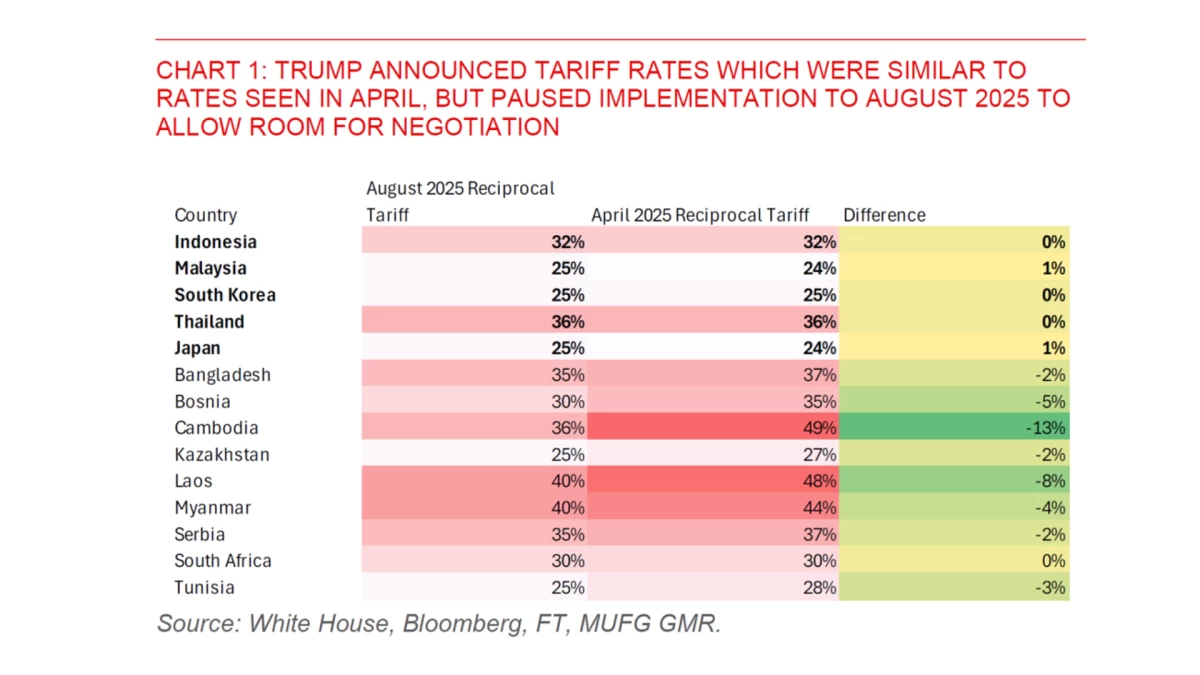
Similarly, MUFG Bank Ltd. said the likes of the Philippines, India, and Singapore “may have a higher chance of seeing a trade deal given that their rates have not been announced yet, even as we acknowledge it may just be a matter of administrative capacity in pushing out the letters.”
President Marcos’ economic managers stated that a “mutually beneficial framework” for trade with the US is currently being developed.
“Any reduction or concession on the current 17-percent reciprocal tariff rate would give the Philippines a competitive edge, particularly in electronics, and strengthen its position against regional peers,” Bhargava said.
Last year, the US was the country’s top export destination, accounting for roughly 17 percent of the country’s total exports. Of these exports, more than half was accounted for by electronic products, “a sector in which the Philippines competes directly with countries like Vietnam and India for US market share”.
Both in May and the first five months of 2025, the US remained the Philippines’ top export destination, despite its share of total exports—just over 15 percent in both periods—falling below the 16 to 17 percent recorded a year ago.
Exports of Philippine goods to the US expanded by 3.6 percent year-on-year to $1.11 billion in May, pushing total shipments for the first five months to $5.38 billion—up 9.1 percent from the same period last year.
Singapore-based DBS Bank Ltd. estimated that Philippine exports to the US comprise approximately two percent of gross domestic product (GDP).
While the Philippine Statistics Authority (PSA) is yet to release the country’s GDP growth for the second quarter of 2025, Bhargava stated that the country’s recent data showed that “external trade made a stronger contribution to GDP in the second quarter.”
The trade balance improved in May, beating market expectations, as exports posted their strongest growth in 13 months, while growth in imports had moderated. “Robust” demand for electronic products, other manufactured goods, and gold was the major driver of export performance during the month.
Bhargava said, however, that despite this positive development in the country’s economic growth, “the cautious pace of private investment may remain a drag on overall performance unless government spending accelerates.”
For the rest of the year, Bhargava said she still sees the Bangko Sentral ng Pilipinas (BSP) reducing a cumulative 50 basis points (bps) in key borrowing costs, which would bring the rate down to 4.75 percent from the current 5.25 percent.

Related Tags

ING Asia-Pacific President Donald Trump US tariffs
ADVERTISEMENT
.most-popular .layout-ratio{ padding-bottom: 79.13%; } @media (min-width: 768px) and (max-width: 1024px) { .widget-title { font-size: 15px !important; } }

{{ articles_filter_1561_widget.title }}

.most-popular .layout-ratio{ padding-bottom: 79.13%; } @media (min-width: 768px) and (max-width: 1024px) { .widget-title { font-size: 15px !important; } }

{{ articles_filter_1562_widget.title }}

.most-popular .layout-ratio{ padding-bottom: 79.13%; } @media (min-width: 768px) and (max-width: 1024px) { .widget-title { font-size: 15px !important; } }

{{ articles_filter_1563_widget.title }}

{{ articles_filter_1564_widget.title }}

.mb-article-details { position: relative; } .mb-article-details .article-body-preview, .mb-article-details .article-body-summary{ font-size: 17px; line-height: 30px; font-family: "Libre Caslon Text", serif; color: #000; } .mb-article-details .article-body-preview iframe , .mb-article-details .article-body-summary iframe{ width: 100%; margin: auto; } .read-more-background { background: linear-gradient(180deg, color(display-p3 1.000 1.000 1.000 / 0) 13.75%, color(display-p3 1.000 1.000 1.000 / 0.8) 30.79%, color(display-p3 1.000 1.000 1.000) 72.5%); position: absolute; height: 200px; width: 100%; bottom: 0; display: flex; justify-content: center; align-items: center; padding: 0; } .read-more-background a{ color: #000; } .read-more-btn { padding: 17px 45px; font-family: Inter; font-weight: 700; font-size: 18px; line-height: 16px; text-align: center; vertical-align: middle; border: 1px solid black; background-color: white; } .hidden { display: none; }
function initializeAllSwipers() { // Get all hidden inputs with cms_article_id document.querySelectorAll('[id^="cms_article_id_"]').forEach(function (input) { const cmsArticleId = input.value; const articleSelector = '#article-' + cmsArticleId + ' .body_images'; const swiperElement = document.querySelector(articleSelector); if (swiperElement && !swiperElement.classList.contains('swiper-initialized')) { new Swiper(articleSelector, { loop: true, pagination: false, navigation: { nextEl: '#article-' + cmsArticleId + ' .swiper-button-next', prevEl: '#article-' + cmsArticleId + ' .swiper-button-prev', }, }); } }); } setTimeout(initializeAllSwipers, 3000); const intersectionObserver = new IntersectionObserver( (entries) => { entries.forEach((entry) => { if (entry.isIntersecting) { const newUrl = entry.target.getAttribute("data-url"); if (newUrl) { history.pushState(null, null, newUrl); let article = entry.target; // Extract metadata const author = article.querySelector('.author-section').textContent.replace('By', '').trim(); const section = article.querySelector('.section-info ').textContent.replace(' ', ' '); const title = article.querySelector('.article-title h1').textContent; // Parse URL for Chartbeat path format const parsedUrl = new URL(newUrl, window.location.origin); const cleanUrl = parsedUrl.host + parsedUrl.pathname; // Update Chartbeat configuration if (typeof window._sf_async_config !== 'undefined') { window._sf_async_config.path = cleanUrl; window._sf_async_config.sections = section; window._sf_async_config.authors = author; } // Track virtual page view with Chartbeat if (typeof pSUPERFLY !== 'undefined' && typeof pSUPERFLY.virtualPage === 'function') { try { pSUPERFLY.virtualPage({ path: cleanUrl, title: title, sections: section, authors: author }); } catch (error) { console.error('ping error', error); } } // Optional: Update document title if (title && title !== document.title) { document.title = title; } } } }); }, { threshold: 0.1 } ); function showArticleBody(button) { const article = button.closest("article"); const summary = article.querySelector(".article-body-summary"); const body = article.querySelector(".article-body-preview"); const readMoreSection = article.querySelector(".read-more-background"); // Hide summary and read-more section summary.style.display = "none"; readMoreSection.style.display = "none"; // Show the full article body body.classList.remove("hidden"); } document.addEventListener("DOMContentLoaded", () => { let loadCount = 0; // Track how many times articles are loaded const offset = [1, 2, 3, 4, 5, 6, 7, 8, 9, 10]; // Offset values const currentUrl = window.location.pathname.substring(1); let isLoading = false; // Prevent multiple calls if (!currentUrl) { console.log("Current URL is invalid."); return; } const sentinel = document.getElementById("load-more-sentinel"); if (!sentinel) { console.log("Sentinel element not found."); return; } function isSentinelVisible() { const rect = sentinel.getBoundingClientRect(); return ( rect.top < window.innerHeight && rect.bottom >= 0 ); } function onScroll() { if (isLoading) return; if (isSentinelVisible()) { if (loadCount >= offset.length) { console.log("Maximum load attempts reached."); window.removeEventListener("scroll", onScroll); return; } isLoading = true; const currentOffset = offset[loadCount]; window.loadMoreItems().then(() => { let article = document.querySelector('#widget_1690 > div:nth-last-of-type(2) article'); intersectionObserver.observe(article) loadCount++; }).catch(error => { console.error("Error loading more items:", error); }).finally(() => { isLoading = false; }); } } window.addEventListener("scroll", onScroll); });

Sign up by email to receive news.