






Manila Bulletin
 Philippines
National
'Show of unity': 32 maritime forces gather in PH for amphibious leaders' meet as China expands presence in WPS
Philippines
National
'Show of unity': 32 maritime forces gather in PH for amphibious leaders' meet as China expands presence in WPS
Philippines
National
'Show of unity': 32 maritime forces gather in PH for amphibious leaders' meet as China expands presence in WPS
'Show of unity': 32 maritime forces gather in PH for amphibious leaders' meet as China expands presence in WPS
Published Jul 8, 2025 02:38 pm


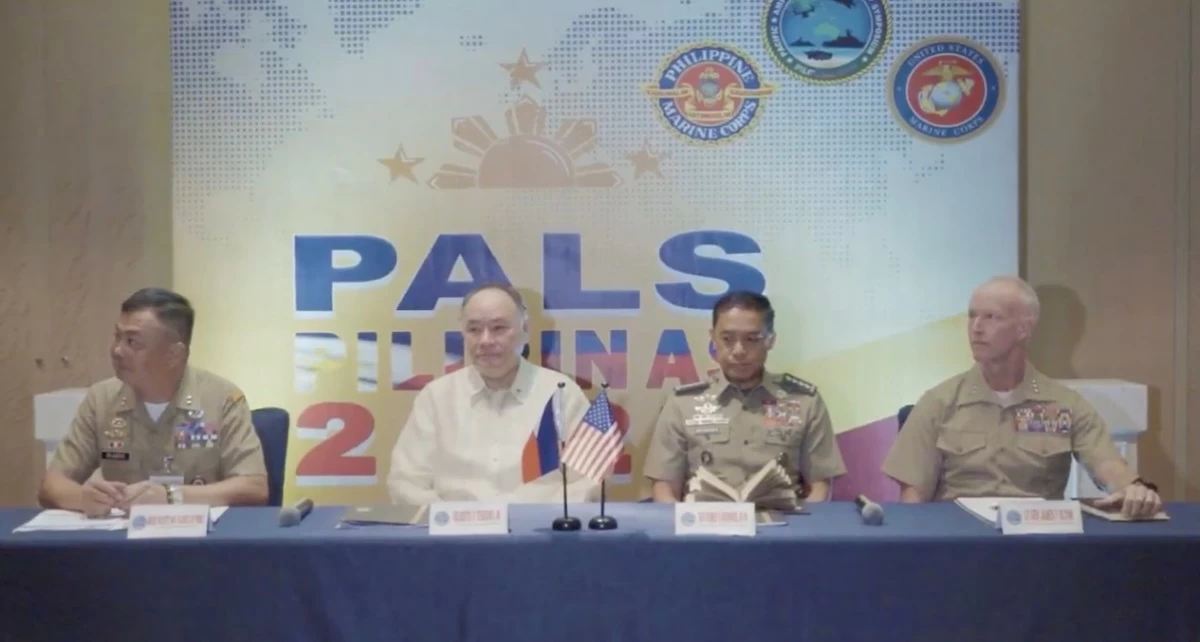
(L-R) Maj. Gen. Vicente MAP Blanco III, commandant of Philippine Marine Corps; Department of National Defense Secretary Gilberto Teodoro Jr.; Armed Forces of the Philippines Chief of Staff, General Romeo Brawner Jr.; and Lt. Gen. James F. Glynn, commander of United States Marine Corps Force Pacific, answer questions from the media during the launch of the Pacific Amphibious Leaders Symposium (PALS) in Taguig City on July 8, 2025. (Courtesy of DND)
Regional amphibious and maritime forces from 32 nations convened in the Philippines for the 11th iteration of the Pacific Amphibious Leaders Symposium (PALS), which kicked off on Tuesday, July 8, in Taguig City.
The PALS is co-hosted for the first time by the Philippine Marine Corps (PMC) and United States Marine Corps (USMC) to “strengthen the relationship and cooperation towards common interests that promote interoperability and stability in the Indo-Pacific region.”
But as this developed, the Philippine Navy (PN) revealed that China deployed 49 People’s Liberation Army-Navy (PLA-N), coast guard, and maritime militia vessels in the West Philippine Sea (WPS) in June, the most number for this year.
According to PMC Commandant, Major General Vicente MAP Blanco III, the PALS 2025 serves as a platform for amphibious leaders to exchange insights and share effective strategies to strengthen multinational collaboration in addressing evolving maritime challenges.
The agenda for PALS 25 includes high-level engagements, panel discussions, and senior leader briefings focusing on critical issues such as harnessing emerging technologies for littoral operations, overcoming logistical challenges during disaster relief, and the strategic use of information operations in today’s maritime landscape.
Participating delegations will also showcase technology-driven solutions for maritime domain awareness, intelligence, surveillance, and reconnaissance (ISR), as well as the role of amphibious forces in promoting multinational security cooperation.
“This all boils down to building the trust and confidence of the nations [that] will come and join this,” Blanco said.
For his part, Lt. Gen. James F. Glynn, commander of USMC Force Pacific, said the Philippines’ strategic location at the heart of the Indo-Pacific makes it a fitting host for high-level discussions on regional security, innovation, and cooperation.
“Being here in the Philippines and its position as a crossroads for all of the things that we're going to discuss, from innovation to capability development, and the applicability across a range of operations, from disaster response to whatever else is required to enforce security to enable commerce and economic growth, I think it is quite timely that we find ourselves in the Philippines,” he said.
Department of National Defense (DND) Secretary Gilberto Teodoro Jr. and Armed Forces of the Philippines (AFP) Chief of Staff, General Romeo Brawner Jr. said the symposium should not be seen as a “show of force” against a country deemed as a "common threat" by the participants, rather a “show of unity” to uphold a rules-based international order and resist unilateral attempts to change the status quo.
“You may put some spin into a show of force or whatnot, but to me, the main purpose is that our leaders of amphibious forces are getting together, talking with each other, developing trust, developing confidence, exchanging experiences, reaching out to not only our traditional allies or like-minded partners, but also the smaller countries to include three or four Latin American countries,” Teodoro said.
“Instead of looking at it as a show of force, for me, this is a show of unity among like-minded nations who get together for a common value, and that is to promote a free and open Indo-Pacific,” Brawner added.
Aside from the PMC and USMC, there were also representatives from 30 other countries attending the PALS until July 10 such as Australia, Bangladesh, Brazil, Brunei, Canada, Chile, Colombia, Ecuador, Fiji, France, Germany, India, Indonesia, Japan, Republic of Korea, Malaysia, Maldives, Mexico, the Netherlands, New Zealand, Papua New Guinea, Peru, Singapore, Sri Lanka, Thailand, Tonga, Timor Leste, United Kingdom, South Korea and Vietnam.
China’s growing presence
Rear Adm. Roy Vincent Trinidad, PN spokesperson for WPS, said 49 PLA-N warships, coast guard and militia vessels were monitored at Bajo de Masinloc (Scarborough or Panatag Shoal), Ayungin (Second Thomas) Shoal, and Pag-asa (Thitu) Island in the WPS in June.
This was the highest deployment made by China in the features it claims within the exclusive economic zone (EEZ) of the Philippines this year. To compare, China mobilized 11 vessels in January, nine in February, 35 in March, 31 in April, and 41 in May.
“As it is right now, we have no direct reference on the tactical implications why it suddenly rose to 49 from [May’s] 41,” Trinidad said in a separate interview at Camp Aguinaldo in Quezon City.
‘WPS dispute not only a cross-regional issue’
Teodoro emphasized that the maritime dispute between the Philippines and China in the WPS is not just a regional concern but a global issue, hence, the PALS is a good avenue to foster cross-regional cooperation to address concerns.
“The motivating factor here is the commonality of threats and the commonality of threat actors,” the defense chief said. “Because of the commonality of threats, the commonality of threat actors, cross-regional operation becomes vital and imperative.”