

ADVERTISEMENT

Jobless rate dips to 3.9% in May amid strong employment gains

Labor force participation highest in over 20 years

Published Jul 8, 2025 12:56 pm  |  Updated Jul 8, 2025 01:08 pm

At A Glance

  • Many job applicants were absorbed by firms in the Philippines in May, resulting in a decline in the number of jobless Filipinos during the month to 2.03 million from 2.11 million unemployed individuals in May 2024.
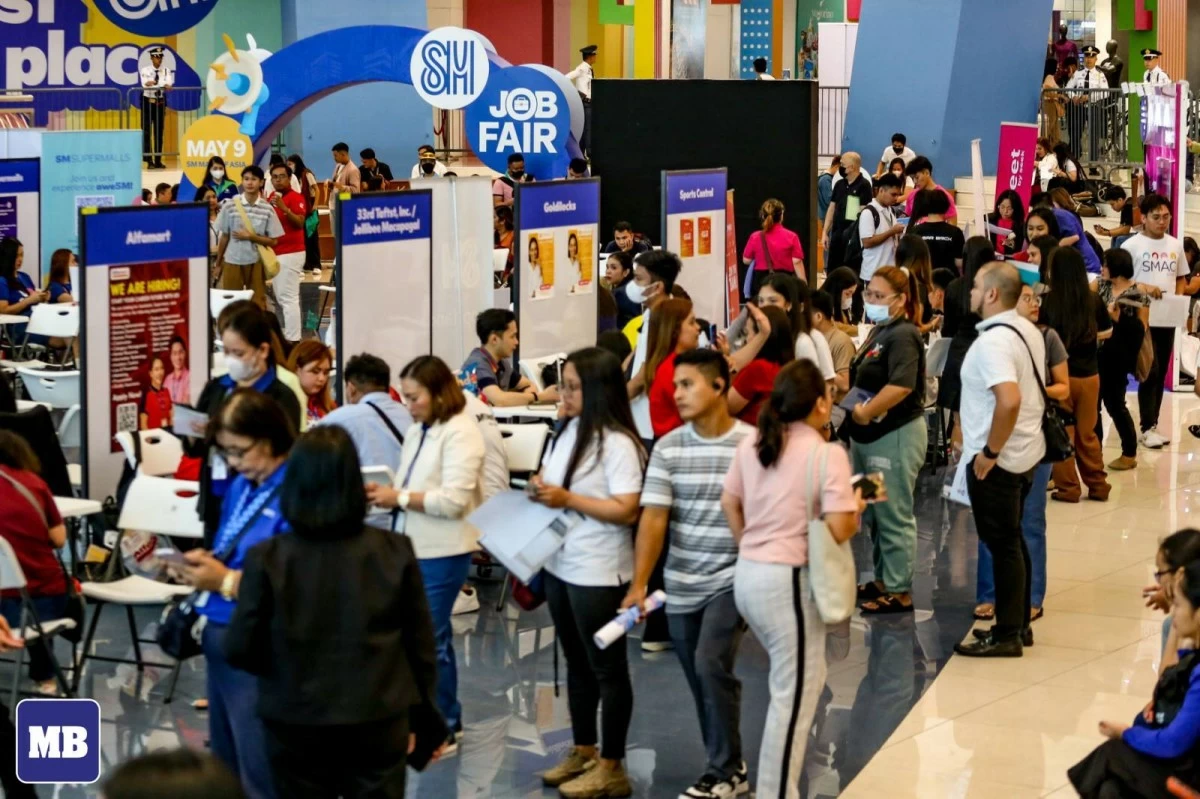
Many job applicants were absorbed by firms in the Philippines in May, resulting in a decline in the number of jobless Filipinos during the month to 2.03 million from 2.11 million unemployed individuals in the same month last year.
Preliminary data from the Philippine Statistics Authority (PSA) showed that the 71,000 drop in unemployment annually brought the unemployment rate back to 3.9 percent, as seen in March. It was lower than last year’s 4.1 percent.
Employment during the month climbed to 96.1 percent rate from both 95.9 percent in May last year and April this year. By number, 50.29 million Filipinos secured employment in May from 48.87 million a year ago, and 48.67 million in the previous month.
According to the PSA, the biggest job gains in May were recorded in wholesale and retail trade (489,000), agriculture and forestry (469,000), administrative and support services (371,000), accommodation and food services (365,000), and other service activities (175,000).
Wage and salary workers comprised the majority of employed Filipinos in May 2025, at 62.8 percent, followed by self-employed individuals without paid employees (27.9 percent), unpaid family workers (7.5 percent), and employers running their family businesses or farms (1.8 percent).
Higher employment rate also came with higher underemployment rate at 13.1 percent from last year’s 9.9 percent. This figure refers to the total share of underemployed individuals in the total number of Filipinos employed during the month.
This means that 6.6 million of the 50.29 million employed individuals expressed the desire to have additional hours of work in their present job, or to have an additional job, or to have a new job with longer hours of work in May 2025.
“Our increase in labor force participation is 1.35 million. Most of them are absorbed. In fact, the increase in employment is even bigger. But unfortunately, not all of them are full-time employees. That is why there was also a substantial year-on-year increase in underemployment,” National Statistician and PSA Undersecretary Claire Dennis Mapa said during a press briefing on Tuesday, July.
Mapa noted that the labor force reached a record high of 52.32 million in May, the highest level in over two decades since April 2005. The labor force participation rate was at 65.8 percent, higher than last year’s 64.8 percent.
The labor force comprises Filipinos aged 15 and above who are either employed or actively seeking employment.
Underemployed persons are those with jobs who are still looking for additional work or longer working hours. It was significantly higher than last year’s figure, despite decrease in April to 14.6 percent.
During the month, 59.2 percent of underemployed Filipinos worked fewer than 40 hours a week or had no work at all, while the remaining 40.8 percent held full-time jobs but still sought additional income.
Bigger workforce to spur higher growth
National Socioeconomic Planner Arsenio M. Balisacan said he welcomes this development, particularly the participation rate, “because it indicates a healthy and competitive Philippine labor market.”
“Generally, a larger workforce can lead to increased economic output and potentially higher GDP [gross domestic product] growth, as more people contribute to the economy,” Balisacan said in a statement released on Tuesday, July 8.
“This also reflects growing confidence in the labor market and the impact of ongoing efforts to expand access to employment opportunities across sectors,” Balisacan added.
He assured that the government will capitalize on recently enacted policy reforms “to improve upskilling and reskilling initiatives.”
These involve more robust industry partnerships under the Enterprise-Based Education and Training (EBET) Framework Act, as well as the implementation of the Expanded Tertiary Education Equivalency and Accreditation Program (ETEEAP) and the passage of the Lifelong Learning Development Framework Bill.
The government is aiming to attract more Global Capability Centers (GCCs) to the Philippines by promoting high-value Information Technology and Business Process Management (IT-BPM) services and improving workforce skills in digitalization and generative AI.
As per the Department of Economy, Planning and Development (DEPDev), the Philippine Development Plan 2023-2028 midterm update will be released this July.

Related Tags

Philippine Statistics Authority (PSA) Unemployment rates
ADVERTISEMENT
.most-popular .layout-ratio{ padding-bottom: 79.13%; } @media (min-width: 768px) and (max-width: 1024px) { .widget-title { font-size: 15px !important; } }

{{ articles_filter_1561_widget.title }}

.most-popular .layout-ratio{ padding-bottom: 79.13%; } @media (min-width: 768px) and (max-width: 1024px) { .widget-title { font-size: 15px !important; } }

{{ articles_filter_1562_widget.title }}

.most-popular .layout-ratio{ padding-bottom: 79.13%; } @media (min-width: 768px) and (max-width: 1024px) { .widget-title { font-size: 15px !important; } }

{{ articles_filter_1563_widget.title }}

{{ articles_filter_1564_widget.title }}

.mb-article-details { position: relative; } .mb-article-details .article-body-preview, .mb-article-details .article-body-summary{ font-size: 17px; line-height: 30px; font-family: "Libre Caslon Text", serif; color: #000; } .mb-article-details .article-body-preview iframe , .mb-article-details .article-body-summary iframe{ width: 100%; margin: auto; } .read-more-background { background: linear-gradient(180deg, color(display-p3 1.000 1.000 1.000 / 0) 13.75%, color(display-p3 1.000 1.000 1.000 / 0.8) 30.79%, color(display-p3 1.000 1.000 1.000) 72.5%); position: absolute; height: 200px; width: 100%; bottom: 0; display: flex; justify-content: center; align-items: center; padding: 0; } .read-more-background a{ color: #000; } .read-more-btn { padding: 17px 45px; font-family: Inter; font-weight: 700; font-size: 18px; line-height: 16px; text-align: center; vertical-align: middle; border: 1px solid black; background-color: white; } .hidden { display: none; }
function initializeAllSwipers() { // Get all hidden inputs with cms_article_id document.querySelectorAll('[id^="cms_article_id_"]').forEach(function (input) { const cmsArticleId = input.value; const articleSelector = '#article-' + cmsArticleId + ' .body_images'; const swiperElement = document.querySelector(articleSelector); if (swiperElement && !swiperElement.classList.contains('swiper-initialized')) { new Swiper(articleSelector, { loop: true, pagination: false, navigation: { nextEl: '#article-' + cmsArticleId + ' .swiper-button-next', prevEl: '#article-' + cmsArticleId + ' .swiper-button-prev', }, }); } }); } setTimeout(initializeAllSwipers, 3000); const intersectionObserver = new IntersectionObserver( (entries) => { entries.forEach((entry) => { if (entry.isIntersecting) { const newUrl = entry.target.getAttribute("data-url"); if (newUrl) { history.pushState(null, null, newUrl); let article = entry.target; // Extract metadata const author = article.querySelector('.author-section').textContent.replace('By', '').trim(); const section = article.querySelector('.section-info ').textContent.replace(' ', ' '); const title = article.querySelector('.article-title h1').textContent; // Parse URL for Chartbeat path format const parsedUrl = new URL(newUrl, window.location.origin); const cleanUrl = parsedUrl.host + parsedUrl.pathname; // Update Chartbeat configuration if (typeof window._sf_async_config !== 'undefined') { window._sf_async_config.path = cleanUrl; window._sf_async_config.sections = section; window._sf_async_config.authors = author; } // Track virtual page view with Chartbeat if (typeof pSUPERFLY !== 'undefined' && typeof pSUPERFLY.virtualPage === 'function') { try { pSUPERFLY.virtualPage({ path: cleanUrl, title: title, sections: section, authors: author }); } catch (error) { console.error('ping error', error); } } // Optional: Update document title if (title && title !== document.title) { document.title = title; } } } }); }, { threshold: 0.1 } ); function showArticleBody(button) { const article = button.closest("article"); const summary = article.querySelector(".article-body-summary"); const body = article.querySelector(".article-body-preview"); const readMoreSection = article.querySelector(".read-more-background"); // Hide summary and read-more section summary.style.display = "none"; readMoreSection.style.display = "none"; // Show the full article body body.classList.remove("hidden"); } document.addEventListener("DOMContentLoaded", () => { let loadCount = 0; // Track how many times articles are loaded const offset = [1, 2, 3, 4, 5, 6, 7, 8, 9, 10]; // Offset values const currentUrl = window.location.pathname.substring(1); let isLoading = false; // Prevent multiple calls if (!currentUrl) { console.log("Current URL is invalid."); return; } const sentinel = document.getElementById("load-more-sentinel"); if (!sentinel) { console.log("Sentinel element not found."); return; } function isSentinelVisible() { const rect = sentinel.getBoundingClientRect(); return ( rect.top < window.innerHeight && rect.bottom >= 0 ); } function onScroll() { if (isLoading) return; if (isSentinelVisible()) { if (loadCount >= offset.length) { console.log("Maximum load attempts reached."); window.removeEventListener("scroll", onScroll); return; } isLoading = true; const currentOffset = offset[loadCount]; window.loadMoreItems().then(() => { let article = document.querySelector('#widget_1690 > div:nth-last-of-type(2) article'); intersectionObserver.observe(article) loadCount++; }).catch(error => { console.error("Error loading more items:", error); }).finally(() => { isLoading = false; }); } } window.addEventListener("scroll", onScroll); });

Sign up by email to receive news.