






Manila Bulletin
 Philippines
National
State of Philippine education 2025: How bold reforms can turn crisis into opportunity
Philippines
National
State of Philippine education 2025: How bold reforms can turn crisis into opportunity
Philippines
National
State of Philippine education 2025: How bold reforms can turn crisis into opportunity
State of Philippine education 2025: How bold reforms can turn crisis into opportunity
As Filipino learners race against time, the Philippine Business for Education (PBEd) is pushing for comprehensive and unified policy reforms to address the country's deepening education crisis
Published Jul 7, 2025 03:46 pm


At A Glance
- PBEd unveils the 2025 State of Philippine Education --- sounding the alarm on a deepening learning crisis and calling for urgent, systemic reforms
- Citing persistent gaps in literacy, infrastructure, and teacher quality, PBEd emphasized the need for unified action to reverse declining educational outcomes and ensure every Filipino learner has access to quality education
- PBEd urges bold reforms to address the deepening Philippine education crisis in 2025, calling for urgent action and system-wide transformation

PBEd's 2025 State of Philippine Education report urges bold reforms to turn the worsening education crisis into an opportunity for long-term national growth. (MANILA BULLETIN FILE PHOTO)
The state of Philippine education in 2025 remains in critical condition, with learners continuing to bear the brunt of longstanding systemic issues.
As education quality declines and learning gaps widen, the need for urgent and unified reforms to prevent further deterioration of the sector is more pressing than ever.
In its latest report, PBEd sounded the alarm over the country’s worsening education crisis.
During a press conference on Monday, July 7, PBEd officials—led by President Chito Salazar and Executive Director Bal Camua—presented the 2025 State of Philippine Education, a comprehensive assessment of the current learning landscape and a reform roadmap designed to address the most pressing challenges.
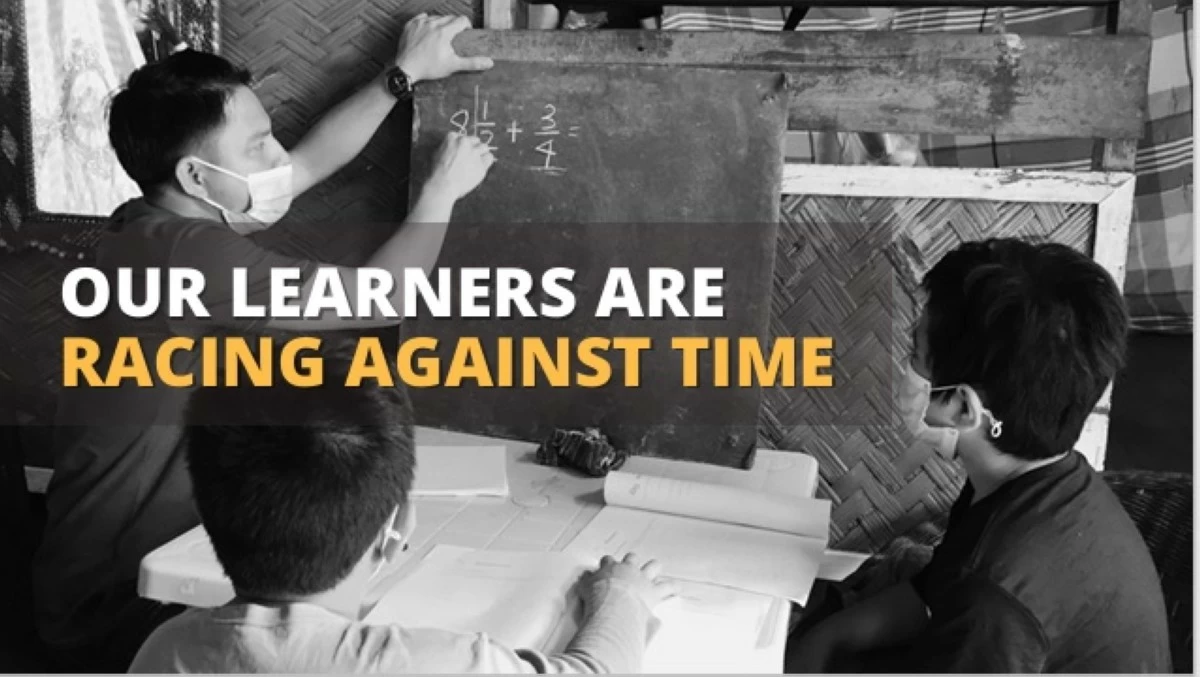
(Photo from PBEd)
PBEd unveiled its findings on the learning crisis affecting Filipino students and laid out a reform strategy to reverse declining education outcomes, address skills mismatches, and strengthen the country’s human capital.
The advocacy group also issued a powerful call for urgent and sweeping reforms to rescue the education system.
A deepening crisis
PBEd’s report paints a stark picture: Filipino learners continue to suffer from persistent, system-wide issues that have defied decades of reform efforts.
The organization cited low literacy and numeracy rates, deteriorating student performance, overburdened teachers, and a troubling disconnect between education and employment.
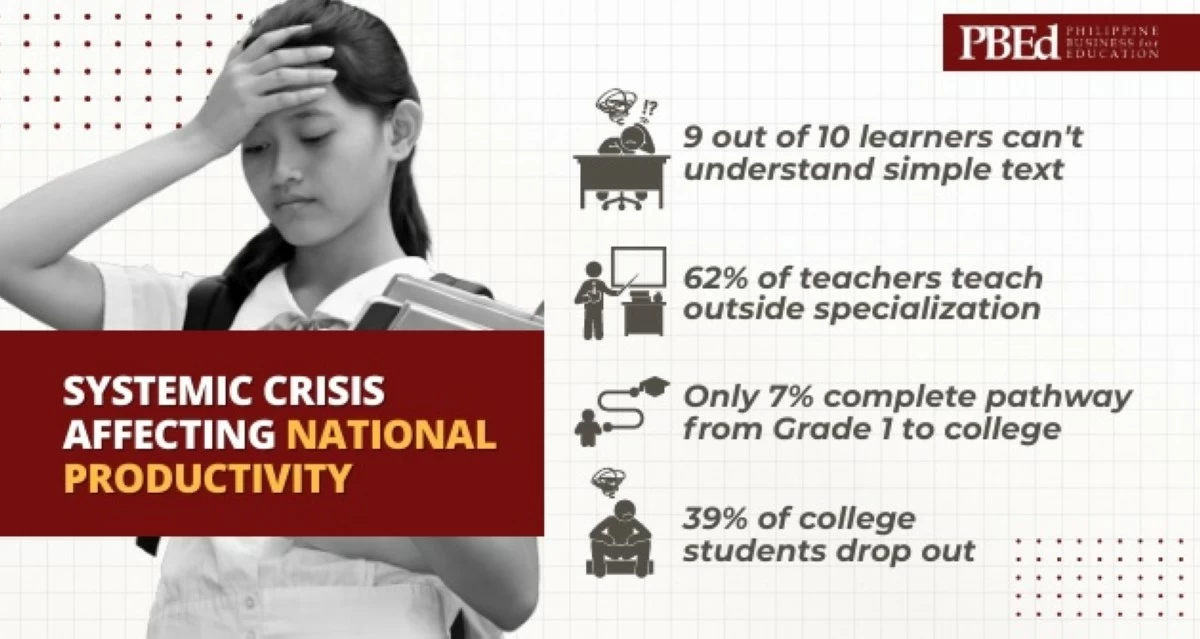
(Photo from PBEd)
Learners are racing against time, PBEd warned, highlighting alarming statistics: nine out of ten students cannot comprehend simple text; 62 percent of teachers are assigned outside their subject specialization; only seven percent of students complete the education pathway from Grade 1 to college; and 39 percent of college students drop out before graduating.
“Our learners can’t wait,” said Camua. “The next three years must be years of decisive, decentralized action—so that we can look back and say we used this crisis to turn the tide,” he added.
Challenges across the system
Despite major reforms over the past decade—including the introduction of the K to 12 program, the trifocalization of the education and training system, and the launch of the Second Congressional Commission on Education (EDCOM 2)—PBEd stressed that progress remains elusive.
The report cited overstretched government agencies, outdated learning materials, insufficient infrastructure, and inadequate teacher training as key contributors to the worsening learning crisis.
PBEd also noted that while graduates struggle to find jobs, industries face talent shortages—indicating a severe job-skills mismatch.
Turning crisis into opportunity
To address the root causes of the crisis, PBEd proposed a reform roadmap that prioritizes strengthening early childhood education and foundational skills; improving teacher recruitment, training, and support; modernizing curricula and assessment systems; increasing education budgets and ensuring efficient spending; and expanding inclusive and remedial learning programs.
PBEd strongly advocated decentralization as a core strategy, arguing that empowering local government units (LGUs) and schools can lead to faster, more responsive, and community-based solutions.
“Local leaders are better positioned to address early childhood nutrition, stunting, and learning needs,” PBEd said. “We need to shift decision-making closer to where learners are,” it added.
This includes granting greater autonomy to school principals, strengthening Local School Boards (LSBs), and involving industries in curriculum development to align training with local economic needs.
Governance through collaboration
PBEd emphasized that governance should be co-owned by both national and local actors, highlighting the importance of community participation in making schools more accountable and resilient.
“When parents, LGUs, school heads, and local industries are at the table, schools become more efficient and effective,” the group said.
Decentralization, it noted, will also improve budget utilization, allowing schools to allocate funds directly for textbooks, repairs, and localized learning interventions.
A call for courageous leadership
Salazar echoed the urgency, calling out long-standing failures in the system that continue to rob generations of Filipino children of a better future.
“It’s not right that 20 percent of children aged 0 to 5 are stunted and go to school hungry. It’s not right that 90 percent of 10-year-olds in Grade 4 cannot read a simple sentence,” Salazar said in a mix of English and Filipino.

(Photo from PBEd)
“It’s not right that after 12 years of schooling, students are still unprepared for college or work. It’s not right that even after finishing college, many still struggle to find a job. It’s not right that our industries can’t find employees with the right skills,” he added.
Salazar stressed that human resources—more than infrastructure like roads and airports—are the country’s most critical asset. “More important than any other hard resource is our people, and that is where our priority should lie,” he added.
A shared responsibility
PBEd leaders underscored that lasting change can only happen through collective action.
“Our leaders should be brave enough to make decisions that might not be politically appealing but are important and vital to the future of our youth,” Salazar said.
He also stressed the need for all stakeholders to come together and find lasting solutions to the education crisis in the country.
“This is something we should all be part of,” Salazar said. “We must make education everyone’s business. Let’s not waste this opportunity to make a real difference in the lives of our youth,” he added.
As the Philippines stands at a pivotal moment, PBEd urged leaders to make bold decisions that may not be politically convenient but are essential for long-term national progress.
“Never let a good crisis go to waste,” Camua reminded, noting that this is not a moment to despair, but to act.
“The crisis has provided the impetus, and our collective will is turning it into a catalyst for genuine transformation,” he said.
“With unwavering urgency and shared purpose, let us ensure this critical moment becomes the turning point for Philippine education—building a brighter, more educated future for every Filipino,” he added.