ADVERTISEMENT

Philippine waters stayed hot for 3 months after El Niño ended — study

Published Jul 4, 2025 02:05 pm
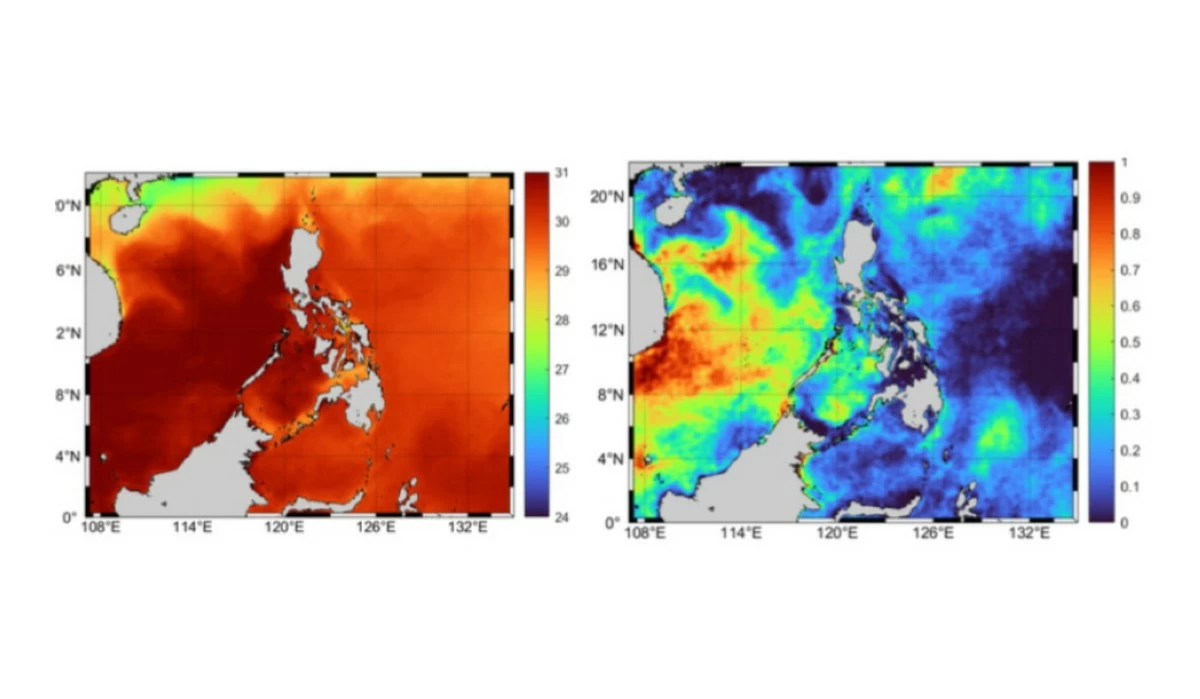
RECORD-BREAKING HEAT—Sea surface temperatures (left) and marine heatwave anomaly (right) around the Philippines in May 2024, at the tail end of the El Niño event. The bar graphs show sea surface temperature values (in °C) and the severity of marine heatwave anomalies (in °C), respectively. (Figures courtesy of Rachel Francisco)
Sea surface temperatures in the Philippines remained elevated for up to three months after the 2023–2024 El Niño officially ended in May 2024, a new scientific study discovered.
A team from the University of the Philippines Marine Science Institute (UP-MSI) found that “these elevated SSTs persisted for 3 months even after the official end of the El Niño in May 2024, especially through June to August 2024.”
The study, Evolution of Marine Heatwave in the Philippines During and After the 2023/24 El Niño, was published in the journal IOP Conference Series: Earth and Environmental Science.
The research was led by Rachel Francisco, Dr. Charina Lyn Amedo-Repollo, and Chloie Ann Libatog of the Physical Oceanography and Observation Laboratory, in collaboration with Dr. Maria Vanessa Baria-Rodriguez of the Interactions of Marine Bionts and Benthic Ecosystems Laboratory.
The researchers noted that the 2023–2024 El Niño “resulted in record-high sea surface temperatures (SST) in the Philippines, with daily SST peaking at 30.45°C in June 2024.”
Per the study, “these temperatures surpassed previous El Niño events, including the 2015–2016 El Niño.”
2 heatwave phases
The team said they used data from the Global OSTIA NRT dataset “to examine the spatiotemporal evolution of sea surface temperatures from March 2023 to August 2024.” From this, they identified “two groups of marine heatwaves.”
The first group occurred from November 2023 to January 2024 in the northwest Philippines.
“Although cooler waters are normally expected from the cold winds brought by the northeast monsoon (amihan), these were not enough to overcome the heat of El Niño,” the researchers stated.
The second, more intense group occurred from April to August 2024 in both the northwest and northeast Philippines.
“As El Niño was ending, warm winds brought by the southwest monsoon (habagat) intensified the heat. This led to prolonged marine heatwaves in the Philippines that persisted even after the El Niño event was over,” they noted.
“In both groups, the marine heatwaves first appeared in the north and progressed southward over time.”
The researchers underscored that “with marine ecosystems already under stress, understanding how these extreme events evolve in a warming world is crucial.”
ADVERTISEMENT
.most-popular .layout-ratio{ padding-bottom: 79.13%; } @media (min-width: 768px) and (max-width: 1024px) { .widget-title { font-size: 15px !important; } }

{{ articles_filter_1561_widget.title }}

.most-popular .layout-ratio{ padding-bottom: 79.13%; } @media (min-width: 768px) and (max-width: 1024px) { .widget-title { font-size: 15px !important; } }

{{ articles_filter_1562_widget.title }}

.most-popular .layout-ratio{ padding-bottom: 79.13%; } @media (min-width: 768px) and (max-width: 1024px) { .widget-title { font-size: 15px !important; } }

{{ articles_filter_1563_widget.title }}

{{ articles_filter_1564_widget.title }}

.mb-article-details { position: relative; } .mb-article-details .article-body-preview, .mb-article-details .article-body-summary{ font-size: 17px; line-height: 30px; font-family: "Libre Caslon Text", serif; color: #000; } .mb-article-details .article-body-preview iframe , .mb-article-details .article-body-summary iframe{ width: 100%; margin: auto; } .read-more-background { background: linear-gradient(180deg, color(display-p3 1.000 1.000 1.000 / 0) 13.75%, color(display-p3 1.000 1.000 1.000 / 0.8) 30.79%, color(display-p3 1.000 1.000 1.000) 72.5%); position: absolute; height: 200px; width: 100%; bottom: 0; display: flex; justify-content: center; align-items: center; padding: 0; } .read-more-background a{ color: #000; } .read-more-btn { padding: 17px 45px; font-family: Inter; font-weight: 700; font-size: 18px; line-height: 16px; text-align: center; vertical-align: middle; border: 1px solid black; background-color: white; } .hidden { display: none; }
function initializeAllSwipers() { // Get all hidden inputs with cms_article_id document.querySelectorAll('[id^="cms_article_id_"]').forEach(function (input) { const cmsArticleId = input.value; const articleSelector = '#article-' + cmsArticleId + ' .body_images'; const swiperElement = document.querySelector(articleSelector); if (swiperElement && !swiperElement.classList.contains('swiper-initialized')) { new Swiper(articleSelector, { loop: true, pagination: false, navigation: { nextEl: '#article-' + cmsArticleId + ' .swiper-button-next', prevEl: '#article-' + cmsArticleId + ' .swiper-button-prev', }, }); } }); } setTimeout(initializeAllSwipers, 3000); const intersectionObserver = new IntersectionObserver( (entries) => { entries.forEach((entry) => { if (entry.isIntersecting) { const newUrl = entry.target.getAttribute("data-url"); if (newUrl) { history.pushState(null, null, newUrl); let article = entry.target; // Extract metadata const author = article.querySelector('.author-section').textContent.replace('By', '').trim(); const section = article.querySelector('.section-info ').textContent.replace(' ', ' '); const title = article.querySelector('.article-title h1').textContent; // Parse URL for Chartbeat path format const parsedUrl = new URL(newUrl, window.location.origin); const cleanUrl = parsedUrl.host + parsedUrl.pathname; // Update Chartbeat configuration if (typeof window._sf_async_config !== 'undefined') { window._sf_async_config.path = cleanUrl; window._sf_async_config.sections = section; window._sf_async_config.authors = author; } // Track virtual page view with Chartbeat if (typeof pSUPERFLY !== 'undefined' && typeof pSUPERFLY.virtualPage === 'function') { try { pSUPERFLY.virtualPage({ path: cleanUrl, title: title, sections: section, authors: author }); } catch (error) { console.error('ping error', error); } } // Optional: Update document title if (title && title !== document.title) { document.title = title; } } } }); }, { threshold: 0.1 } ); function showArticleBody(button) { const article = button.closest("article"); const summary = article.querySelector(".article-body-summary"); const body = article.querySelector(".article-body-preview"); const readMoreSection = article.querySelector(".read-more-background"); // Hide summary and read-more section summary.style.display = "none"; readMoreSection.style.display = "none"; // Show the full article body body.classList.remove("hidden"); } document.addEventListener("DOMContentLoaded", () => { let loadCount = 0; // Track how many times articles are loaded const offset = [1, 2, 3, 4, 5, 6, 7, 8, 9, 10]; // Offset values const currentUrl = window.location.pathname.substring(1); let isLoading = false; // Prevent multiple calls if (!currentUrl) { console.log("Current URL is invalid."); return; } const sentinel = document.getElementById("load-more-sentinel"); if (!sentinel) { console.log("Sentinel element not found."); return; } function isSentinelVisible() { const rect = sentinel.getBoundingClientRect(); return ( rect.top < window.innerHeight && rect.bottom >= 0 ); } function onScroll() { if (isLoading) return; if (isSentinelVisible()) { if (loadCount >= offset.length) { console.log("Maximum load attempts reached."); window.removeEventListener("scroll", onScroll); return; } isLoading = true; const currentOffset = offset[loadCount]; window.loadMoreItems().then(() => { let article = document.querySelector('#widget_1690 > div:nth-last-of-type(2) article'); intersectionObserver.observe(article) loadCount++; }).catch(error => { console.error("Error loading more items:", error); }).finally(() => { isLoading = false; }); } } window.addEventListener("scroll", onScroll); });

Sign up by email to receive news.