ADVERTISEMENT

'Conquering the skies': PH Army inaugurates helicopter flight simulator

Published Jul 4, 2025 11:23 am
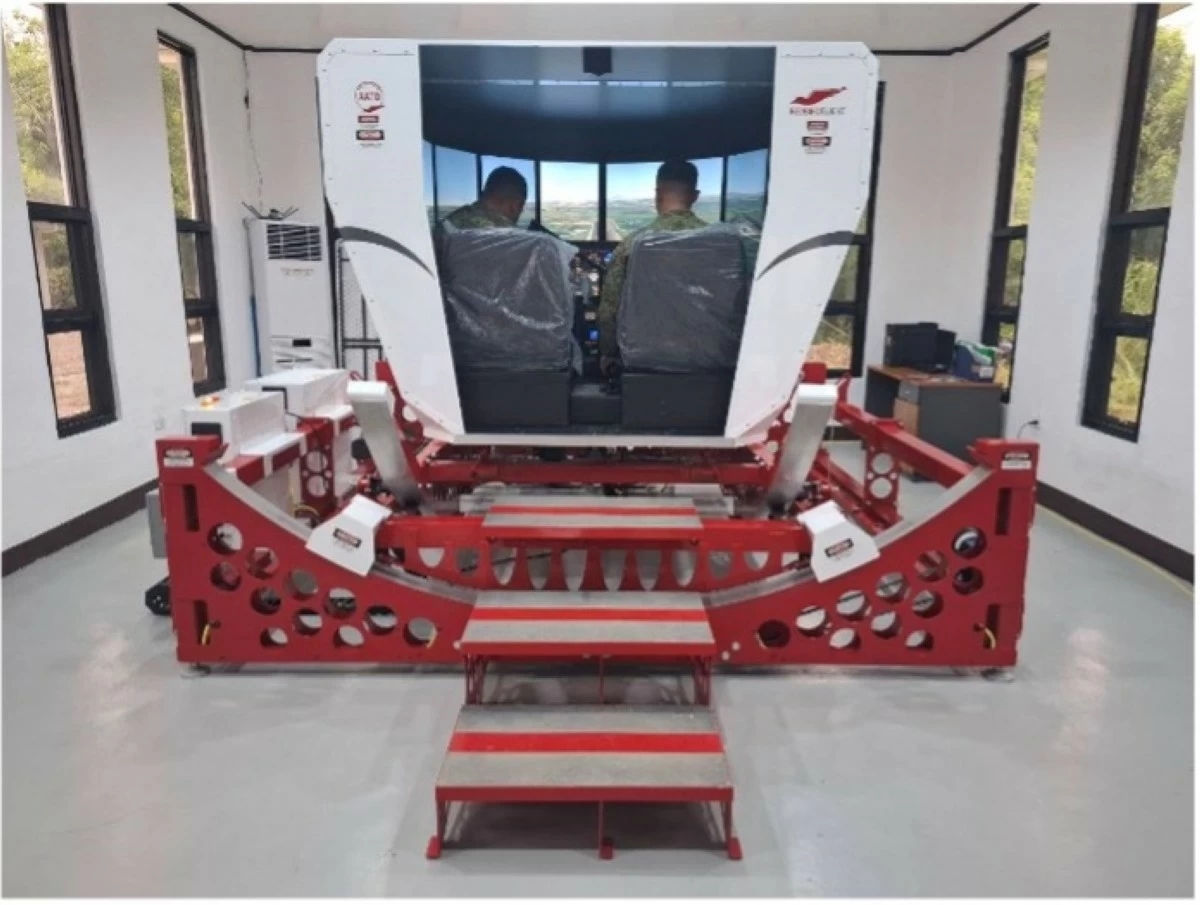
Philippine Army aviators test the newly-launched Redbird VTO helicopter simulator of the Army Aviation Regiment in Fort Magsaysay, Palayan, Nueva Ecija on July 3, 2025. (Photo: Army Aviation Regiment)
There is no stopping the Philippine Army (PA) from conquering the skies as it unveiled its newest capability, a helicopter flight simulator, intended to boost the flight training of its aviators.
In a statement Friday, July 4, the Army Aviation Regiment said the newly-acquired rotary wing flight simulator is a Redbird VTO, which is an advanced full-motion and cost-effective training device designed to simulate flying the Robinson R44 helicopter for utility work, private transport, and training.
Lieutenant General Roy M. Galido, PA commanding general, visited the flight simulation facility of the Army Aviation Regiment in Fort Ramon Magsaysay, Palayan City, Nueva Ecija to personally test it.
“The simulator moves along arc-shaped tracks that provides the feeling of being suspended from the rotor head. The simulator’s visual system provides an expansive field-of-view, including over 200° of wrap-around visuals and an impressive vertical view of 70°,” the Aviation Regiment said.
“This huge vertical field-of-view will allow Army helicopter pilots to see everything from the skids to the sky,” it added.
Galido had approved the acquisition of the simulator to provide Army aviators a better training platform that will hone their skills in flying safely the piston-engined R44 helicopters in a controlled and safe training environment.
The acquisition of the simulator was part of the Army Aviation Capability Development Program.
According to the Army Aviation Regiment, the Redbird VTO procured by the Army is the first helicopter simulator of its kind to be acquired not only in the Armed Forces of the Philippines (AFP) but in the Philippines as well.
The simulator was manufactured by Redbird Flight Simulations, Inc. based in Texas, United States.
From protecting the country’s land, the Army has since expanded its capabilities and is now able to conduct aerial patrols as part of the Land Defense Concept, a core component of the Comprehensive Archipelagic Defense Concept (CADC) which aims to protect the Philippines as a multi-island nation.
The ability to conduct airspace patrols allows the Army to quickly respond to urgent missions across the country without needing to depend on the Philippine Navy or Philippine Air Force for transport.

Related Tags

Philippine Army Army Aviation Regiment helicopter simulator
ADVERTISEMENT
.most-popular .layout-ratio{ padding-bottom: 79.13%; } @media (min-width: 768px) and (max-width: 1024px) { .widget-title { font-size: 15px !important; } }

{{ articles_filter_1561_widget.title }}

.most-popular .layout-ratio{ padding-bottom: 79.13%; } @media (min-width: 768px) and (max-width: 1024px) { .widget-title { font-size: 15px !important; } }

{{ articles_filter_1562_widget.title }}

.most-popular .layout-ratio{ padding-bottom: 79.13%; } @media (min-width: 768px) and (max-width: 1024px) { .widget-title { font-size: 15px !important; } }

{{ articles_filter_1563_widget.title }}

{{ articles_filter_1564_widget.title }}

.mb-article-details { position: relative; } .mb-article-details .article-body-preview, .mb-article-details .article-body-summary{ font-size: 17px; line-height: 30px; font-family: "Libre Caslon Text", serif; color: #000; } .mb-article-details .article-body-preview iframe , .mb-article-details .article-body-summary iframe{ width: 100%; margin: auto; } .read-more-background { background: linear-gradient(180deg, color(display-p3 1.000 1.000 1.000 / 0) 13.75%, color(display-p3 1.000 1.000 1.000 / 0.8) 30.79%, color(display-p3 1.000 1.000 1.000) 72.5%); position: absolute; height: 200px; width: 100%; bottom: 0; display: flex; justify-content: center; align-items: center; padding: 0; } .read-more-background a{ color: #000; } .read-more-btn { padding: 17px 45px; font-family: Inter; font-weight: 700; font-size: 18px; line-height: 16px; text-align: center; vertical-align: middle; border: 1px solid black; background-color: white; } .hidden { display: none; }
function initializeAllSwipers() { // Get all hidden inputs with cms_article_id document.querySelectorAll('[id^="cms_article_id_"]').forEach(function (input) { const cmsArticleId = input.value; const articleSelector = '#article-' + cmsArticleId + ' .body_images'; const swiperElement = document.querySelector(articleSelector); if (swiperElement && !swiperElement.classList.contains('swiper-initialized')) { new Swiper(articleSelector, { loop: true, pagination: false, navigation: { nextEl: '#article-' + cmsArticleId + ' .swiper-button-next', prevEl: '#article-' + cmsArticleId + ' .swiper-button-prev', }, }); } }); } setTimeout(initializeAllSwipers, 3000); const intersectionObserver = new IntersectionObserver( (entries) => { entries.forEach((entry) => { if (entry.isIntersecting) { const newUrl = entry.target.getAttribute("data-url"); if (newUrl) { history.pushState(null, null, newUrl); let article = entry.target; // Extract metadata const author = article.querySelector('.author-section').textContent.replace('By', '').trim(); const section = article.querySelector('.section-info ').textContent.replace(' ', ' '); const title = article.querySelector('.article-title h1').textContent; // Parse URL for Chartbeat path format const parsedUrl = new URL(newUrl, window.location.origin); const cleanUrl = parsedUrl.host + parsedUrl.pathname; // Update Chartbeat configuration if (typeof window._sf_async_config !== 'undefined') { window._sf_async_config.path = cleanUrl; window._sf_async_config.sections = section; window._sf_async_config.authors = author; } // Track virtual page view with Chartbeat if (typeof pSUPERFLY !== 'undefined' && typeof pSUPERFLY.virtualPage === 'function') { try { pSUPERFLY.virtualPage({ path: cleanUrl, title: title, sections: section, authors: author }); } catch (error) { console.error('ping error', error); } } // Optional: Update document title if (title && title !== document.title) { document.title = title; } } } }); }, { threshold: 0.1 } ); function showArticleBody(button) { const article = button.closest("article"); const summary = article.querySelector(".article-body-summary"); const body = article.querySelector(".article-body-preview"); const readMoreSection = article.querySelector(".read-more-background"); // Hide summary and read-more section summary.style.display = "none"; readMoreSection.style.display = "none"; // Show the full article body body.classList.remove("hidden"); } document.addEventListener("DOMContentLoaded", () => { let loadCount = 0; // Track how many times articles are loaded const offset = [1, 2, 3, 4, 5, 6, 7, 8, 9, 10]; // Offset values const currentUrl = window.location.pathname.substring(1); let isLoading = false; // Prevent multiple calls if (!currentUrl) { console.log("Current URL is invalid."); return; } const sentinel = document.getElementById("load-more-sentinel"); if (!sentinel) { console.log("Sentinel element not found."); return; } function isSentinelVisible() { const rect = sentinel.getBoundingClientRect(); return ( rect.top < window.innerHeight && rect.bottom >= 0 ); } function onScroll() { if (isLoading) return; if (isSentinelVisible()) { if (loadCount >= offset.length) { console.log("Maximum load attempts reached."); window.removeEventListener("scroll", onScroll); return; } isLoading = true; const currentOffset = offset[loadCount]; window.loadMoreItems().then(() => { let article = document.querySelector('#widget_1690 > div:nth-last-of-type(2) article'); intersectionObserver.observe(article) loadCount++; }).catch(error => { console.error("Error loading more items:", error); }).finally(() => { isLoading = false; }); } } window.addEventListener("scroll", onScroll); });

Sign up by email to receive news.