






The European Union Election Observation Mission (EU-EOM) has recommended a “comprehensive review” and possible reforms on the Philippines’ electoral legal framework in hopes of addressing the gaps in the conduct of elections in the country following the 2025 midterm polls.
Manila Bulletin
 Philippines
National
In final report, EU observers recommend 21 election reforms in PH
Philippines
National
In final report, EU observers recommend 21 election reforms in PH
Philippines
National
In final report, EU observers recommend 21 election reforms in PH
In final report, EU observers recommend 21 election reforms in PH
Published Jul 3, 2025 02:27 pm


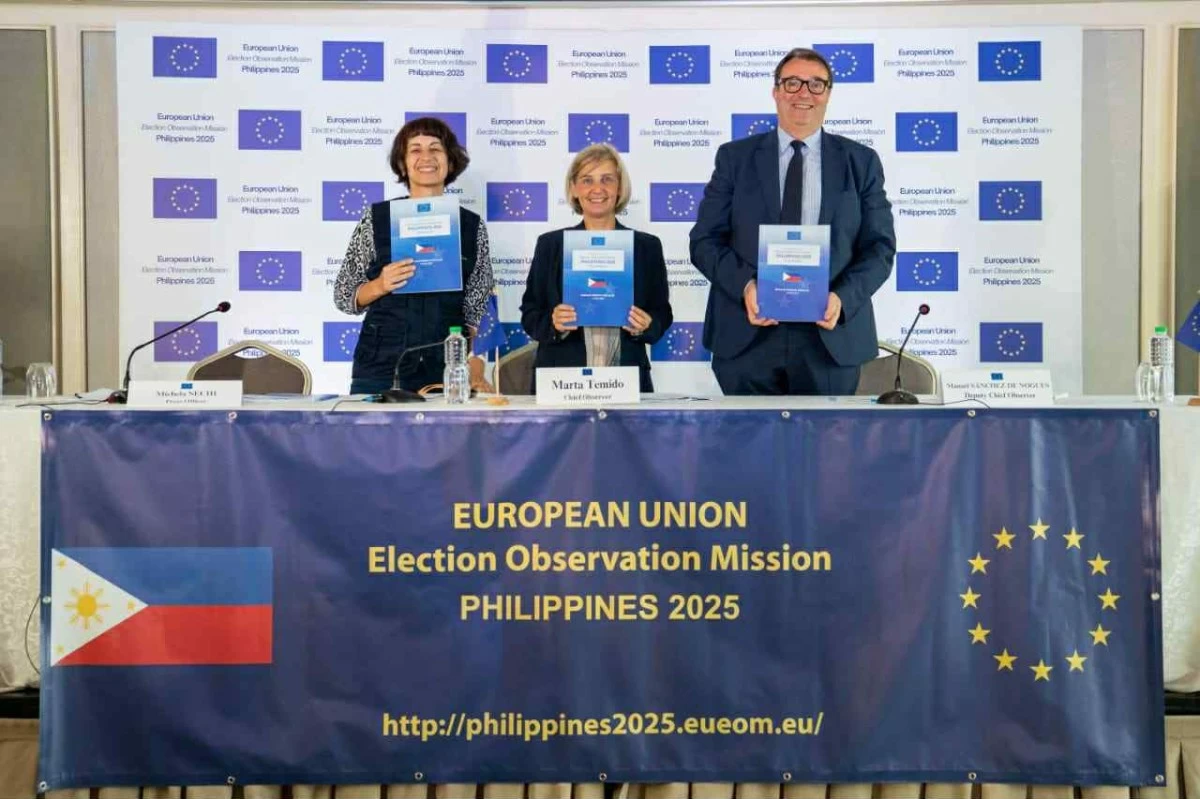
EU-EOM Chief Observer Marta Temido (center) and Deputy Chief Observer Manuel Sanchez de Nogues (right) present the mission's final report that contains the 21 items of recommendations to reform the conduct of elections in the Philippines. Also in the photo is Press Officer Michela Sechi. (Photo from EU-EOM)
During a press conference held in Makati City on Thursday, July 3, Chief Observer Marta Temido presented the mission’s final report and 21 items of recommendations—ranging from the need for a comprehensive review and reform of the electoral legal framework to addressing disinformation and the artificial boosting of social media followers by candidates.
“Regarding coming to the recommendations and the legal framework, in a general way, we say, we observed and we recommend that the legal framework should be recordified and the text of the electoral code consolidated and harmonized with the existing election legislation so that discrepancies and inconsistencies are removed,” she said.
“And after that first recommendation, several other recommendations are related to the need of legal framework reforms,” she added.
'Outdated' electoral code
In the 106-page final report published on the Delegation of the European Union to the Philippines’ website, the mission called out the “outdated” 1985 Omnibus Election Code (OEC) that has been superseded by the 1987 Philippine Constitution and subsequent laws and regulations.
Nearly half of the provisions of the OEC are already outdated, the report pointed out.
“Loopholes and inconsistencies in the long-outdated electoral code allowed COMELEC and the judiciary to retain broad discretion in interpreting and applying electoral rules,” the mission lamented.
“The text of the election code has not been updated, and articles that are no longer applicable have not been repealed but remain in place, making it difficult to determine which provisions are still in force and which have been rendered inoperative by more recent legal acts. In the absence of consolidated legislation, COMELEC and the judiciary retain broad discretion in interpreting and applying electoral rules, significantly shaping the legal framework,” the report read.
It cited issues and concerns raised by legislations, such as the Anti-Terrorism Act of 2020, the >font-family: Gilroy; display: inline !important;>Revised Penal Code, the 2012 Cybercrime Prevention Act, and the Terrorism Financing Prevention Act of 2012.
“These shortcomings call for reforms and for a comprehensive review of the electoral legal framework, which have also been advocated by many Filipino politicians, candidates, officials, journalists and members of the civil society,” Temido said.
21 recommendations
While the EU-EOM has 21 recommendations, it identified seven priority recommendations for Philippines officials and stakeholders to consider.
Aside from reforming the electoral legal framework, the mission also calls to “remove blanket restrictions on the right to active and passive suffrage for convicted imprisoned citizens, including the five year suspension after a sentence is served; the right of access to polling precincts should be made explicit for all duly accredited national and international election observers, not just those from citizen arms organizations; and decisions on the rejection of the registration of candidates should be based on objective criteria and should be spelled out in the legal framework.”
In addition, the mission also recommended that “Criminal defamation provisions, including for online activities, should be repealed in favour of civil sanctions designed to restore the reputation harmed; temporary special measures could be introduced to achieve gender parity in elected and appointed positions; and the election administration should provide adequate means of voting in secret in terms of polling layout and booths, as well as train electoral boards and focus voter education on the importance of a secret vote.”
They also pointed out that although “freedom of press was respected during the campaign,” long-standing challenges, such as attacks and intimidation against journalists, economic vulnerability, and a prevailing culture of impunity, remain.
The mission likewise raised concerns on how some candidates boosted their campaigns by artificially increasing the number of their followers on social media.
“This is not illegal but can mislead potential voters, undermining their ability to make informed choices,” Temido.
EU-EOM Deputy Chief Observer Manuel Sanchez de Nogues also laid out the mission’s recommendation on countering disinformation during the election period.
Citing the final report, he said that there must be “a sustainable support system for independent media and investigative journalists and fact-checking should be further strengthened and maintained alongside continued expansion of media and digital literacy programs for all sectors of society.”
‘Unprecedented turnout’
Temido also hailed Filipino voters for the “unprecedented” turnout for the midterm election, saying that it “showed a strong commitment to democratic values, despite persistent challenges that included electoral violence, vote-buying, concentration of political power among a few families and a legal framework marked by significant gaps and ambiguities.”
With the final report now available for public consumption, she encouraged Filipinos to download and read the statements, reports, and missions.
“We offer these recommendations in a spirit of partnership. A partnership which has a long history between the European Union and the Philippines,” she said.
“Ultimately, it's up to you, the Filipino citizens, your elected lawmakers, the electoral administration and civil society to determine which recommendations, which reforms will best serve the country,” she added.
While Temido expressed hope that all of the mission’s recommendations will be implemented, she said that “the final decision rests with the sovereign will of the country and its people.”
The mission is scheduled for bilateral discussions and roundtable with its main Filipino interlocutors to hear their feedback on the recommendations.
“The mission leaves, but the EU delegation stays in the Philippines, ready to support the reforms if needed. So, let me thank the Comelec and the Philippine authorities for inviting our mission. And let me thank the Filipino people for the warm welcome we received,” she stated.
The mission, composed of 226 observers from EU member-states, Canada, Norway and Switzerland, to observe the electoral process—from the campaign period to the final counting of votes—was conducted from March 28 to June 2.