






The statement from the Quad Foreign Ministers that raised concerns about the “dangerous and provocative actions” in the South China Sea shows the international community’s “strong objection” against such actions and underscores the need to adhere to international laws, the Department of Foreign Affairs (DFA) said on Thursday, July 3.
Manila Bulletin
 Philippines
National
DFA: Quad ministers' statement shows 'strong objection' against aggression in WPS
Philippines
National
DFA: Quad ministers' statement shows 'strong objection' against aggression in WPS
Philippines
National
DFA: Quad ministers' statement shows 'strong objection' against aggression in WPS
DFA: Quad ministers' statement shows 'strong objection' against aggression in WPS
Published Jul 3, 2025 02:59 pm


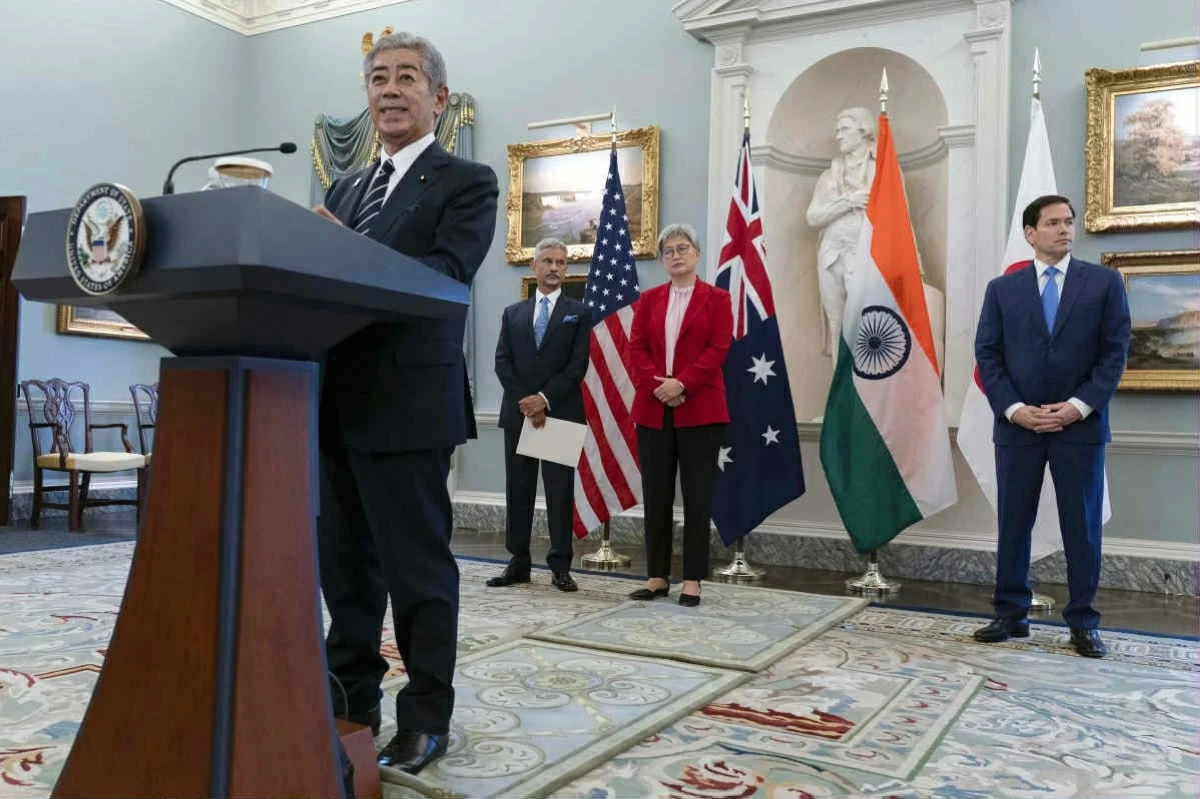
Japanese Foreign Minister Iwaya Takeshi, flanked by (from left) Indian External Affairs Minister Subrahmanyam Jaishankar, Australian Foreign Minister Penny Wong, and US Secretary of State Marco Rubio, speaks to the media before the Indo-Pacific Quad meeting at the State Department in Washington D.C. on Tuesday, July 1, 2025. (AP Photo/Jose Luis Magana)
In a statement, the DFA welcomed the Joint Statement of the Quad Foreign Ministers, which is composed of the United States, Australia, India, and Japan that strongly opposed any unilateral actions that seek to change the status quo in the East China Sea and South China Sea.
Though the joint statement, as well as that of the DFA, did not mention China, the Philippines has raised diplomatic protests against Beijing’s aggressive actions in the resource-rich region and has repeatedly urged for adherence to the United Nations Convention on the Law of the Sea (UNCLOS) and the 2016 Arbitral Tribunal award that was also mentioned by the Quad Foreign Ministers.
“By highlighting the continuing dangerous and provocative actions, and the use of force and coercion in the South China Sea, the Quad Foreign Ministers has kept focus on the incidents that the Philippines has regularly contended with in the West Philippine Sea,” the DFA said.
“Their statement demonstrates the strong objection by the international community against such illegal, coercive, aggressive and deceptive actions in the West Philippine Sea and the South China Sea,” it added.
The DFA also expressed appreciation for the Foreign Ministers’ “unequivocal support for the final and valid 2016 South China Sea Arbitral Award, further cementing its status as an unassailable part of the corpus of international law.”
The award, it stated, “has served as a shining affirmation of the dispute settlement mechanism under UNCLOS,” and was cited by the International Tribunal for the Law of the Sea (ITLOS) and the International Court of Justice (ICJ) in their respective legal issuances.
The Arbitral Award, handed to the Philippines in 2016, invalidated the basis of China’s nine-dash line claim and had been rejected by the Asian economic powerhouse repeatedly.
In its joint statement, the Quad Foreign Ministers also condemned “the unsafe use of water cannons and ramming or blocking actions in the South China Sea” because “these actions threaten peace and stability in the region.”
“We are seriously concerned by the militarization of disputed features. We emphasize the importance of upholding freedom of navigation and overflight, other lawful uses of the sea, and unimpeded commerce consistent with international law,” the ministers said.
Furthermore, the DFA also welcomed the Quad’s commitment to capacitate the Indo-Pacific region by coordinating on maritime and transnational security, economic prosperity and security, critical and emerging technology, and support for humanitarian assistance and emergency response.
It also stressed that the Philippines “will continue to uphold the rules-based order governed by international law, particularly UNCLOS, and will continue to prioritize effective diplomacy and the constructive management of differences in addressing the situation at sea” in its aim to maintain regional peace and stability in the South China Sea and in the wider Indo-Pacific region.