






Manila Bulletin
 Philippines
National
Lithuania open to help PH capacity-building in cybersecurity, defense
Philippines
National
Lithuania open to help PH capacity-building in cybersecurity, defense
Philippines
National
Lithuania open to help PH capacity-building in cybersecurity, defense
Lithuania open to help PH capacity-building in cybersecurity, defense
Published Jul 2, 2025 05:12 pm


Stressing the importance for smaller states to work together in facing the “global challenges” posed by China’s and Russia’s power, Lithuanian Defense Minister Dovilė Šakalienė on Wednesday, July 2, opened up about the possibility of exchanging notes and sharing information with the Philippines on critical issues, such as cybersecurity and defense.
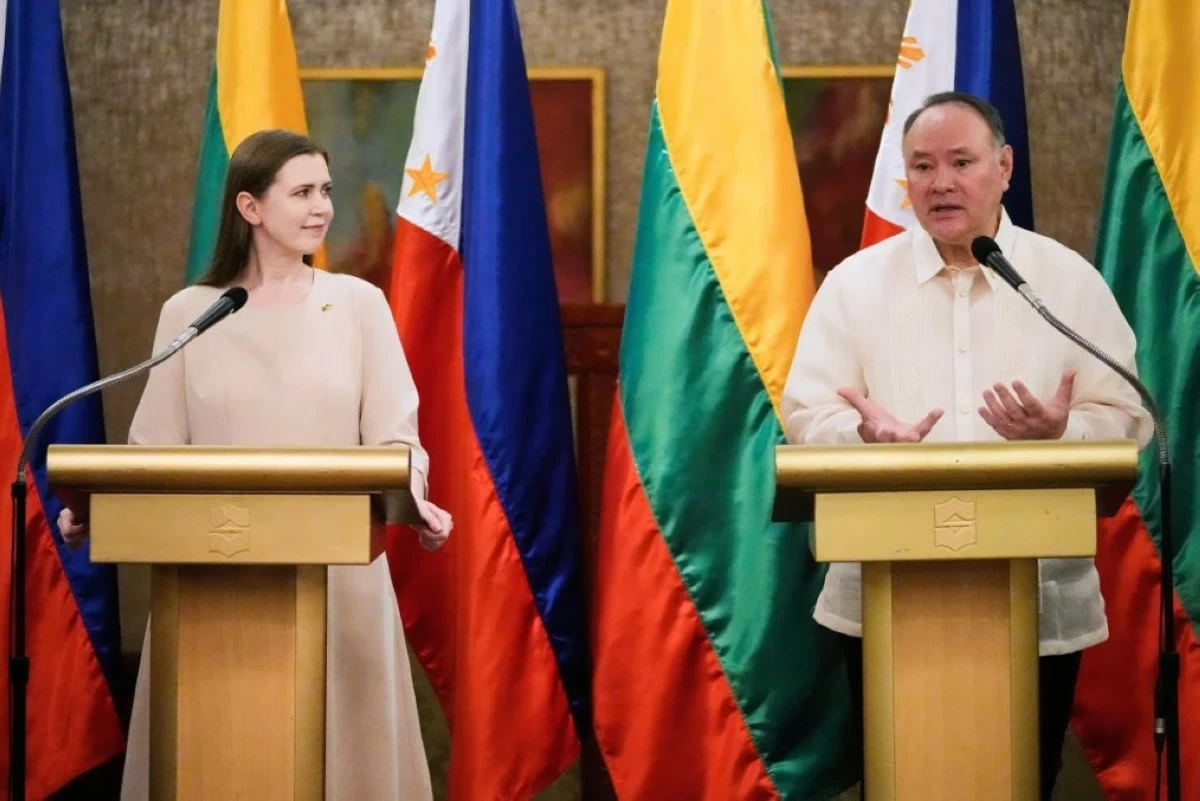
Philippine Defense Secretary Gilberto Teodoro Jr. (right) and Lithuanian Minister for Defense Dovilė Šakalienė talk during a press conference at a Makati hotel on Monday, June 30, 2025. (AP Photo/Aaron Favila)
Speaking to select members of the Philippine media in Makati City, the defense minister underscored the importance of building “a tightly interconnected network of all the democratic countries” to strengthen defense capabilities and skills, as what the Philippines had been doing with its neighbors amid China’s relentless aggressive actions in the West Philippine Sea.
“I think that the position of your minister, that smaller states have to cooperate even closer, is really a great idea. Because in certain cases, building a sort of a tightly interconnected network of all the democratic countries that are undergoing the same global challenges in the sense that pressure by Russia and China is not specified to one region,” she said.
“So for us, to first of all, strengthen our defense capabilities together, seeing where we can share certain skills, competencies, technologies, train together, exercise together,” she added.
The official is also pushing for strengthened connections, adding that “sharing is caring” and highly valuable in the international arena.
Role of US, int’l community
Šakalienė admitted that the “current global security architecture for democratic states” is built upon their bond with the United States, which also needs the help of Europe and the Indo-Pacific region.
“So as I said, since we both really work with United States, it really makes sense to connect the bottom part of the triangle, to develop closer connection between us, understand better what is going on, hopefully share also classified information. So, we need what methods are applied against each of us so that we can develop better joint response,” she explained.
But as for entering into a formal alliance, the official said that getting North Atlantic Treaty Organization (NATO) and the Indo-Pacific Four (IP4) to work together “is already a very good format.”
“Do we need to have some formalized alliance? I think this is open for discussion . . . I'm happy to discuss several possibilities,” she added.
Cybersecurity
The defense minister shared that there is current cooperation between Lithuania and the Philippines on cybersecurity, with the Philippines becoming an observer last year during the Amber Mist 2024, which is being run by the Lithuanian Armed Forces to train cyberattack response, and invited this year as participant to the cyber security exercise.
“We are hoping that we will have five countries from the region in this exercise. So the Philippines, Japan, Korea, Australia, and Taiwan. And I think that is going to be very useful because we are going to share quite practical information because certain cyber attacks that we're facing are quite similar,” she said, noting that these “attacks are on the rise.”
She pointed to Russia and China for “piloting certain methods in one region and then applying in the other region.”
“And it's still not only ongoing, but aggravating,” she furthered, citing the rise of cyber incidents by 60 percent from 2023 to 2024.
The official further lamented the “informational incidents or specifically disinformation campaigns” that’s “very active in our country.”
“And from what we hear, Philippines with Chinese informational activity in the region and pressure, for example, with gaslighting about the incidents in the West Philippine Sea. So, you see also a lot of disinformation and propaganda.”