ADVERTISEMENT

Lithuania eyeing more Filipino workers in maritime, health sectors—minister

Published Jul 2, 2025 03:23 pm
The Lithuanian government is looking to hire more Filipino workers in the transportation, maritime, and health sectors, with Defense Minister Dovilė Šakalienė citing Filipino workers’ “wonderful reputation.”

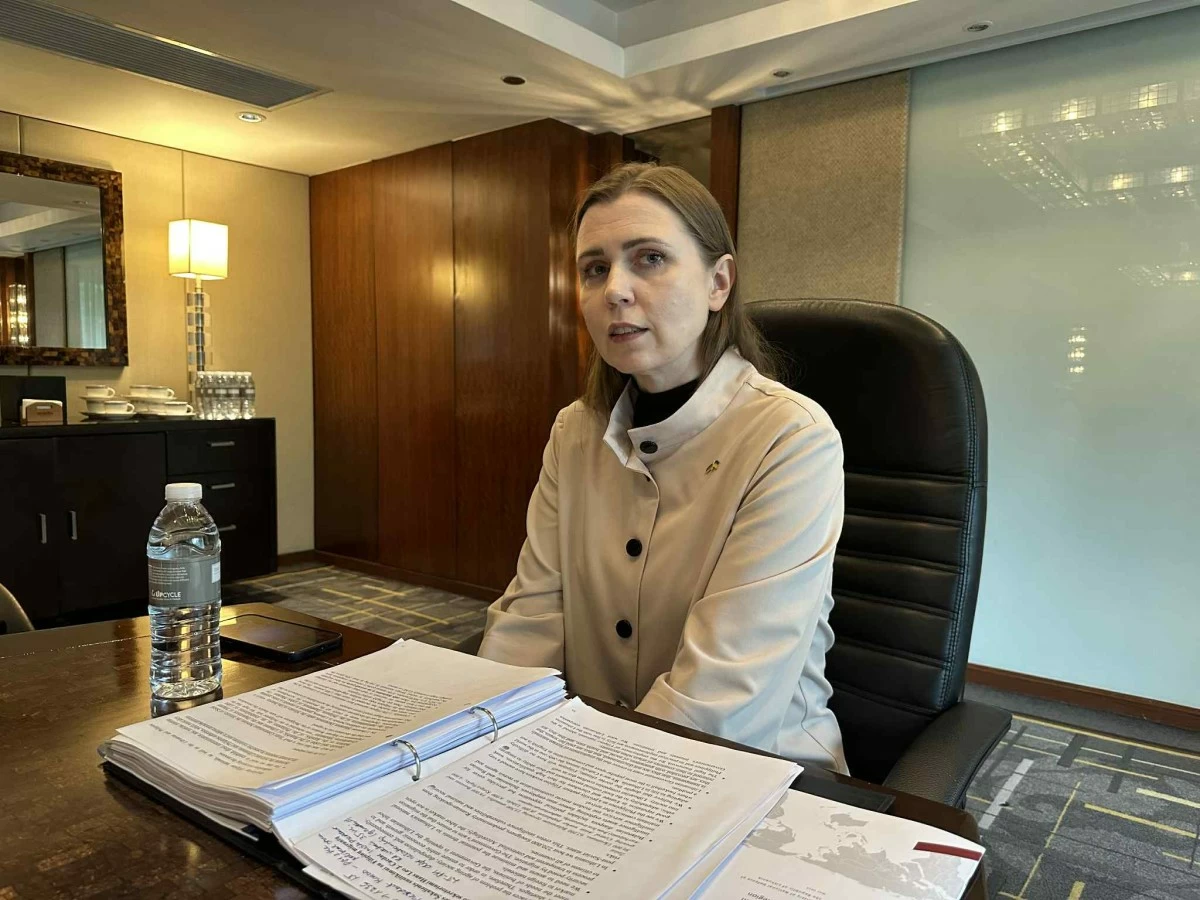
Defense Minister Dovilė Šakalienė of Lithuania in an interview with select members of Philippine media, including from the Manila Bulletin, on Wednesday, July 2, 2025. (Raymund Antonio/MB)
In an interview with select members of Philippine media in Makati City on Wednesday, July 2, the official underscored Lithuania’s need for Filipino workers, who she described as “skilled, competent, reliable.”

“We lack workforce in areas such as, for example, transportation, social care, medical care . . . Philippine society is Catholic, and people are overwhelmingly English-speaking, which is really important and very convenient for our society,” she said, adding that Lithuania is also a predominantly Catholic society.

Noting that Lithuania has over 50,000 to 60,000 migrant workers from Belarus in the transportation sector, Šakalienė said that “it could be great to have long-range, long-distance, English-speaking Filipino drivers.”

She also mentioned that Lithuania will embrace Filipino sailors and shipyard workers as this is an industry that Filipino workers are famous in.

“And in general, of course, as aging society, we have this need of social care, medical care workers. So from nurse assistants to nurses, to other professions that are related to that, that also would be something to very seriously discuss, because the need is there,” she added.

The defense minister, who earlier met with the Department of National Defense (DND) and the Department of Migrant Workers (DMW) to discuss relevant issues, shared that the country is currently “expanding our defense industry,” with the civil industry also a part of it.

“So therefore, having skilled citizens of Philippines that would be willing to work here, that would also be one area that I would be, as defense minister, looking forward to,” Šakalienė said.

The minister admitted that the “unprecedented number of Russian-speaking migrant workers” in Lithuania now “is a concern of national security for us, because of our vulnerability due to relations to Russia or Belarus, and unprecedented proactive action by special services of Russia and Belarus.”

“So, therefore, Catholic, non-radical, highly ethical, highly skilled, English-speaking Filipino workers seem like a very natural priority to us, and I am supportive of my colleagues who are already working regarding this issue,” she added.

The official shared that there is a “rise” on the interest of Filipinos in Lithuania as evident in the 1,200 Filipino nationals currently with residence permits in Lithuania.

Of that number, 1,000 arrived in the last two years.

“This is a very recent rise because this dynamic happened basically in the last two years,” the minister stated.

While she did not give an exact number of Filipino workers that she would like to see in Lithuania in the coming years, Šakalienė said that she hopes to switch the current “220,000 Russian speaking migrant workers from post-Soviet states to quite a large part of that number, I hope, could be from Philippines.”

Aside from religion and language, she highlighted that the Philippines and Lithuania share “a connection” on the societal level because family is the cornerstone of their societies.

“What I have also learned through the conversations that I had with my colleagues from Philippines and several informal conversations, family is the main value here in Philippines, just like in Lithuania, family is exceptionally important,” she furthered.

The details of the employment of Filipino workers in the Baltic state are currently being discussed by Lithuania’s Minister of Social Security and Labor and the DMW.

“And hopefully, it will be finalized soon. And hopefully, document can be signed also as soon as possible,” Šakalienė said, adding that Lithuania’s migration department under the Minister of Interior is now in contact with the DMW “and also working on how to move forward.”

The invitation for the Filipino workforce to consider Lithuania will also be a part of the discussion when its Prime Minister visits the Philippines, which the defense minister said she hopes would happen by the end of this year.

Related Tags

Filipino workers Lithuania DMW Dovile Sakaliene health sector maritime industry
ADVERTISEMENT
.most-popular .layout-ratio{ padding-bottom: 79.13%; } @media (min-width: 768px) and (max-width: 1024px) { .widget-title { font-size: 15px !important; } }

{{ articles_filter_1561_widget.title }}

.most-popular .layout-ratio{ padding-bottom: 79.13%; } @media (min-width: 768px) and (max-width: 1024px) { .widget-title { font-size: 15px !important; } }

{{ articles_filter_1562_widget.title }}

.most-popular .layout-ratio{ padding-bottom: 79.13%; } @media (min-width: 768px) and (max-width: 1024px) { .widget-title { font-size: 15px !important; } }

{{ articles_filter_1563_widget.title }}

{{ articles_filter_1564_widget.title }}

.mb-article-details { position: relative; } .mb-article-details .article-body-preview, .mb-article-details .article-body-summary{ font-size: 17px; line-height: 30px; font-family: "Libre Caslon Text", serif; color: #000; } .mb-article-details .article-body-preview iframe , .mb-article-details .article-body-summary iframe{ width: 100%; margin: auto; } .read-more-background { background: linear-gradient(180deg, color(display-p3 1.000 1.000 1.000 / 0) 13.75%, color(display-p3 1.000 1.000 1.000 / 0.8) 30.79%, color(display-p3 1.000 1.000 1.000) 72.5%); position: absolute; height: 200px; width: 100%; bottom: 0; display: flex; justify-content: center; align-items: center; padding: 0; } .read-more-background a{ color: #000; } .read-more-btn { padding: 17px 45px; font-family: Inter; font-weight: 700; font-size: 18px; line-height: 16px; text-align: center; vertical-align: middle; border: 1px solid black; background-color: white; } .hidden { display: none; }
function initializeAllSwipers() { // Get all hidden inputs with cms_article_id document.querySelectorAll('[id^="cms_article_id_"]').forEach(function (input) { const cmsArticleId = input.value; const articleSelector = '#article-' + cmsArticleId + ' .body_images'; const swiperElement = document.querySelector(articleSelector); if (swiperElement && !swiperElement.classList.contains('swiper-initialized')) { new Swiper(articleSelector, { loop: true, pagination: false, navigation: { nextEl: '#article-' + cmsArticleId + ' .swiper-button-next', prevEl: '#article-' + cmsArticleId + ' .swiper-button-prev', }, }); } }); } setTimeout(initializeAllSwipers, 3000); const intersectionObserver = new IntersectionObserver( (entries) => { entries.forEach((entry) => { if (entry.isIntersecting) { const newUrl = entry.target.getAttribute("data-url"); if (newUrl) { history.pushState(null, null, newUrl); let article = entry.target; // Extract metadata const author = article.querySelector('.author-section').textContent.replace('By', '').trim(); const section = article.querySelector('.section-info ').textContent.replace(' ', ' '); const title = article.querySelector('.article-title h1').textContent; // Parse URL for Chartbeat path format const parsedUrl = new URL(newUrl, window.location.origin); const cleanUrl = parsedUrl.host + parsedUrl.pathname; // Update Chartbeat configuration if (typeof window._sf_async_config !== 'undefined') { window._sf_async_config.path = cleanUrl; window._sf_async_config.sections = section; window._sf_async_config.authors = author; } // Track virtual page view with Chartbeat if (typeof pSUPERFLY !== 'undefined' && typeof pSUPERFLY.virtualPage === 'function') { try { pSUPERFLY.virtualPage({ path: cleanUrl, title: title, sections: section, authors: author }); } catch (error) { console.error('ping error', error); } } // Optional: Update document title if (title && title !== document.title) { document.title = title; } } } }); }, { threshold: 0.1 } ); function showArticleBody(button) { const article = button.closest("article"); const summary = article.querySelector(".article-body-summary"); const body = article.querySelector(".article-body-preview"); const readMoreSection = article.querySelector(".read-more-background"); // Hide summary and read-more section summary.style.display = "none"; readMoreSection.style.display = "none"; // Show the full article body body.classList.remove("hidden"); } document.addEventListener("DOMContentLoaded", () => { let loadCount = 0; // Track how many times articles are loaded const offset = [1, 2, 3, 4, 5, 6, 7, 8, 9, 10]; // Offset values const currentUrl = window.location.pathname.substring(1); let isLoading = false; // Prevent multiple calls if (!currentUrl) { console.log("Current URL is invalid."); return; } const sentinel = document.getElementById("load-more-sentinel"); if (!sentinel) { console.log("Sentinel element not found."); return; } function isSentinelVisible() { const rect = sentinel.getBoundingClientRect(); return ( rect.top < window.innerHeight && rect.bottom >= 0 ); } function onScroll() { if (isLoading) return; if (isSentinelVisible()) { if (loadCount >= offset.length) { console.log("Maximum load attempts reached."); window.removeEventListener("scroll", onScroll); return; } isLoading = true; const currentOffset = offset[loadCount]; window.loadMoreItems().then(() => { let article = document.querySelector('#widget_1690 > div:nth-last-of-type(2) article'); intersectionObserver.observe(article) loadCount++; }).catch(error => { console.error("Error loading more items:", error); }).finally(() => { isLoading = false; }); } } window.addEventListener("scroll", onScroll); });

Sign up by email to receive news.