






Manila Bulletin
 Philippines
National
Heavy rainfall warnings raised over parts of Luzon due to potential cyclone, 'habagat'
Philippines
National
Heavy rainfall warnings raised over parts of Luzon due to potential cyclone, 'habagat'
Philippines
National
Heavy rainfall warnings raised over parts of Luzon due to potential cyclone, 'habagat'
Heavy rainfall warnings raised over parts of Luzon due to potential cyclone, 'habagat'
Published Jul 2, 2025 12:45 pm
|
Updated Jul 2, 2025 02:30 pm


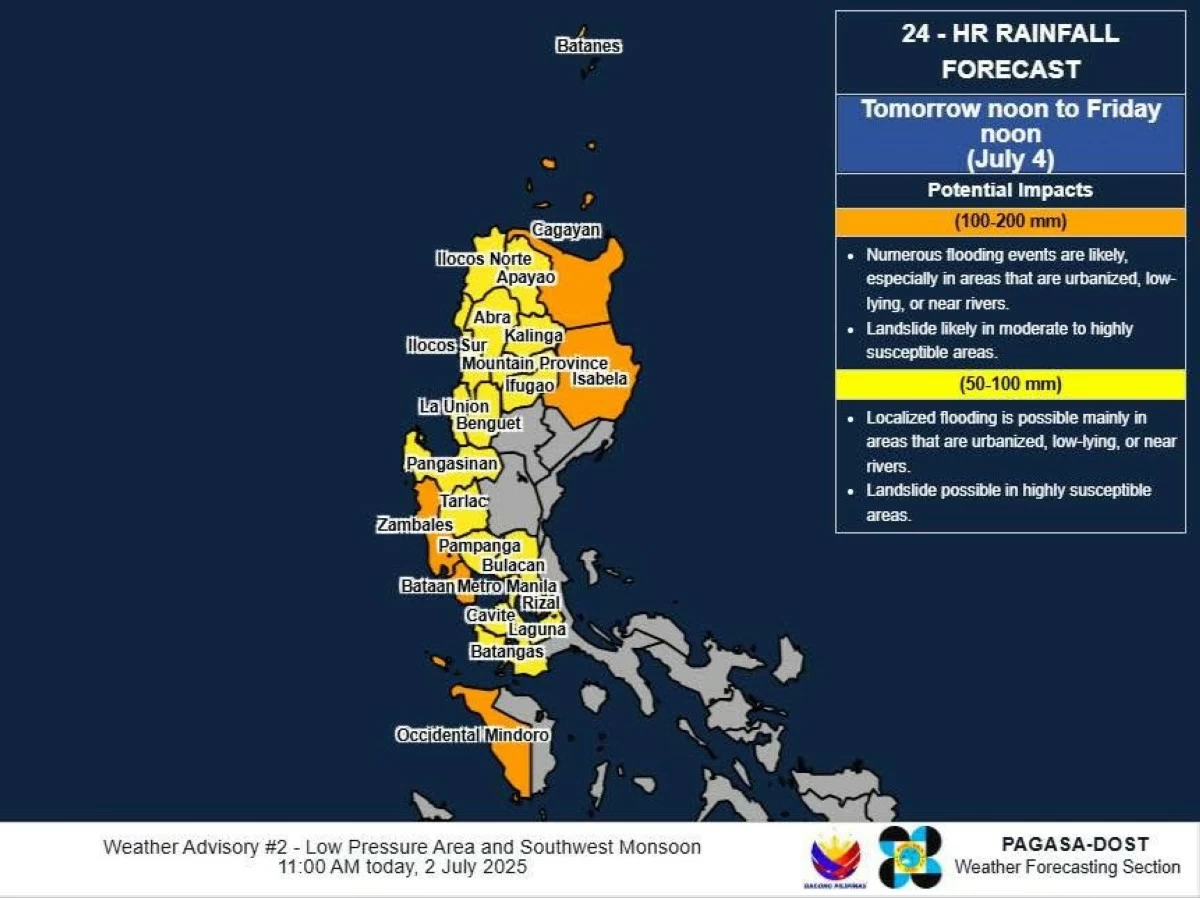
PAGASA
Heavy rainfall warnings have been raised over several areas in Luzon as a Low-Pressure Area (LPA) and the southwest monsoon (habagat) are expected to bring moderate to intense rains in the coming days, the Philippine Atmospheric, Geophysical and Astronomical Services Administration (PAGASA) said on Wednesday, July 2.
As of 8 a.m., the LPA was located 230 kilometers east of Tuguegarao City, Cagayan, and still has a high probability of developing into a tropical depression within 24 hours. If it intensifies, it will be named “Bising.”
In a heavy rainfall outlook issued at 11 a.m., PAGASA said 50 to 100 millimeters (mm) of rainfall, classified as moderate to heavy, may persist in Batanes, Cagayan, Isabela, Apayao, Kalinga, Abra, Ilocos Norte, Zambales, Bataan, and Occidental Mindoro until Thursday noon, July 3.
From Thursday noon to Friday noon, July 4, rainfall is expected to intensify, with 100 to 200 mm or heavy to intense rain likely over Cagayan, Isabela, Zambales, Bataan, and Occidental Mindoro.
Moderate to heavy rainfall is also forecast during this period in Batanes, Apayao, Kalinga, Ilocos Norte, Ilocos Sur, Abra, Ifugao, Mountain Province, Metro Manila, La Union, Pangasinan, Benguet, Tarlac, Pampanga, Bulacan, Rizal, Laguna, Cavite, and Batangas.
From Friday noon to Saturday noon, July 5, moderate to heavy rainfall is expected to continue over Batanes, Cagayan, Apayao, Ilocos Norte, Ilocos Sur, La Union, Pangasinan, Abra, Benguet, Zambales, Bataan, and Occidental Mindoro.
PAGASA warned that the amount of rainfall may be higher in mountainous and elevated areas, and impacts may be worsened in communities that have already experienced significant rainfall in recent days.
The public and disaster risk reduction and management offices concerned are advised to take all necessary precautions to protect life and property.
PAGASA explained that a heavy rainfall warning provides a forecast for the next three hours at the municipal level using Doppler radar technology, which makes it a precise tool for real-time decision-making, particularly in flood-prone areas.
Meanwhile, a weather advisory covers a broader 24-hour period and is issued at the provincial level.
While it provides a general overview of weather disturbances, PAGASA said it lacks the short-term accuracy of a heavy rainfall warning and should not be used as the basis for class suspensions or other official decisions.