

ADVERTISEMENT

Wimbledon hits by record-breaking Day 1 temperatures as tournament gets started

Published Jul 1, 2025 10:09 am

At A Glance

  • LONDON (AP) — Wimbledon players and spectators were hit by record-breaking Day 1 heat as the temperature rose to 91 degrees Fahrenheit — 33 Celsius — at the oldest Grand Slam tournament on Monday, June 30.
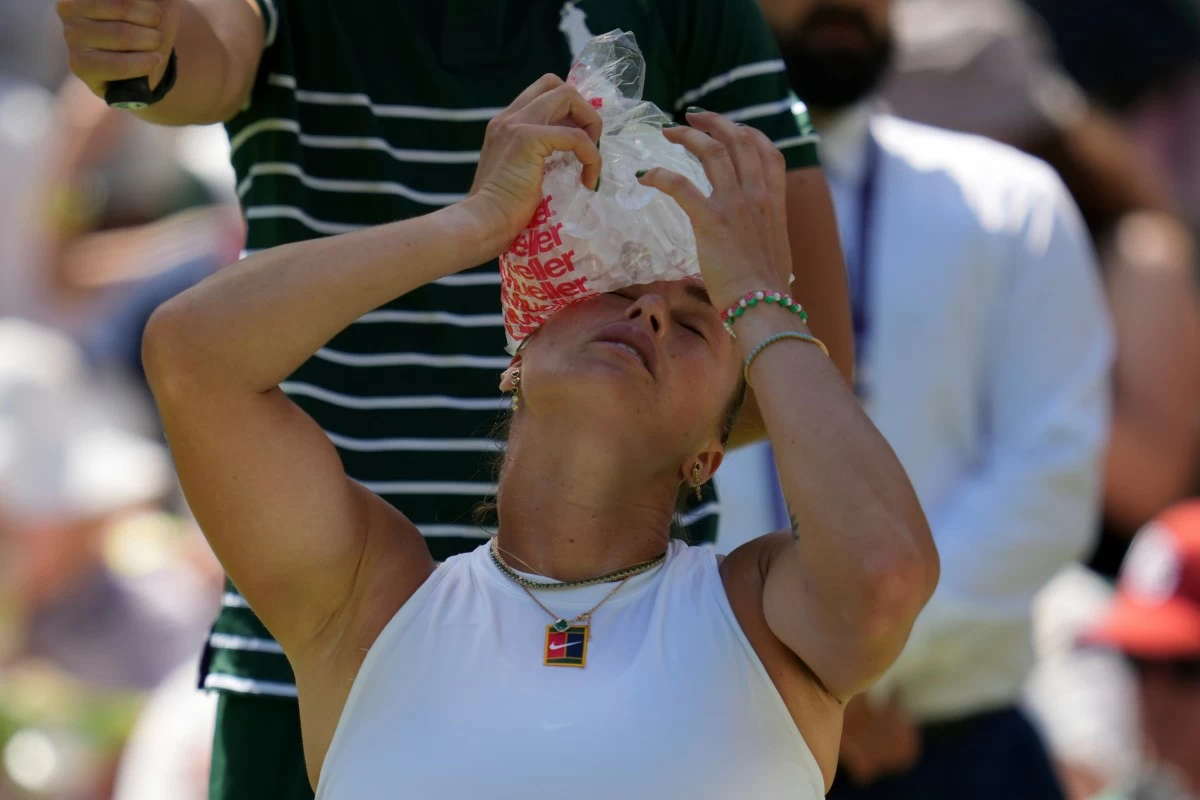
Aryna Sabalenka of Belarus uses an ice pack to cool during her match against Carson Branstine of Canada at their first round women's single match at the Wimbledon Tennis Championships in London, Monday, June 30. (AP Photo/Kin Cheung)
LONDON (AP) — Wimbledon players and spectators were hit by record-breaking Day 1 heat as the temperature rose to 91 degrees Fahrenheit — 33 Celsius — at the oldest Grand Slam tournament on Monday, June 30.
For sure, you feel like the sun is getting closer and closer every minute that passes by,” said Adrian Mannarino, a 37-year-old Frenchman who frequently sprayed his shaved head with sunscreen at changeovers during his first-round victory. “I was struggling a little more than usual.
The 2001 fortnight had the previous hottest opening day at the All England Club, reaching 85 degrees F (29.3 degrees C).
“I feel like everyone is kind of struggling with the heat right now,” Germany's Eva Lys said after winning her match Monday.
Some sweat-soaked athletes sought help from ice-filled towels wrapped around their necks while they sat on sideline chairs.
Others said it actually wasn't all that unbearable, especially given that the weather was not extraordinary compared to what often occurs during the local summers when the Australian Open is held in Melbourne in January or the U.S. Open is in New York in August and September. At those events, temperatures regularly get to 90 degrees F (32 degrees C) and can top 100 degrees F (38 degrees C).
A 2023 Associated Press analysis showed the average high temperatures felt during the U.S. Open and the three other major tennis tournaments steadily have gotten higher and more dangerous in recent decades, reflecting the climate change that has created record heat waves. For the players, it can inhibit them from playing their best and, worse, increase the likelihood of heat-related illness.
By local standards, this certainly was significant.
“I’m not going to lie, it was pretty hot. I think (it was) a bit of a rookie mistake, not doing a change of clothes at the end of the set,” said Sonay Kartal, a British player who eliminated 2017 French Open champion Jelena Ostapenko. “It was hot, but I had ice towels, cold drinks and stuff. I wouldn’t say it affected me too much.”
The average daytime temperature in London in June is 71 degrees F (21.5 degrees C). The government’s official weather office said this spring was Britain's “warmest and sunniest” since that’s been tracked.
“I’ll spend the whole day going from one shady spot to another,” said Sally Bolton, the chief executive officer of the All England Club.
“Obviously, it’s a very warm day. The first obvious point to make is that the athletes compete in temperatures like this all year on the tour,” Bolton said. “For us Brits here at The Championships, it feels very hot.”
Wimbledon, like other tennis tournaments, monitors air temperature, surface temperature and humidity for a heat-stress reading that, if it exceeds 30.1 degrees C (about 86 degrees F), allows for 10-minute breaks between the second and third sets of women's matches or between the third and fourth sets of men's matches.
Among other precautions being taken Monday, Bolton said, were having more ice on court available for players to use to cool off, rotating ball girls and boys more frequently “if we feel we need to,” and giving regular breaks to workers around the grounds.
As for fans, Bolton said, “we're offering the same advice as lots of the medical professionals: Come prepared. Bring a hat. Wear sunscreen. Wear light clothing if you can. Take breaks out of the sun. We’ve got over 100 water points around the grounds, so definitely stay hydrated. And keep an eye on your friends and others around you. If people look like they're suffering a little bit from heat stress, we’ve got a really significantly sized medical team here.”
Fans used umbrellas to offer shade, rather than protection from the drizzles often seen around these parts. A year ago, because of persistent showers, it took four days — instead of the scheduled two — to complete the first round.
Thinking back to the rain-filled Wimbledon of 2024, Bolton joked: “We’re not used to these sort of temperatures, but we’re absolutely ready for it — and actually delighted that it's sunny and not wet, like it was last year.”

Related Tags

Wimbledon
ADVERTISEMENT
.most-popular .layout-ratio{ padding-bottom: 79.13%; } @media (min-width: 768px) and (max-width: 1024px) { .widget-title { font-size: 15px !important; } }

{{ articles_filter_1561_widget.title }}

.most-popular .layout-ratio{ padding-bottom: 79.13%; } @media (min-width: 768px) and (max-width: 1024px) { .widget-title { font-size: 15px !important; } }

{{ articles_filter_1562_widget.title }}

.most-popular .layout-ratio{ padding-bottom: 79.13%; } @media (min-width: 768px) and (max-width: 1024px) { .widget-title { font-size: 15px !important; } }

{{ articles_filter_1563_widget.title }}

{{ articles_filter_1564_widget.title }}

.mb-article-details { position: relative; } .mb-article-details .article-body-preview, .mb-article-details .article-body-summary{ font-size: 17px; line-height: 30px; font-family: "Libre Caslon Text", serif; color: #000; } .mb-article-details .article-body-preview iframe , .mb-article-details .article-body-summary iframe{ width: 100%; margin: auto; } .read-more-background { background: linear-gradient(180deg, color(display-p3 1.000 1.000 1.000 / 0) 13.75%, color(display-p3 1.000 1.000 1.000 / 0.8) 30.79%, color(display-p3 1.000 1.000 1.000) 72.5%); position: absolute; height: 200px; width: 100%; bottom: 0; display: flex; justify-content: center; align-items: center; padding: 0; } .read-more-background a{ color: #000; } .read-more-btn { padding: 17px 45px; font-family: Inter; font-weight: 700; font-size: 18px; line-height: 16px; text-align: center; vertical-align: middle; border: 1px solid black; background-color: white; } .hidden { display: none; }
function initializeAllSwipers() { // Get all hidden inputs with cms_article_id document.querySelectorAll('[id^="cms_article_id_"]').forEach(function (input) { const cmsArticleId = input.value; const articleSelector = '#article-' + cmsArticleId + ' .body_images'; const swiperElement = document.querySelector(articleSelector); if (swiperElement && !swiperElement.classList.contains('swiper-initialized')) { new Swiper(articleSelector, { loop: true, pagination: false, navigation: { nextEl: '#article-' + cmsArticleId + ' .swiper-button-next', prevEl: '#article-' + cmsArticleId + ' .swiper-button-prev', }, }); } }); } setTimeout(initializeAllSwipers, 3000); const intersectionObserver = new IntersectionObserver( (entries) => { entries.forEach((entry) => { if (entry.isIntersecting) { const newUrl = entry.target.getAttribute("data-url"); if (newUrl) { history.pushState(null, null, newUrl); let article = entry.target; // Extract metadata const author = article.querySelector('.author-section').textContent.replace('By', '').trim(); const section = article.querySelector('.section-info ').textContent.replace(' ', ' '); const title = article.querySelector('.article-title h1').textContent; // Parse URL for Chartbeat path format const parsedUrl = new URL(newUrl, window.location.origin); const cleanUrl = parsedUrl.host + parsedUrl.pathname; // Update Chartbeat configuration if (typeof window._sf_async_config !== 'undefined') { window._sf_async_config.path = cleanUrl; window._sf_async_config.sections = section; window._sf_async_config.authors = author; } // Track virtual page view with Chartbeat if (typeof pSUPERFLY !== 'undefined' && typeof pSUPERFLY.virtualPage === 'function') { try { pSUPERFLY.virtualPage({ path: cleanUrl, title: title, sections: section, authors: author }); } catch (error) { console.error('ping error', error); } } // Optional: Update document title if (title && title !== document.title) { document.title = title; } } } }); }, { threshold: 0.1 } ); function showArticleBody(button) { const article = button.closest("article"); const summary = article.querySelector(".article-body-summary"); const body = article.querySelector(".article-body-preview"); const readMoreSection = article.querySelector(".read-more-background"); // Hide summary and read-more section summary.style.display = "none"; readMoreSection.style.display = "none"; // Show the full article body body.classList.remove("hidden"); } document.addEventListener("DOMContentLoaded", () => { let loadCount = 0; // Track how many times articles are loaded const offset = [1, 2, 3, 4, 5, 6, 7, 8, 9, 10]; // Offset values const currentUrl = window.location.pathname.substring(1); let isLoading = false; // Prevent multiple calls if (!currentUrl) { console.log("Current URL is invalid."); return; } const sentinel = document.getElementById("load-more-sentinel"); if (!sentinel) { console.log("Sentinel element not found."); return; } function isSentinelVisible() { const rect = sentinel.getBoundingClientRect(); return ( rect.top < window.innerHeight && rect.bottom >= 0 ); } function onScroll() { if (isLoading) return; if (isSentinelVisible()) { if (loadCount >= offset.length) { console.log("Maximum load attempts reached."); window.removeEventListener("scroll", onScroll); return; } isLoading = true; const currentOffset = offset[loadCount]; window.loadMoreItems().then(() => { let article = document.querySelector('#widget_1690 > div:nth-last-of-type(2) article'); intersectionObserver.observe(article) loadCount++; }).catch(error => { console.error("Error loading more items:", error); }).finally(() => { isLoading = false; }); } } window.addEventListener("scroll", onScroll); });

Sign up by email to receive news.