






Manila Bulletin
 Philippines
National
PAGASA not ruling out possibility of LPA developing into tropical depression
Philippines
National
PAGASA not ruling out possibility of LPA developing into tropical depression
Philippines
National
PAGASA not ruling out possibility of LPA developing into tropical depression
PAGASA not ruling out possibility of LPA developing into tropical depression
Published Jul 1, 2025 07:58 am


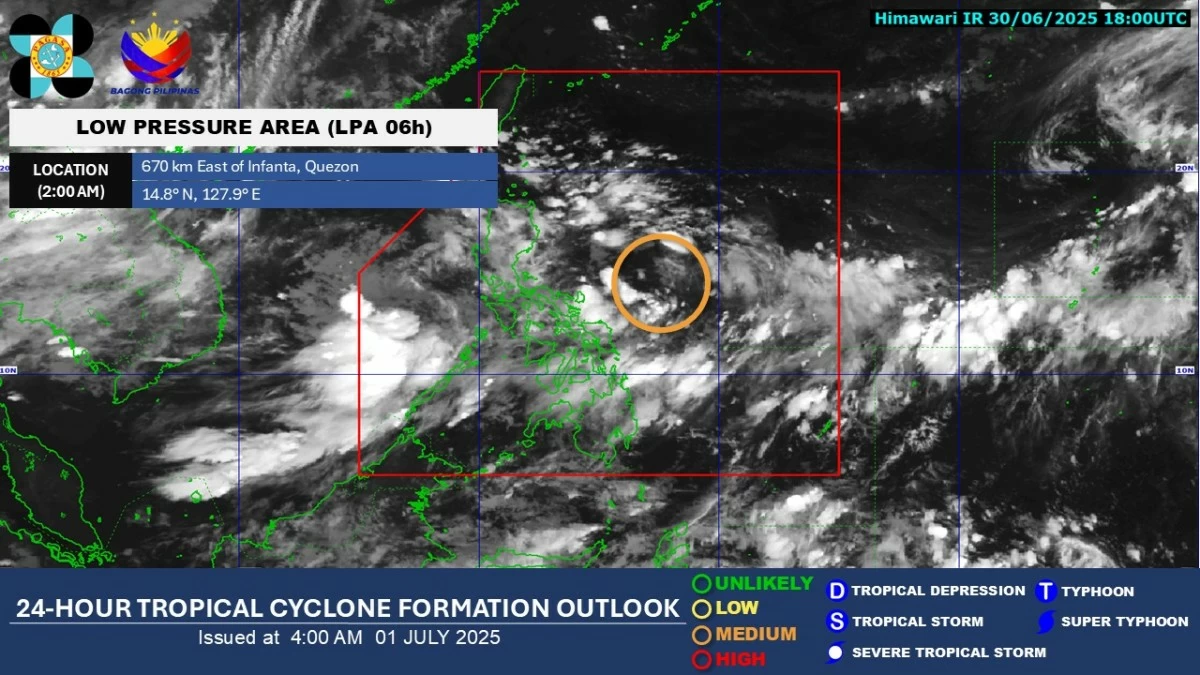
PAGASA
The Low-Pressure Area (LPA) spotted east of Luzon may still develop into a tropical depression in the coming days, said the Philippine Atmospheric, Geophysical and Astronomical Services Administration (PAGASA) on Tuesday, July 1.
As of 3 a.m., the LPA was located about 650 kilometers east of Infanta, Quezon, PAGASA weather specialist Obet Badrina said.
Badrina said the chance of the LPA developing into a tropical cyclone within 24 hours remains low, but noted that the likelihood could increase over the next few days.
If the weather disturbance develops into a tropical depression within the Philippine Area of Responsibility, it will be named “Bising.”
He added that the weather system may either cross Luzon or, due to its position near eastern Luzon, “recurve” away from land.
Badrina also advised the public to continue monitoring PAGASA’s official updates regarding the LPA.
On Tuesday, the trough or extension of the LPA will continue to bring cloudy skies with scattered rain showers and thunderstorms over Bicol Region, Isabela, Quirino, Aurora, and Quezon.
Similar conditions are expected in Metro Manila, Bataan, Zambales, Pampanga, Tarlac, Bulacan, Nueva Ecija, Cavite, Laguna, Batangas, Rizal, Oriental Mindoro, Occidental Mindoro, Marinduque, Romblon, Palawan, the Zamboanga Peninsula, Northern Mindanao, Caraga, and the entire Visayas due to the southwest monsoon, or “habagat.”
The rest of Mindanao and Luzon will experience partly cloudy to cloudy skies with isolated rain showers or thunderstorms.
From Wednesday, July 2, to Saturday, July 5, scattered rain showers and thunderstorms are expected to continue over most of Luzon and the Visayas due to the combined effects of the southwest monsoon and the LPA.
Badrina added that rainfall in Mindanao is expected to gradually decrease during the forecast period.
PAGASA advised the public to remain alert for possible flash floods and landslides, especially during moderate to heavy rainfall or severe thunderstorms.
Badrina noted that July is typically one of the months with the highest number of tropical cyclones, with an average of two to three storms forming during this period.