ADVERTISEMENT

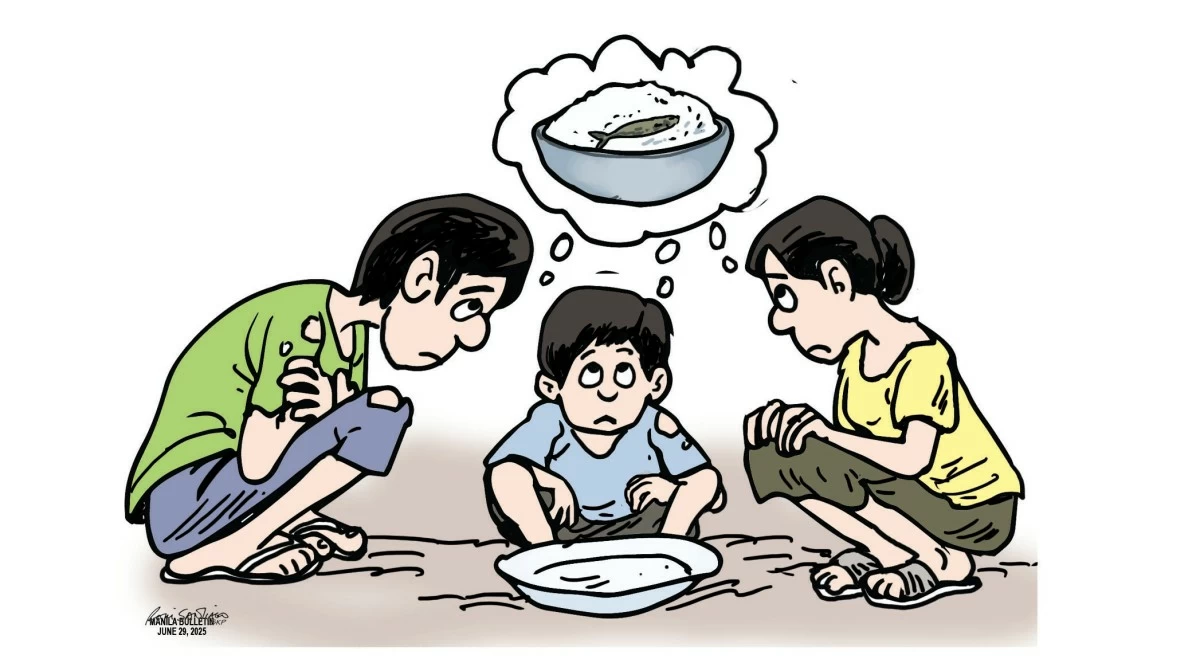
Hunger at our doorstep: A call for united action

Published Jun 29, 2025 12:05 am  |  Updated Jun 28, 2025 04:22 pm
A national Social Weather Stations (SWS) survey, conducted April 23–28, 2025, and released June 27, revealed that one in five Filipino families (or 20 percent of Filipino households) experienced involuntary hunger—defined as being hungry and having nothing to eat—at least once in the past three months. The survey results show that the hunger rate remained nearly unchanged from the 19.1 percent recorded in a survey fielded from April 11 to 15.
In March, a similar survey recorded 27.2 percent of households, or roughly 7.5 million families, suffering involuntary hunger—the highest rate since the Covid pandemic. Although today’s data shows a reduced number of hungry Filipinos, it is still a call for united action.
These are numbers that tell of daily heartbreaks. Hunger isn’t just a fleeting discomfort; it impacts childhood development, school performance, workforce productivity, and long-term health.
Multiple intertwined factors are driving this crisis, one of them persistent poverty. Figures from the Philippines Statistics Authority show that in 2023, poverty incidence in the rural areas was recorded at 22.1 percent, while in the urban areas, it was 10.2 percent.
Meanwhile, food inadequacy remains widespread—proof that many “non-poor” are still food-insecure. High cost of living and inflation—especially food prices—rising oil prices, and consequently, increasing transport costs will further deepen the crisis.
Global instability, particularly the war in the Middle East, is disrupting energy supplies and driving up crude oil and shipping costs. These ripple effects hit local consumers with higher fuel and food prices—a burden too heavy for many families reliant on a single income.
The Philippine government has rolled out initiatives such as Pantawid Pamilyang Pilipino Program, rice subsidies, and budget allocations for community feeding programs. NGOs, religious organizations, and private companies have mobilized food distribution drives, soup kitchens, and school-based feeding programs.
However, despite these efforts, response remains scattered and under-resourced in remote and disaster-prone areas. Coordination, funding, and comprehensive impacts are still falling short.
To fight household hunger and restore Filipino dignity, we need four fronts of action: First, government must legislate to boost food security. Price controls and social safety nets tied to food security, not just income thresholds, should be strengthened. Local food production must be supported by subsidies and incentives for small farmers.
Second, private sector needs to integrate hunger relief. Mainstream food sourcing and distribution through corporate social responsibility programs can contribute much to help the hungry.
Third, community and faith groups should become active partners. Parish-run kitchens, barangay level seed banks, and youth volunteer networks can reinforce local resilience.
And fourth, individuals and families can make a difference—in small and big ways. They can support community pantries by sharing surplus produce, volunteer time, or donate canned goods. They can advocate online by raising awareness, push for legislation via petitions, social media and letter-writing. There is need for very active citizens.
Hunger can no longer be relegated to the margins. When one in five Filipino families goes without food even once, it’s a national crisis. The convergence of inflation, skyrocketing oil prices, global disruption, and deepening poverty is a warning—and a responsibility.
We cannot wait for tomorrow. We must reach out today—mobilize our communities, support effective policies, and offer immediate relief. Whether by donating rice, organizing pantry drives, or advocating for food security laws, every Filipino can—and must—play a part.
Let this be the moment Filipinos stand together—feeding hope, strengthening families, and ensuring that no one goes to bed hungry. The time is now.
ADVERTISEMENT
.most-popular .layout-ratio{ padding-bottom: 79.13%; } @media (min-width: 768px) and (max-width: 1024px) { .widget-title { font-size: 15px !important; } }

{{ articles_filter_1561_widget.title }}

.most-popular .layout-ratio{ padding-bottom: 79.13%; } @media (min-width: 768px) and (max-width: 1024px) { .widget-title { font-size: 15px !important; } }

{{ articles_filter_1562_widget.title }}

.most-popular .layout-ratio{ padding-bottom: 79.13%; } @media (min-width: 768px) and (max-width: 1024px) { .widget-title { font-size: 15px !important; } }

{{ articles_filter_1563_widget.title }}

{{ articles_filter_1564_widget.title }}

.mb-article-details { position: relative; } .mb-article-details .article-body-preview, .mb-article-details .article-body-summary{ font-size: 17px; line-height: 30px; font-family: "Libre Caslon Text", serif; color: #000; } .mb-article-details .article-body-preview iframe , .mb-article-details .article-body-summary iframe{ width: 100%; margin: auto; } .read-more-background { background: linear-gradient(180deg, color(display-p3 1.000 1.000 1.000 / 0) 13.75%, color(display-p3 1.000 1.000 1.000 / 0.8) 30.79%, color(display-p3 1.000 1.000 1.000) 72.5%); position: absolute; height: 200px; width: 100%; bottom: 0; display: flex; justify-content: center; align-items: center; padding: 0; } .read-more-background a{ color: #000; } .read-more-btn { padding: 17px 45px; font-family: Inter; font-weight: 700; font-size: 18px; line-height: 16px; text-align: center; vertical-align: middle; border: 1px solid black; background-color: white; } .hidden { display: none; }
function initializeAllSwipers() { // Get all hidden inputs with cms_article_id document.querySelectorAll('[id^="cms_article_id_"]').forEach(function (input) { const cmsArticleId = input.value; const articleSelector = '#article-' + cmsArticleId + ' .body_images'; const swiperElement = document.querySelector(articleSelector); if (swiperElement && !swiperElement.classList.contains('swiper-initialized')) { new Swiper(articleSelector, { loop: true, pagination: false, navigation: { nextEl: '#article-' + cmsArticleId + ' .swiper-button-next', prevEl: '#article-' + cmsArticleId + ' .swiper-button-prev', }, }); } }); } setTimeout(initializeAllSwipers, 3000); const intersectionObserver = new IntersectionObserver( (entries) => { entries.forEach((entry) => { if (entry.isIntersecting) { const newUrl = entry.target.getAttribute("data-url"); if (newUrl) { history.pushState(null, null, newUrl); let article = entry.target; // Extract metadata const author = article.querySelector('.author-section').textContent.replace('By', '').trim(); const section = article.querySelector('.section-info ').textContent.replace(' ', ' '); const title = article.querySelector('.article-title h1').textContent; // Parse URL for Chartbeat path format const parsedUrl = new URL(newUrl, window.location.origin); const cleanUrl = parsedUrl.host + parsedUrl.pathname; // Update Chartbeat configuration if (typeof window._sf_async_config !== 'undefined') { window._sf_async_config.path = cleanUrl; window._sf_async_config.sections = section; window._sf_async_config.authors = author; } // Track virtual page view with Chartbeat if (typeof pSUPERFLY !== 'undefined' && typeof pSUPERFLY.virtualPage === 'function') { try { pSUPERFLY.virtualPage({ path: cleanUrl, title: title, sections: section, authors: author }); } catch (error) { console.error('ping error', error); } } // Optional: Update document title if (title && title !== document.title) { document.title = title; } } } }); }, { threshold: 0.1 } ); function showArticleBody(button) { const article = button.closest("article"); const summary = article.querySelector(".article-body-summary"); const body = article.querySelector(".article-body-preview"); const readMoreSection = article.querySelector(".read-more-background"); // Hide summary and read-more section summary.style.display = "none"; readMoreSection.style.display = "none"; // Show the full article body body.classList.remove("hidden"); } document.addEventListener("DOMContentLoaded", () => { let loadCount = 0; // Track how many times articles are loaded const offset = [1, 2, 3, 4, 5, 6, 7, 8, 9, 10]; // Offset values const currentUrl = window.location.pathname.substring(1); let isLoading = false; // Prevent multiple calls if (!currentUrl) { console.log("Current URL is invalid."); return; } const sentinel = document.getElementById("load-more-sentinel"); if (!sentinel) { console.log("Sentinel element not found."); return; } function isSentinelVisible() { const rect = sentinel.getBoundingClientRect(); return ( rect.top < window.innerHeight && rect.bottom >= 0 ); } function onScroll() { if (isLoading) return; if (isSentinelVisible()) { if (loadCount >= offset.length) { console.log("Maximum load attempts reached."); window.removeEventListener("scroll", onScroll); return; } isLoading = true; const currentOffset = offset[loadCount]; window.loadMoreItems().then(() => { let article = document.querySelector('#widget_1690 > div:nth-last-of-type(2) article'); intersectionObserver.observe(article) loadCount++; }).catch(error => { console.error("Error loading more items:", error); }).finally(() => { isLoading = false; }); } } window.addEventListener("scroll", onScroll); });

Sign up by email to receive news.