







Private sector calls for roadmap on AI upskilling
Published Jun 27, 2025 04:59 pm


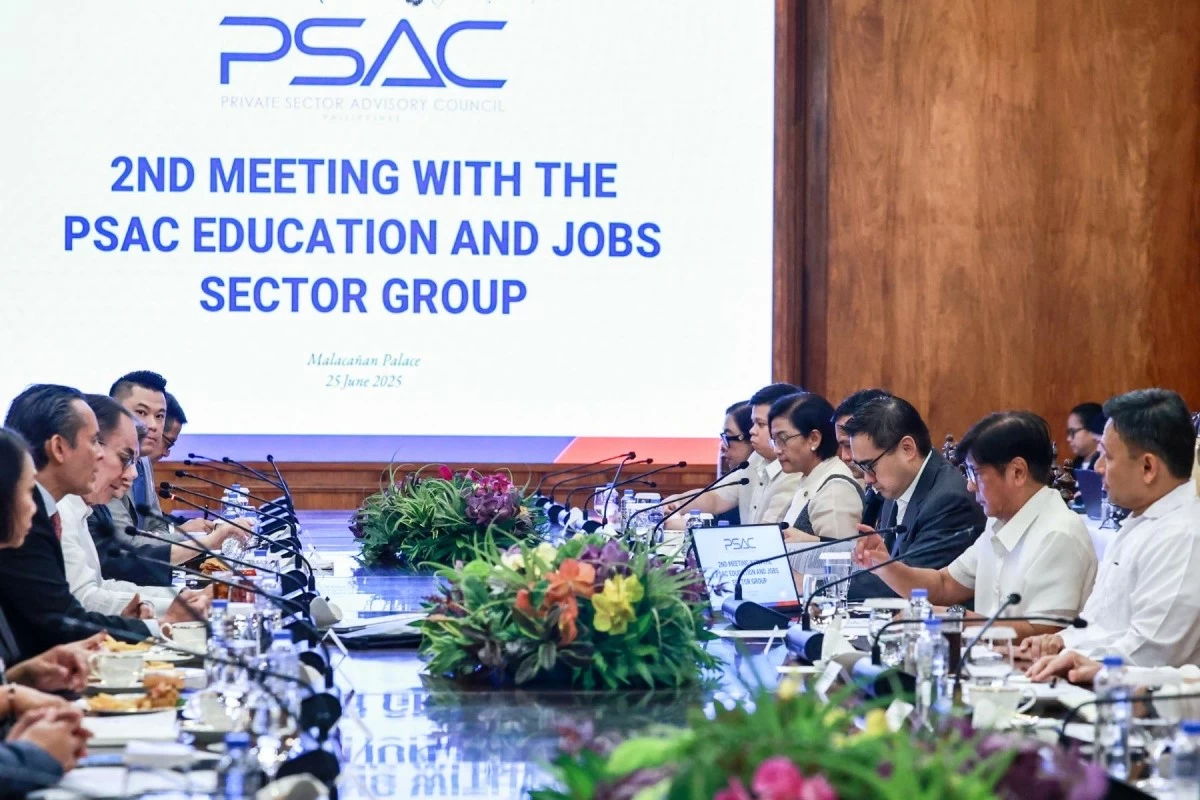
The Private Sector Advisory Council (PSAC) – Jobs and Education Sector meeting with President Ferdinand “Bongbong” Marcos Jr. (PSAC photo)
The Private Sector Advisory Council (PSAC) is recommending the establishment of a government-led roadmap aimed at equipping Filipinos with the capacity to successfully harness artificial intelligence (AI).
PSAC, through its jobs and education sector, recently presented to President Ferdinand “Bongbong” Marcos Jr. the prospects of establishing the so-called National AI Upskilling Roadmap.
This roadmap is proposed to be the government’s flagship imitative to address the populace’s information gap with AI by equipping every Filipino with the necessary skills to “live and work” in an AI-powered world.
PSAC is calling for an immediate rollout of such framework, to be headed by the Commission on Higher Education (CHEd), Technical Education and Skills Development Authority (TESDA), and Analytics & AI Association of the Philippines (AAP).
“Our goal is simple—create real opportunities for Filipinos to thrive in a fast-changing world,” said Aboitiz Group President and Chief Executive Officer (CEO) Sabin Aboitiz, who is concurrently the strategic lead convenor of PSAC.
“Through stronger collaboration between the private sector and government, we can turn our shared vision into action,” he added.
Once institutionalized, the National AI Upskilling Roadmap will be a key component of the Department of Science and Technology’s (DOST) National AI Strategy, as well as would be integrated into the Education Commission 2’s (EDCOM 2) National Education and Workforce Development Plan (NatPlan).
The roadmap is seen to foster inclusive access, covering digital literacy for the general public to advanced AI training for professionals.
PSAC education and jobs committee co-lead Fred Ayala said the National AI Upskilling Roadmap is an “urgent necessity,” noting that millions of Filipinos are at risk of being left behind by the growing adoption of AI.
“This is about empowering every Filipino, regardless of age or background, with the skills and confidence to survive, thrive, and lead in an AI-driven world. We cannot afford to wait,” said Ayala, president of iPeople Inc.
“The time to act, with the leadership of the government and the active participation of the private sector, is now,” he continued.
In the meantime, PSAC said the ongoing digital leadership training program for civil servants is being scaled up to reach 50,000 learners within two years.
With its goal of preparing government leaders to thrive in a digital-first environment, the program is being overseen by the Civil Service Institute, Department of Information and Communications Technology (DICT), and several private sector higher education institutions.
Apart from the roadmap, PSAC also recommended that the President issue an executive order (EO) to establish a Cabinet cluster specifically for education.
Consisting of the Department of Education (DepEd), CHED, and TESDA, the cluster will foster close coordination among the education agencies in implementing reform recommendations of EDCOM 2, particularly the NatPlan.
The Senate and the House of Representatives earlier jointly passed a concurrent resolution suggesting the creation of the cluster, with the goal of addressing the country’s education crisis.
Meanwhile, to support the country’s growing industrial sectors, PSAC also advocated for a “one-stop shop” to remove regulatory bottlenecks and improve the ease of doing business in high-potential industries.
This government body will include the Anti-Red Tape Authority (ARTA), the Department of Trade and Industry (DTI), and other concerned agencies.
Industries that will potentially benefit from this include semiconductors, electronics, and smart manufacturing.