







DOTr, USTDA ink deal for Luzon Economic Corridor railway
Published Jun 27, 2025 02:25 pm


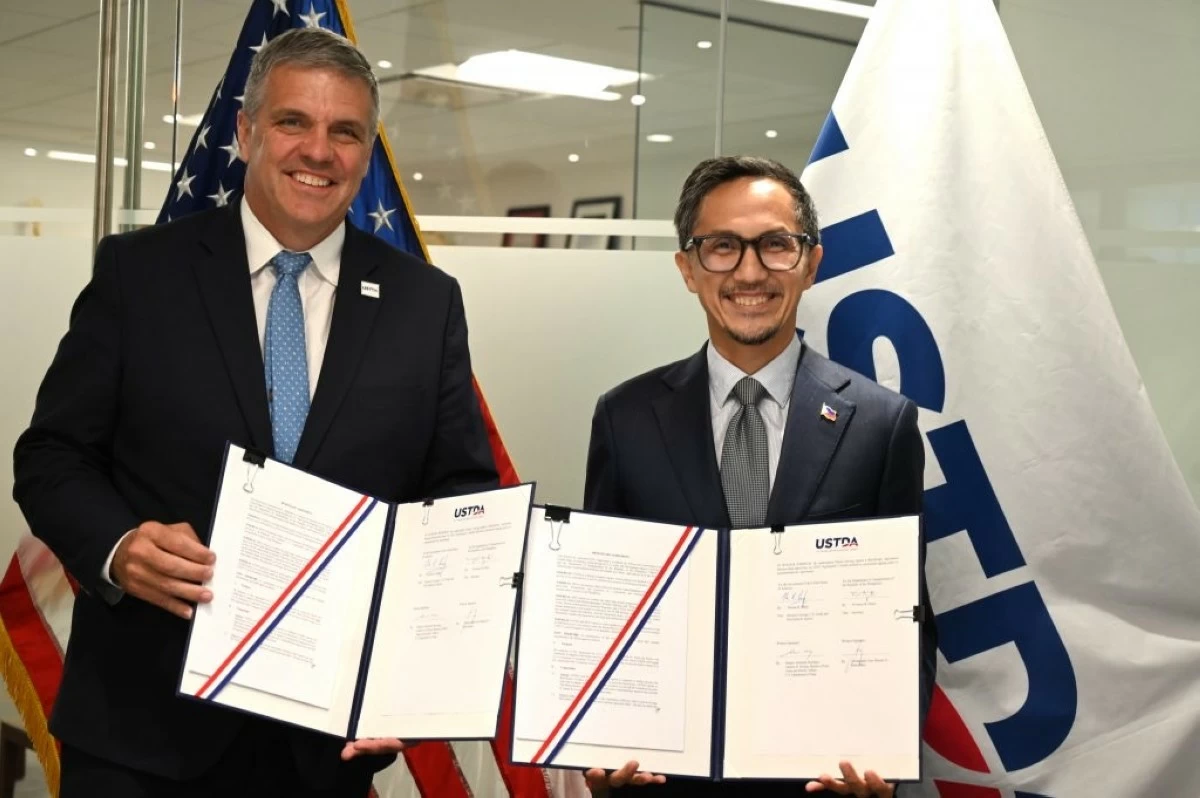
(Left) USTDA Acting Director Thomas Hardy and DOTr Secretary Vince Dizon (USTDA photo)
The Philippines signed an agreement with the United States (US) for technical assistance in the construction of the Subic-Clark-Manila-Batangas (SCMB) Railway, a major component of the Luzon Economic Corridor (LEC), which is expected to attract investments.
The Department of Transportation (DOTr) announced on Friday, June 27, that it has entered into an agreement with the US Trade and Development Agency (USTDA) for the initiative.
The proposed freight cargo railway is expected to span 250 kilometers, connecting four major economic hubs in Luzon: the Port of Subic, Clark International Airport, the Port of Manila, and the Port of Batangas.
According to government data, these four ports account for approximately 80 percent of the country’s total port traffic.
The SCMB Railway is seen as a means to decentralize port activity beyond Metro Manila, while also easing freight congestion.
As part of the LEC, the SCMB Railway will provide essential connectivity for freight transport needs across Luzon’s major economic hubs, paving the path for substantial economic growth.
“Once operational, the SCMB Railway will attract investments, create new opportunities for businesses, and most importantly, generate quality jobs that will benefit millions of Filipinos,” Special Assistant to the President for Investment and Economic Affairs Secretary Frederick Go said in a statement.
The LEC, which is envisioned to foster investment and trade across Luzon, was conceptualized during a trilateral summit between the Philippines, the US, and Japan last year
The LEC is part of the Partnership for Global Infrastructure and Investment of the Group of Seven (G7), aimed at providing infrastructure financing of developing countries.
Last month, Go said the USTDA will allocate $3.8 million or about ₱214.73 million for its technical assistance for the SCMB project instead of the initial plan of $2.5 million.
The USTDA will provide technical expertise related to transportation modeling, port-rail integration analysis, and legal and institutional planning.
The American agency has tapped Virginia-based consulting firm Cadmus Group to oversee the project.
According to the USTDA, this phase of the project will help mobilize financing for the railway’s implementation by addressing the lending requirements of Manila-based multilateral lender Asian Development Bank (ADB).
The project cost is expected to be around $3.2-billion.
In funding part of the project, USTDA Acting Director Thomas Hardy said the rail line will generate significant export opportunities for US firms, particularly in “high-tech rail technologies, equipment, and services.”
For America’s point-of-view, helping fund the SCMB project is a firm commitment of increasing economic cooperation to develop an essential trading route that will mutually benefit American and Filipinos, he said.
“Our partnership with the Philippines exemplifies the strength of American leadership in the Indo-Pacific and underscores our commitment to advancing our shared interests,” said Hardy.
Apart from the US, the Philippines is also looking to tap Sweden’s development finance institution, Swedfund, on a separate $1.2-million grant to provide additional support for the project.
The SCMB Railway is set to be complemented by the North-South Commuter Railway (NSCR), which will transport passengers along a 147-kilometer rail line connecting the provinces of Pampanga and Laguna.
The NSCR, which will cost around ₱870 billion, will carry as many as 800,000 passengers daily once operational.