ADVERTISEMENT

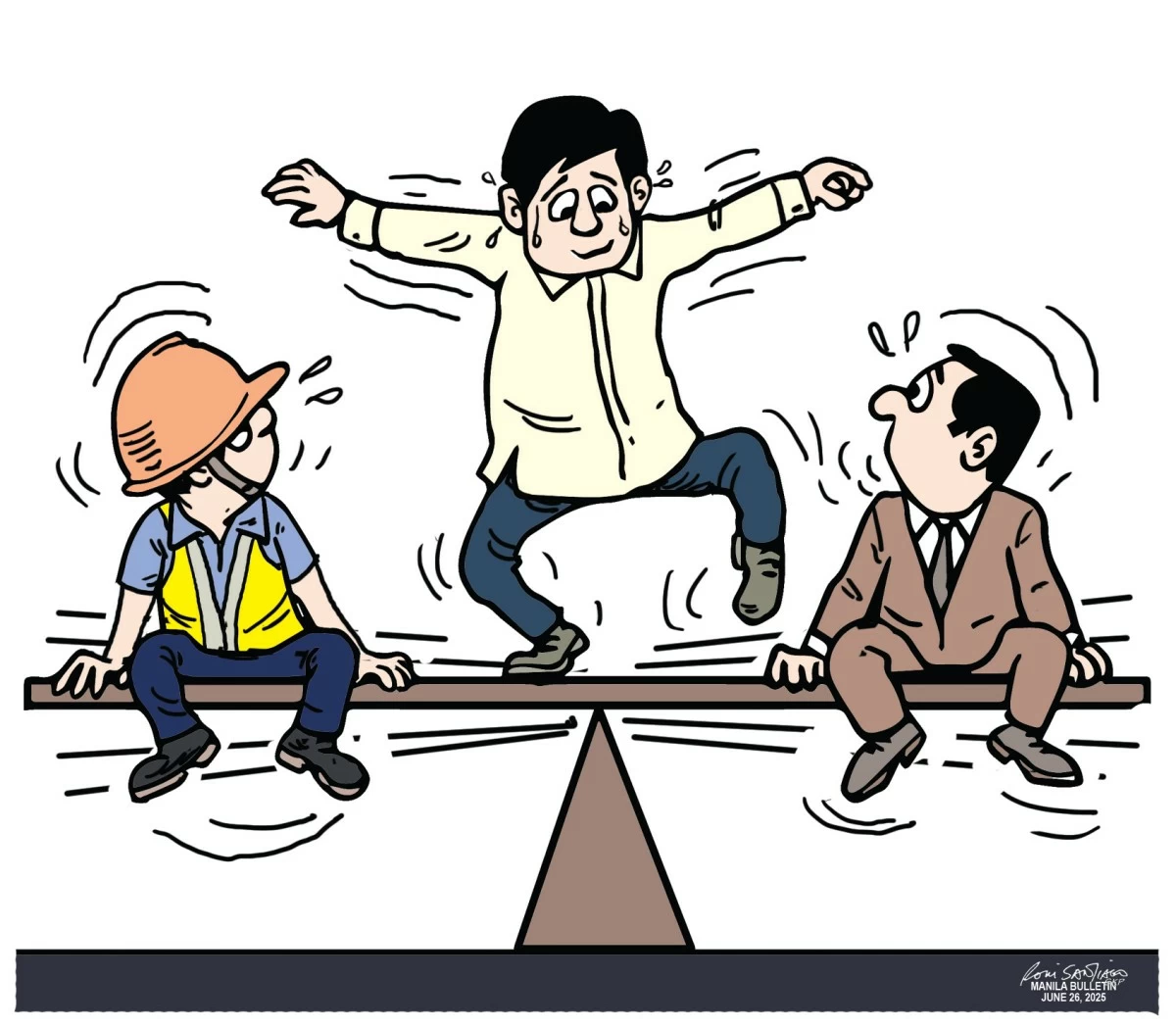
Wage setting in the PH: Striking the balance

Published Jun 26, 2025 12:01 am  |  Updated Jun 25, 2025 04:47 pm
As the Philippine Congress adjourned sine die on June 13 without reconciling the conflicting House and Senate versions of a proposed across-the-board minimum wage increase, the quest for attaining a living wage goes on. The House of Representatives had earlier passed a bill mandating a ₱200 daily wage hike for private sector workers. In contrast, the Senate version—approved last year—offered a more modest ₱100 increase. The inability to harmonize these proposals defers the provision of tangible relief to millions of Filipino workers struggling to cope with the rising cost of living.
For context, the current daily minimum wage in Metro Manila ranges from ₱610 to ₱645, while in other regions it falls significantly lower. Ibon Foundation, an independent economic think tank, pegs the living wage in Metro Manila at approximately ₱1,217 per day—nearly double the prevailing minimum. This stark disparity underscores the reality that many workers are not earning enough to meet their families’ basic needs despite working full-time.
Inflation remains a persistent burden, particularly on the poorest households, for whom food and transportation costs comprise a major share of daily expenses. Meanwhile, the labor sector’s call for a legislated wage increase stems from frustration with the slow pace and uneven outcomes of adjustments issued by Regional Tripartite Wage and Productivity Boards. Critics argue that the existing mechanisms often favor employers’ positions and rarely reflect the true cost of living, especially in urban centers where inflation bites hardest.
On the other hand, the Employers Confederation of the Philippines (ECOP) has reiterated its long-standing opposition to legislated wage hikes, warning that a substantial across-the-board increase could result in job losses, particularly among micro, small, and medium enterprises (MSMEs), which comprise over 99 percent of all businesses in the country. ECOP argues that wage-setting should remain under the jurisdiction of regional wage boards that are better positioned to calibrate wage adjustments in response to local economic conditions.
The concerns raised by both labor and employer groups are valid. The challenge lies in striking a delicate balance between sustaining job creation and ensuring that workers earn a decent wage. A legislated wage hike, without complementary support mechanisms for small businesses, such as tax breaks, access to credit, and productivity-enhancing programs, could scuttle investments in business development targeted at sectors aspiring to rise above the poverty level. These proposed mitigating measures can help absorb the impact of higher labor costs without leading to retrenchment or business closures.
In the longer term, the goal should be to transition from minimum wages toward enabling business and industry to afford and implement living wages. This requires boosting productivity, expanding higher-value industries, and investing in education and skills development so that more workers can access better-paying jobs. The government must also institutionalize regular, transparent reviews of wage levels, with strong worker representation, to ensure that wages evolve in tandem with economic realities.
Legislators must broaden their perspectives and redirect their focus on measures that support a more inclusive economy. The Filipino people deserve forward pathways that combine compassion with pragmatism—ensuring that no one is left behind in the nation’s quest for shared prosperity.

Related Tags

RONI SANTIAGO WAGE
ADVERTISEMENT
.most-popular .layout-ratio{ padding-bottom: 79.13%; } @media (min-width: 768px) and (max-width: 1024px) { .widget-title { font-size: 15px !important; } }

{{ articles_filter_1561_widget.title }}

.most-popular .layout-ratio{ padding-bottom: 79.13%; } @media (min-width: 768px) and (max-width: 1024px) { .widget-title { font-size: 15px !important; } }

{{ articles_filter_1562_widget.title }}

.most-popular .layout-ratio{ padding-bottom: 79.13%; } @media (min-width: 768px) and (max-width: 1024px) { .widget-title { font-size: 15px !important; } }

{{ articles_filter_1563_widget.title }}

{{ articles_filter_1564_widget.title }}

.mb-article-details { position: relative; } .mb-article-details .article-body-preview, .mb-article-details .article-body-summary{ font-size: 17px; line-height: 30px; font-family: "Libre Caslon Text", serif; color: #000; } .mb-article-details .article-body-preview iframe , .mb-article-details .article-body-summary iframe{ width: 100%; margin: auto; } .read-more-background { background: linear-gradient(180deg, color(display-p3 1.000 1.000 1.000 / 0) 13.75%, color(display-p3 1.000 1.000 1.000 / 0.8) 30.79%, color(display-p3 1.000 1.000 1.000) 72.5%); position: absolute; height: 200px; width: 100%; bottom: 0; display: flex; justify-content: center; align-items: center; padding: 0; } .read-more-background a{ color: #000; } .read-more-btn { padding: 17px 45px; font-family: Inter; font-weight: 700; font-size: 18px; line-height: 16px; text-align: center; vertical-align: middle; border: 1px solid black; background-color: white; } .hidden { display: none; }
function initializeAllSwipers() { // Get all hidden inputs with cms_article_id document.querySelectorAll('[id^="cms_article_id_"]').forEach(function (input) { const cmsArticleId = input.value; const articleSelector = '#article-' + cmsArticleId + ' .body_images'; const swiperElement = document.querySelector(articleSelector); if (swiperElement && !swiperElement.classList.contains('swiper-initialized')) { new Swiper(articleSelector, { loop: true, pagination: false, navigation: { nextEl: '#article-' + cmsArticleId + ' .swiper-button-next', prevEl: '#article-' + cmsArticleId + ' .swiper-button-prev', }, }); } }); } setTimeout(initializeAllSwipers, 3000); const intersectionObserver = new IntersectionObserver( (entries) => { entries.forEach((entry) => { if (entry.isIntersecting) { const newUrl = entry.target.getAttribute("data-url"); if (newUrl) { history.pushState(null, null, newUrl); let article = entry.target; // Extract metadata const author = article.querySelector('.author-section').textContent.replace('By', '').trim(); const section = article.querySelector('.section-info ').textContent.replace(' ', ' '); const title = article.querySelector('.article-title h1').textContent; // Parse URL for Chartbeat path format const parsedUrl = new URL(newUrl, window.location.origin); const cleanUrl = parsedUrl.host + parsedUrl.pathname; // Update Chartbeat configuration if (typeof window._sf_async_config !== 'undefined') { window._sf_async_config.path = cleanUrl; window._sf_async_config.sections = section; window._sf_async_config.authors = author; } // Track virtual page view with Chartbeat if (typeof pSUPERFLY !== 'undefined' && typeof pSUPERFLY.virtualPage === 'function') { try { pSUPERFLY.virtualPage({ path: cleanUrl, title: title, sections: section, authors: author }); } catch (error) { console.error('ping error', error); } } // Optional: Update document title if (title && title !== document.title) { document.title = title; } } } }); }, { threshold: 0.1 } ); function showArticleBody(button) { const article = button.closest("article"); const summary = article.querySelector(".article-body-summary"); const body = article.querySelector(".article-body-preview"); const readMoreSection = article.querySelector(".read-more-background"); // Hide summary and read-more section summary.style.display = "none"; readMoreSection.style.display = "none"; // Show the full article body body.classList.remove("hidden"); } document.addEventListener("DOMContentLoaded", () => { let loadCount = 0; // Track how many times articles are loaded const offset = [1, 2, 3, 4, 5, 6, 7, 8, 9, 10]; // Offset values const currentUrl = window.location.pathname.substring(1); let isLoading = false; // Prevent multiple calls if (!currentUrl) { console.log("Current URL is invalid."); return; } const sentinel = document.getElementById("load-more-sentinel"); if (!sentinel) { console.log("Sentinel element not found."); return; } function isSentinelVisible() { const rect = sentinel.getBoundingClientRect(); return ( rect.top < window.innerHeight && rect.bottom >= 0 ); } function onScroll() { if (isLoading) return; if (isSentinelVisible()) { if (loadCount >= offset.length) { console.log("Maximum load attempts reached."); window.removeEventListener("scroll", onScroll); return; } isLoading = true; const currentOffset = offset[loadCount]; window.loadMoreItems().then(() => { let article = document.querySelector('#widget_1690 > div:nth-last-of-type(2) article'); intersectionObserver.observe(article) loadCount++; }).catch(error => { console.error("Error loading more items:", error); }).finally(() => { isLoading = false; }); } } window.addEventListener("scroll", onScroll); });

Sign up by email to receive news.