

ADVERTISEMENT

International Space Station welcomes its first astronauts from India, Poland and Hungary

Published Jun 26, 2025 11:09 pm

At A Glance

  • The crew of four will spend two weeks at the orbiting lab, performing dozens of experiments. They launched Wednesday from NASA's Kennedy Space Center.
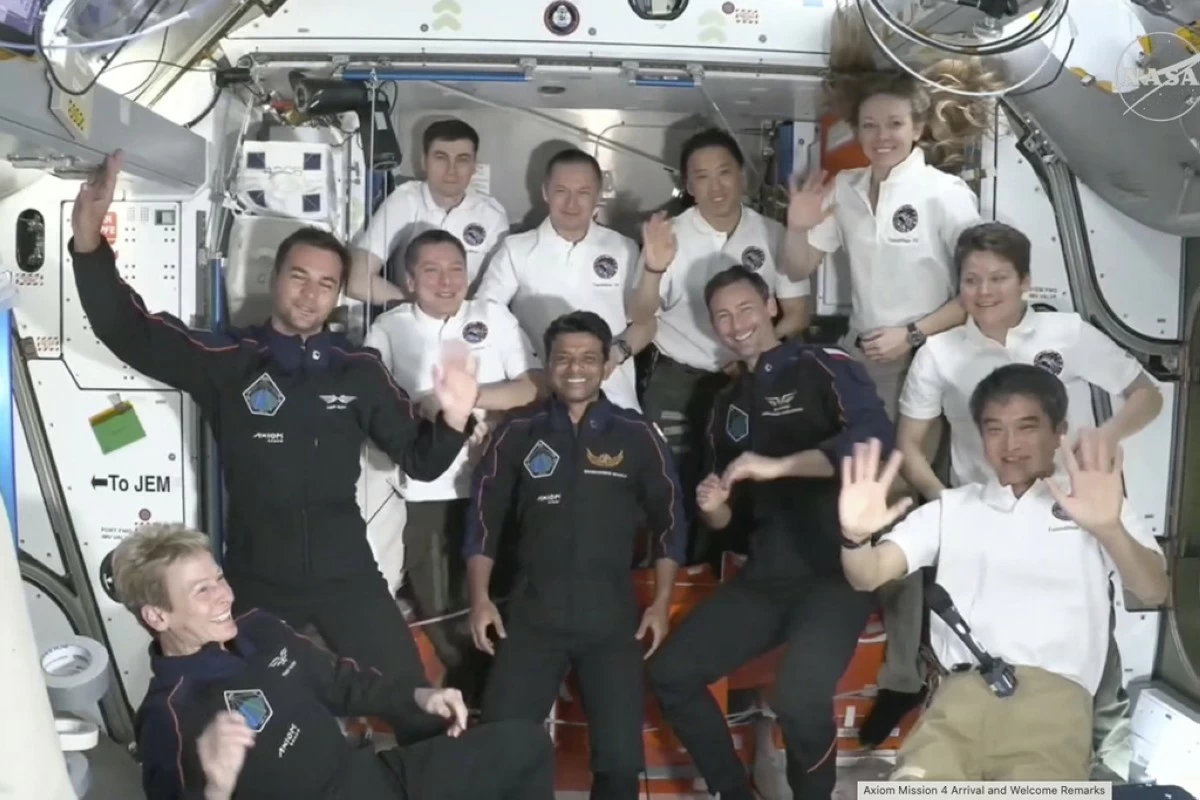
CAPE CANAVERAL, Fla. (AP) — The first astronauts in more than 40 years from India, Poland and Hungary arrived at the International Space Station on Thursday, ferried there by SpaceX on a private flight.
The crew of four will spend two weeks at the orbiting lab, performing dozens of experiments. They launched Wednesday from NASA’s Kennedy Space Center.
America’s most experienced astronaut, Peggy Whitson, is the commander of the visiting crew. She works for Axiom Space, the Houston company that arranged the chartered flight.
Besides Whitson, the crew includes India’s Shubhanshu Shukla, a pilot in the Indian Air Force; Hungary’s Tibor Kapu, a mechanical engineer; and Poland’s Slawosz Uznanski-Wisniewski, a radiation expert and one of the European Space Agency’s project astronauts on temporary flight duty.
No one has ever visited the International Space Station from those countries before. The time anyone rocketed into orbit from those countries was in the late 1970s and 1980s, traveling with the Soviets.
Speaking in both English and their native languages, the new arrivals shared hugs and handshakes with the space station's seven full-time residents, celebrating with drink pouches sipped through straws. Six nations were represented: four from the U.S., three from Russia and one each from Japan, India, Poland and Hungary.
“We have so many countries at the same time on the space station,” Kapu said, adding that seven of the 11 astronauts are first-time space fliers “which also tells me how much space is expanding.”
Added Uznanski-Wisniewski: “We will all try to do the best representing our countries.” Shukla rated the experience so far as “fantastic ... wonderful.
The space station's commander, Japan's Takuya Onishi, said he was happy to finally see their smiling faces after “waiting for you guys so long.” Whitson also made note of the lengthy delay and preflight quarantine.
To stay healthy, the four newcomers went into quarantine on May 25, stuck in it as their launch kept getting delayed. The latest postponement was for space station leak monitoring, NASA wanted to make sure everything was safe following repairs to a longtime leak on the Russian side of the outpost.
It's the fourth Axiom-sponsored flight to the space station since 2022. The company is one of several that are developing their own space stations due to launch in the coming years. NASA plans to abandon the International Space Station in 2030 after more than three decades of operation, and is encouraging private ventures to replace it.

Related Tags

WORLDNEWS
ADVERTISEMENT
.most-popular .layout-ratio{ padding-bottom: 79.13%; } @media (min-width: 768px) and (max-width: 1024px) { .widget-title { font-size: 15px !important; } }

{{ articles_filter_1561_widget.title }}

.most-popular .layout-ratio{ padding-bottom: 79.13%; } @media (min-width: 768px) and (max-width: 1024px) { .widget-title { font-size: 15px !important; } }

{{ articles_filter_1562_widget.title }}

.most-popular .layout-ratio{ padding-bottom: 79.13%; } @media (min-width: 768px) and (max-width: 1024px) { .widget-title { font-size: 15px !important; } }

{{ articles_filter_1563_widget.title }}

{{ articles_filter_1564_widget.title }}

.mb-article-details { position: relative; } .mb-article-details .article-body-preview, .mb-article-details .article-body-summary{ font-size: 17px; line-height: 30px; font-family: "Libre Caslon Text", serif; color: #000; } .mb-article-details .article-body-preview iframe , .mb-article-details .article-body-summary iframe{ width: 100%; margin: auto; } .read-more-background { background: linear-gradient(180deg, color(display-p3 1.000 1.000 1.000 / 0) 13.75%, color(display-p3 1.000 1.000 1.000 / 0.8) 30.79%, color(display-p3 1.000 1.000 1.000) 72.5%); position: absolute; height: 200px; width: 100%; bottom: 0; display: flex; justify-content: center; align-items: center; padding: 0; } .read-more-background a{ color: #000; } .read-more-btn { padding: 17px 45px; font-family: Inter; font-weight: 700; font-size: 18px; line-height: 16px; text-align: center; vertical-align: middle; border: 1px solid black; background-color: white; } .hidden { display: none; }
function initializeAllSwipers() { // Get all hidden inputs with cms_article_id document.querySelectorAll('[id^="cms_article_id_"]').forEach(function (input) { const cmsArticleId = input.value; const articleSelector = '#article-' + cmsArticleId + ' .body_images'; const swiperElement = document.querySelector(articleSelector); if (swiperElement && !swiperElement.classList.contains('swiper-initialized')) { new Swiper(articleSelector, { loop: true, pagination: false, navigation: { nextEl: '#article-' + cmsArticleId + ' .swiper-button-next', prevEl: '#article-' + cmsArticleId + ' .swiper-button-prev', }, }); } }); } setTimeout(initializeAllSwipers, 3000); const intersectionObserver = new IntersectionObserver( (entries) => { entries.forEach((entry) => { if (entry.isIntersecting) { const newUrl = entry.target.getAttribute("data-url"); if (newUrl) { history.pushState(null, null, newUrl); let article = entry.target; // Extract metadata const author = article.querySelector('.author-section').textContent.replace('By', '').trim(); const section = article.querySelector('.section-info ').textContent.replace(' ', ' '); const title = article.querySelector('.article-title h1').textContent; // Parse URL for Chartbeat path format const parsedUrl = new URL(newUrl, window.location.origin); const cleanUrl = parsedUrl.host + parsedUrl.pathname; // Update Chartbeat configuration if (typeof window._sf_async_config !== 'undefined') { window._sf_async_config.path = cleanUrl; window._sf_async_config.sections = section; window._sf_async_config.authors = author; } // Track virtual page view with Chartbeat if (typeof pSUPERFLY !== 'undefined' && typeof pSUPERFLY.virtualPage === 'function') { try { pSUPERFLY.virtualPage({ path: cleanUrl, title: title, sections: section, authors: author }); } catch (error) { console.error('ping error', error); } } // Optional: Update document title if (title && title !== document.title) { document.title = title; } } } }); }, { threshold: 0.1 } ); function showArticleBody(button) { const article = button.closest("article"); const summary = article.querySelector(".article-body-summary"); const body = article.querySelector(".article-body-preview"); const readMoreSection = article.querySelector(".read-more-background"); // Hide summary and read-more section summary.style.display = "none"; readMoreSection.style.display = "none"; // Show the full article body body.classList.remove("hidden"); } document.addEventListener("DOMContentLoaded", () => { let loadCount = 0; // Track how many times articles are loaded const offset = [1, 2, 3, 4, 5, 6, 7, 8, 9, 10]; // Offset values const currentUrl = window.location.pathname.substring(1); let isLoading = false; // Prevent multiple calls if (!currentUrl) { console.log("Current URL is invalid."); return; } const sentinel = document.getElementById("load-more-sentinel"); if (!sentinel) { console.log("Sentinel element not found."); return; } function isSentinelVisible() { const rect = sentinel.getBoundingClientRect(); return ( rect.top < window.innerHeight && rect.bottom >= 0 ); } function onScroll() { if (isLoading) return; if (isSentinelVisible()) { if (loadCount >= offset.length) { console.log("Maximum load attempts reached."); window.removeEventListener("scroll", onScroll); return; } isLoading = true; const currentOffset = offset[loadCount]; window.loadMoreItems().then(() => { let article = document.querySelector('#widget_1690 > div:nth-last-of-type(2) article'); intersectionObserver.observe(article) loadCount++; }).catch(error => { console.error("Error loading more items:", error); }).finally(() => { isLoading = false; }); } } window.addEventListener("scroll", onScroll); });

Sign up by email to receive news.