

ADVERTISEMENT

Honduras and US discuss immigration, security after tense start under Trump

Published Jun 26, 2025 11:58 am
TEGUCIGALPA, Honduras (AP) — Honduras President Xiomara Castro and U.S. Homeland Security Secretary Kristi Noem discussed immigration and border security in their first meeting Wednesday, after Castro had previously rejected President Donald Trump’s calls for ramped up deportations.
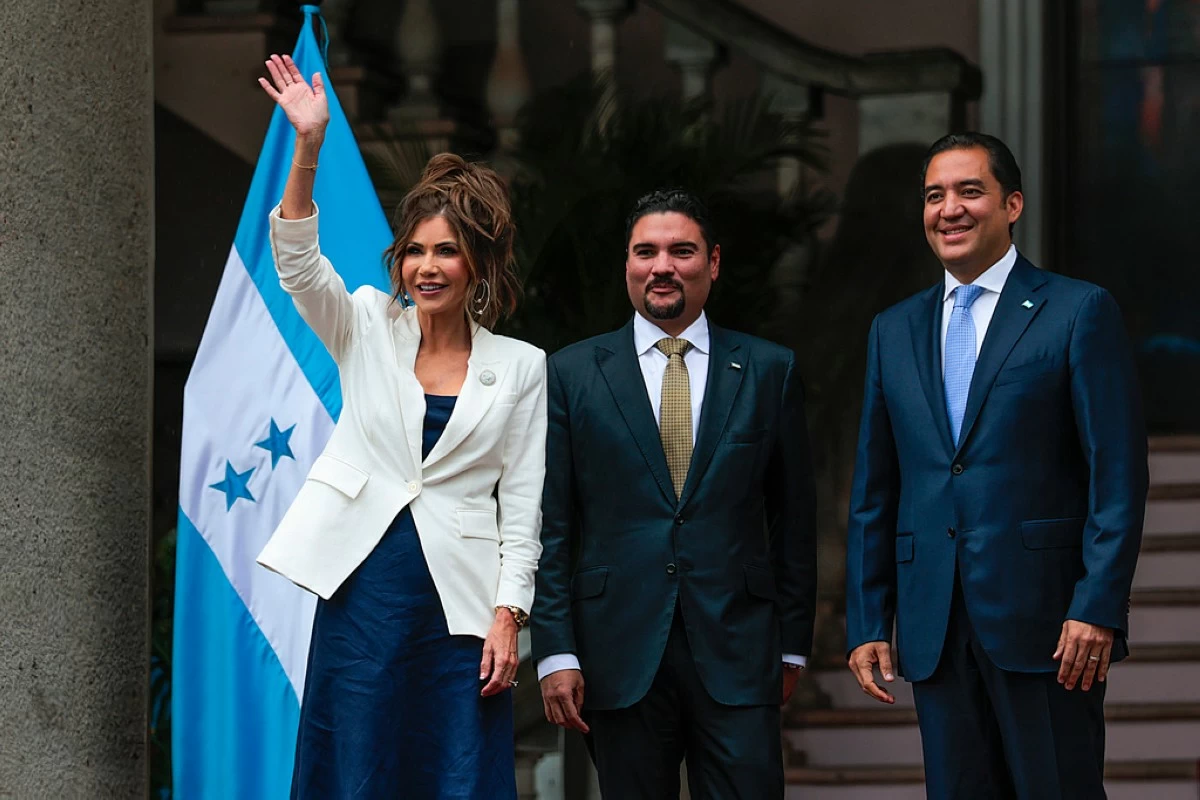
U.S. Homeland Security Secretary Kristi Noem waves alongside Honduran Foreign Minister Javier Bu, center, and presidential private secretary Hector Zelaya at the president's residence in Tegucigalpa, Honduras, Wednesday, June 25, 2025. (Anna Moneymaker/Pool photo via AP)
Noem was the first Trump Cabinet member to visit Honduras.
The two leaders did not make comments to the press after their meeting. But Honduras Foreign Affairs Minister Javier Bú Soto later said that Honduras signed a letter of intent toward reaching an agreement on sharing biometric data from people transiting the country with the U.S. government. The U.S. has signed similar agreements with other governments across the region.
The two governments also signed an agreement related to migrants seeking protection in Honduras, he said, though he did not explain what it entailed.
“We are going to continue mutually collaborating on issues of migration security, border security and the fight against drug trafficking,” Bú Soto said.
Noem was headed next to Guatemala where she was scheduled to meet with President Bernardo Arévalo on Thursday.
Relations between the U.S. and Castro’s administration had been tense since she ordered the end of the longstanding extradition treaty last year. It was under that treaty that Castro sent her predecessor ex-President Juan Orlando Hernández to the United States to be tried on drug trafficking charges.
The U.S. ambassador at the time had angered Castro by criticizing the visit of Honduran officials to Venezuela to meet with that country’s longtime defense minister, Vladimir Padrino López, who has been indicted on drug trafficking charges by the U.S.
Then in January, Castro raised the possibility of ending Honduras’ cooperation with the U.S. military if Trump followed through on his promised mass deportations.
The main U.S. military presence in Honduras is at Soto Cano Air Base outside the capital. While it is a Honduran base, the U.S. has maintained a significant presence there since 1983 and it has become a key U.S. launching point for humanitarian and anti-drug missions in Central America.
Castro eventually reversed course earlier this year on the extradition treaty and restored the agreement after negotiations with the Trump administration.
But Honduras was notably left off U.S. Secretary of State Marco Rubio’s trip through the region in February.
Honduran international affairs analyst Graco Pérez the two governments discussed likely discussed more than they announced.
“That is the official version, we don’t know the other part,” Pérez said.
He also questioned comments made by Castro’s son and Presidential Minister Hector Zelaya after the meeting emphasizing the strength of the countries' relationship and coordination.
“For three and a half years they were confronting (the U.S.) and now, in the last six months, they want to give the impression that relations are very cordial,” Pérez said. “I don’t think it’s like that.”
Earlier Wednesday, Noem met with Costa Rican President Rodrigo Chaves in San Jose. They signed a letter reaffirming the U.S. support for Costa Rica’s bid to join the Global Entry program. That is a program run by the U.S. Customs and Border Protection, which allows certain passengers who applied to the program and are prescreened to get expedited entry into the U.S.
Noem also said the U.S. would help Chaves advance toward his goal of scanning all people and goods entering Costa Rica. The U.S. has been signing agreements across the region for governments to collect and share biometric data on people entering their countries.
“(Costa Rica) will give us the most advanced information that we need to know on people who could come into our countries that could do us harm, but also how to prevent them from spreading their criminality and their evil across the world,” Noem said.
Noem visited Panama on Tuesday, where she met with President José Raúl Mulino. The U.S. government has designated $14 million for a repatriation program where Panama flies migrants back to their countries.

Related Tags

WORLDNEWS
ADVERTISEMENT
.most-popular .layout-ratio{ padding-bottom: 79.13%; } @media (min-width: 768px) and (max-width: 1024px) { .widget-title { font-size: 15px !important; } }

{{ articles_filter_1561_widget.title }}

.most-popular .layout-ratio{ padding-bottom: 79.13%; } @media (min-width: 768px) and (max-width: 1024px) { .widget-title { font-size: 15px !important; } }

{{ articles_filter_1562_widget.title }}

.most-popular .layout-ratio{ padding-bottom: 79.13%; } @media (min-width: 768px) and (max-width: 1024px) { .widget-title { font-size: 15px !important; } }

{{ articles_filter_1563_widget.title }}

{{ articles_filter_1564_widget.title }}

.mb-article-details { position: relative; } .mb-article-details .article-body-preview, .mb-article-details .article-body-summary{ font-size: 17px; line-height: 30px; font-family: "Libre Caslon Text", serif; color: #000; } .mb-article-details .article-body-preview iframe , .mb-article-details .article-body-summary iframe{ width: 100%; margin: auto; } .read-more-background { background: linear-gradient(180deg, color(display-p3 1.000 1.000 1.000 / 0) 13.75%, color(display-p3 1.000 1.000 1.000 / 0.8) 30.79%, color(display-p3 1.000 1.000 1.000) 72.5%); position: absolute; height: 200px; width: 100%; bottom: 0; display: flex; justify-content: center; align-items: center; padding: 0; } .read-more-background a{ color: #000; } .read-more-btn { padding: 17px 45px; font-family: Inter; font-weight: 700; font-size: 18px; line-height: 16px; text-align: center; vertical-align: middle; border: 1px solid black; background-color: white; } .hidden { display: none; }
function initializeAllSwipers() { // Get all hidden inputs with cms_article_id document.querySelectorAll('[id^="cms_article_id_"]').forEach(function (input) { const cmsArticleId = input.value; const articleSelector = '#article-' + cmsArticleId + ' .body_images'; const swiperElement = document.querySelector(articleSelector); if (swiperElement && !swiperElement.classList.contains('swiper-initialized')) { new Swiper(articleSelector, { loop: true, pagination: false, navigation: { nextEl: '#article-' + cmsArticleId + ' .swiper-button-next', prevEl: '#article-' + cmsArticleId + ' .swiper-button-prev', }, }); } }); } setTimeout(initializeAllSwipers, 3000); const intersectionObserver = new IntersectionObserver( (entries) => { entries.forEach((entry) => { if (entry.isIntersecting) { const newUrl = entry.target.getAttribute("data-url"); if (newUrl) { history.pushState(null, null, newUrl); let article = entry.target; // Extract metadata const author = article.querySelector('.author-section').textContent.replace('By', '').trim(); const section = article.querySelector('.section-info ').textContent.replace(' ', ' '); const title = article.querySelector('.article-title h1').textContent; // Parse URL for Chartbeat path format const parsedUrl = new URL(newUrl, window.location.origin); const cleanUrl = parsedUrl.host + parsedUrl.pathname; // Update Chartbeat configuration if (typeof window._sf_async_config !== 'undefined') { window._sf_async_config.path = cleanUrl; window._sf_async_config.sections = section; window._sf_async_config.authors = author; } // Track virtual page view with Chartbeat if (typeof pSUPERFLY !== 'undefined' && typeof pSUPERFLY.virtualPage === 'function') { try { pSUPERFLY.virtualPage({ path: cleanUrl, title: title, sections: section, authors: author }); } catch (error) { console.error('ping error', error); } } // Optional: Update document title if (title && title !== document.title) { document.title = title; } } } }); }, { threshold: 0.1 } ); function showArticleBody(button) { const article = button.closest("article"); const summary = article.querySelector(".article-body-summary"); const body = article.querySelector(".article-body-preview"); const readMoreSection = article.querySelector(".read-more-background"); // Hide summary and read-more section summary.style.display = "none"; readMoreSection.style.display = "none"; // Show the full article body body.classList.remove("hidden"); } document.addEventListener("DOMContentLoaded", () => { let loadCount = 0; // Track how many times articles are loaded const offset = [1, 2, 3, 4, 5, 6, 7, 8, 9, 10]; // Offset values const currentUrl = window.location.pathname.substring(1); let isLoading = false; // Prevent multiple calls if (!currentUrl) { console.log("Current URL is invalid."); return; } const sentinel = document.getElementById("load-more-sentinel"); if (!sentinel) { console.log("Sentinel element not found."); return; } function isSentinelVisible() { const rect = sentinel.getBoundingClientRect(); return ( rect.top < window.innerHeight && rect.bottom >= 0 ); } function onScroll() { if (isLoading) return; if (isSentinelVisible()) { if (loadCount >= offset.length) { console.log("Maximum load attempts reached."); window.removeEventListener("scroll", onScroll); return; } isLoading = true; const currentOffset = offset[loadCount]; window.loadMoreItems().then(() => { let article = document.querySelector('#widget_1690 > div:nth-last-of-type(2) article'); intersectionObserver.observe(article) loadCount++; }).catch(error => { console.error("Error loading more items:", error); }).finally(() => { isLoading = false; }); } } window.addEventListener("scroll", onScroll); });

Sign up by email to receive news.