






Manila Bulletin
 Lifestyle
Travel
Experience the future of travel with Philippine Airlines' new A350-1000
Lifestyle
Travel
Experience the future of travel with Philippine Airlines' new A350-1000
Lifestyle
Travel
Experience the future of travel with Philippine Airlines' new A350-1000
Experience the future of travel with Philippine Airlines' new A350-1000
By Rey Ilagan
Published Jun 23, 2025 09:02 pm


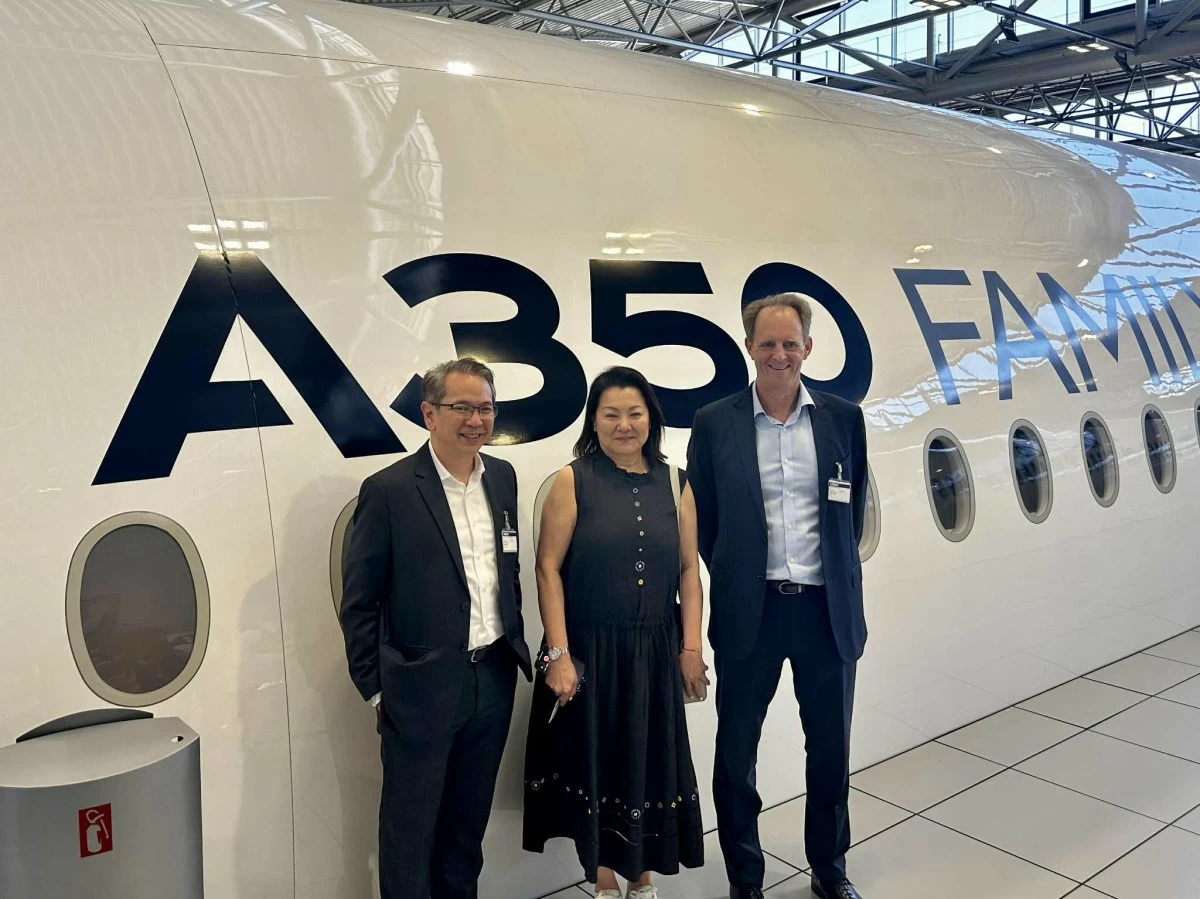
PAL's Atty. Carlo Luis Fernandez, executive vice president and COO; Sheila Pascual, director; and Richard Nuttall, president, visit the Airbus headquarters in Toulouse, France. (Photo by Rey Ilagan/Manila Bulletin)
TOULOUSE, FRANCE — Inside Airbus’ sprawling final assembly line in Toulouse, a new aircraft is quietly taking shape—one that carries not just the Philippine flag on its tail, but the future of Philippine Airlines (PAL). On June 20, 2025, PAL offered a first look at its next-generation flagship: the Airbus A350-1000, a sleek, wide-bodied aircraft that represents a bold step forward in the airline’s long-haul ambitions.
Currently under production, the A350-1000 isn’t just an aircraft; it’s a commitment to elevated service, modern design, and more efficient, sustainable travel. For PAL, it marks the beginning of a new chapter in its 84-year history, and for travelers, a new way to fly farther, better, and with deeper care.
“The A350-1000 takes Philippine Airlines to a new level. It will give us an airline and a product that we can all be truly proud of, and it reflects well not just on the airline, but also serves as a great ambassador for the country,” said Richard Nuttall, PAL president, during a media presentation in Toulouse.
Atty. Carlos Luis Fernandez, PAL executive vice president and chief operating officer, echoed this. “It’s time for the next chapter. It’s time to elevate our fleet with new technology, enhanced cabin features, and the performance and reliability needed for future growth,” said Fernandez. “We began this transformation with the introduction of the Airbus A350-900 in 2018 — an aircraft built here in Toulouse and beloved by our passengers for its comfort and efficiency.”
Nuttall and Fernandez were joined by PAL Director Sheila Pascual, alongside Airbus executives and members of the media, to mark this milestone moment for the flag carrier.
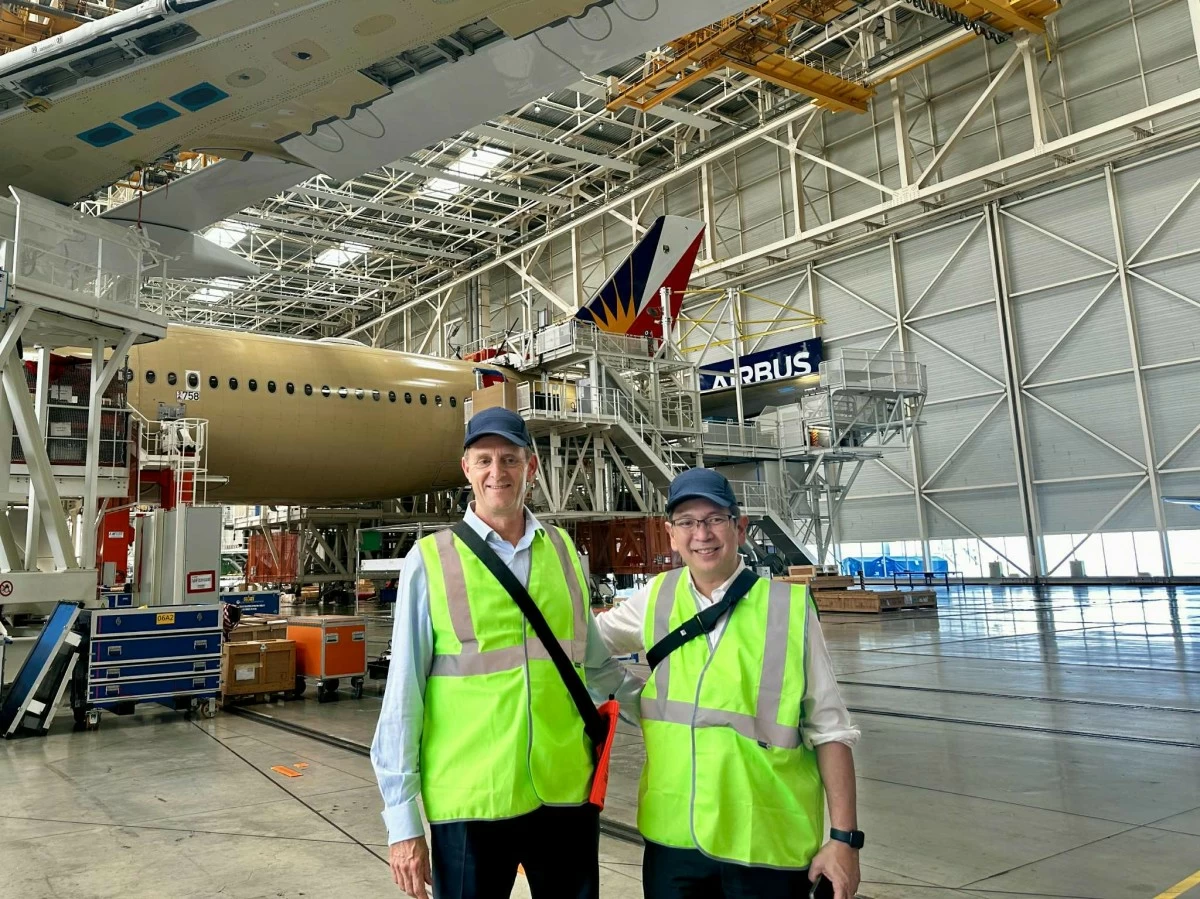
PAL President Richard Nuttall and Executive Vice President and COO Atty. Carlo Luis Fernandez (Photo by Rey Ilagan/Manila Bulletin)
The A350 family
The A350-1000 aircraft, powered by Rolls-Royce Trent XWB-97 engines, is capable of flying up to 16,100 kilometers nonstop. This makes it ideal for PAL’s transpacific routes—flights that span polar paths from North America to Manila.
The aircraft will feature a tri-class layout, accommodating 382 passengers: 42 in Business Class, 24 in Premium Economy, and 316 in Economy. Each class offers its own upgraded comforts—from privacy doors, direct aisle access, personal vanity mirrors, and curated inflight dining in Business to thoughtful legroom and fresh interiors in Economy.
But what PAL hopes to deliver, beyond comfort, is intention. “From a service perspective, our motto is ‘Buong Pusong Alaga’ or care that comes from the heart,” Fernandez said. “We want the new aircraft to reflect that. We want the best product but more importantly, we want customers to be our priority.”
This is not PAL’s first foray with the A350. The airline introduced the A350-900 in 2018, an aircraft known for its fuel efficiency and cabin quietness—features that made it a favorite among PAL’s frequent flyers. “The A350-900 has been a favorite among our passengers for its comfort and efficiency. Now, with the A350-1000, we take that experience further, flying longer, cleaner, and better,” Nuttall explained.
At Airbus’ facility in Toulouse, the assembly of PAL’s first A350-1000 is already underway, with five key sections—nose, forward fuselage, center fuselage, rear, and wings—now being connected and fitted with systems for air, water, and power. The level of precision involved is striking: every duct, cable, and component is subject to rigorous quality checks.
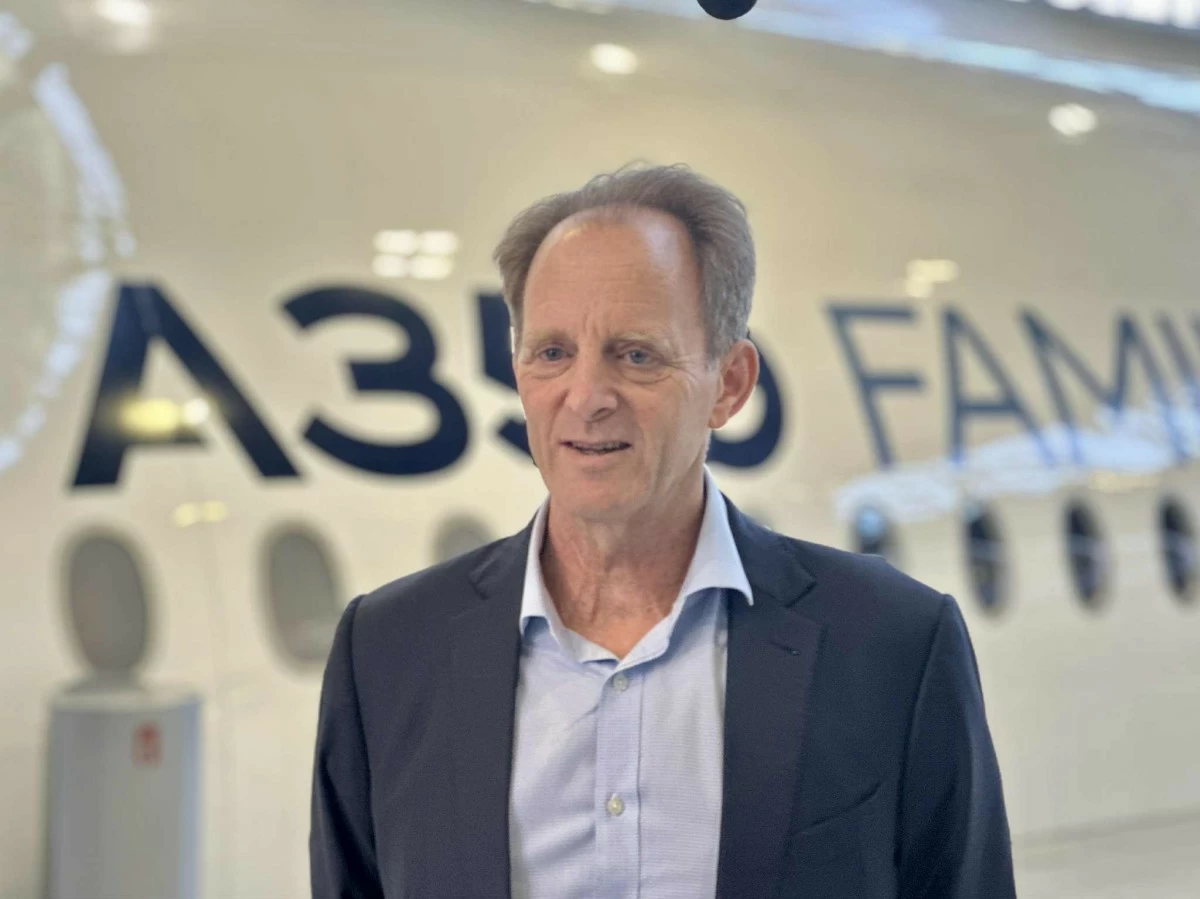
Richard Nuttall (Photo by Rey Ilagan/Manila Bulletin)
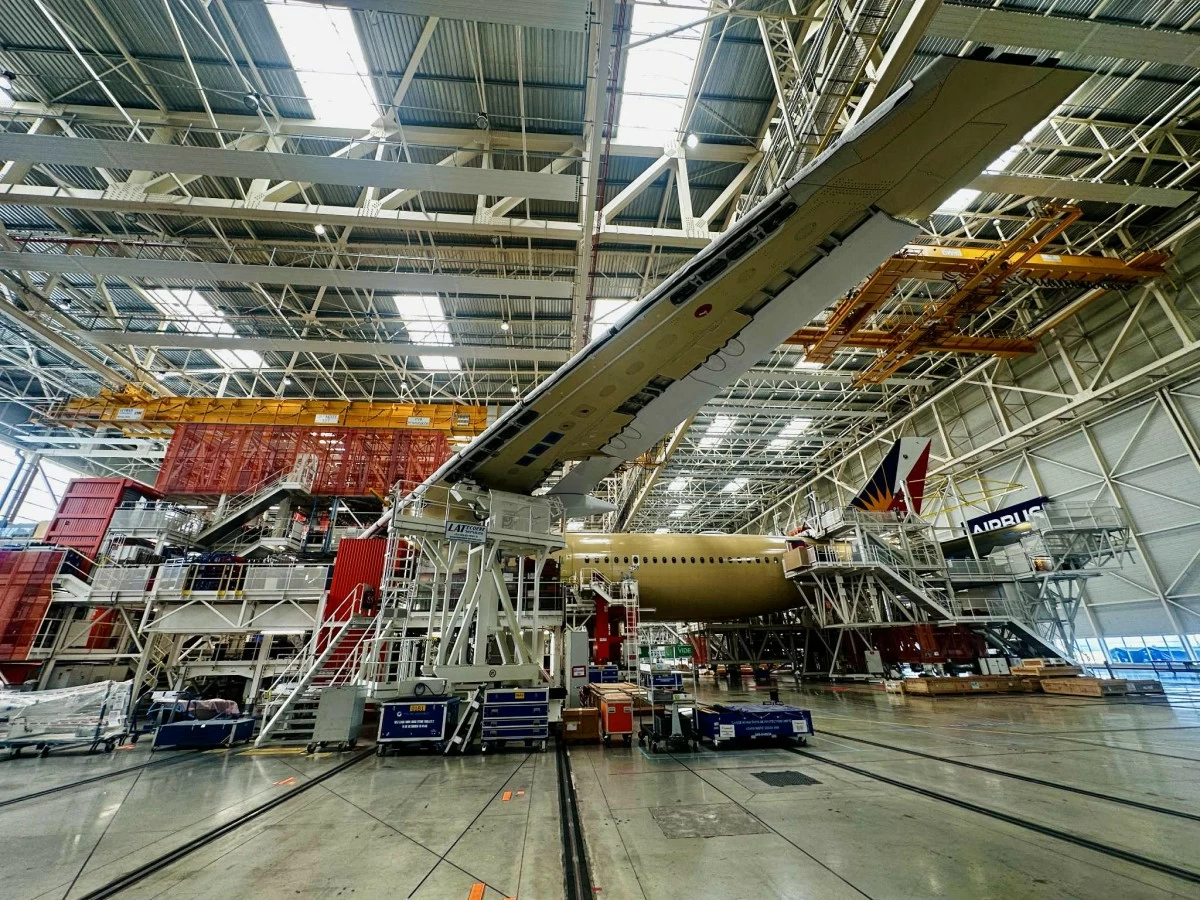
PAL's new A350-1000 at Airbus' final assembly line (Photo by Rey Ilagan/Manila Bulletin)
Partners in the sky
PAL and Airbus go back a long way—46 years to be exact. It’s a partnership that has defined much of PAL’s modern fleet, with Airbus aircraft now making up 73 percent of the flag carrier’s 79 aircraft.
“We are happy to strengthen the strategic partnership between Philippine Airlines and Airbus that has given both companies good value over the decades, the result of a shared vision where our teams work together to achieve customer satisfaction, quality operations, and high safety standards above all,” Nuttall shared.
The partnership began with the A300B4, PAL’s first-ever Airbus acquisition and a game-changer in global aviation. As the world’s first twin-engine, twin-aisle aircraft, the A300B4 brought widebody comfort to short- and medium-haul routes.
By 1997, PAL had turned to the A320 family as the backbone of its domestic and regional network with A319, A320, and A321 serving key routes. For long-haul ambitions, the A340 joined the fleet in 1996, extending PAL’s reach to Europe. At its peak, the A340 flew to Las Vegas, Los Angeles, Auckland, and Vancouver, and in 2015, carried Pope Francis home to Rome after his Philippine visit.
Today, the A330 serves as PAL’s widebody workhorse across a variety of key destinations: Hawaii, Japan, the Middle East, and Australia (Melbourne and Sydney). Meanwhile, the luxurious A350-900 handles the airline’s longest nonstop routes—New York and Toronto to Manila—via transpolar flights. These ultra-long-haul routes are among the world’s top 15 longest-distance commercial services.
“Looking forward to the new A350-1000s, I assure you that we will be a demanding partner, expecting an even greater level of spirited collaboration to ensure that PAL’s new flagship will be a sterling addition to our fleet,” he said.

Atty. Carlo Luis Fernandez (Photo by Rey Ilagan/Manila Bulletin)
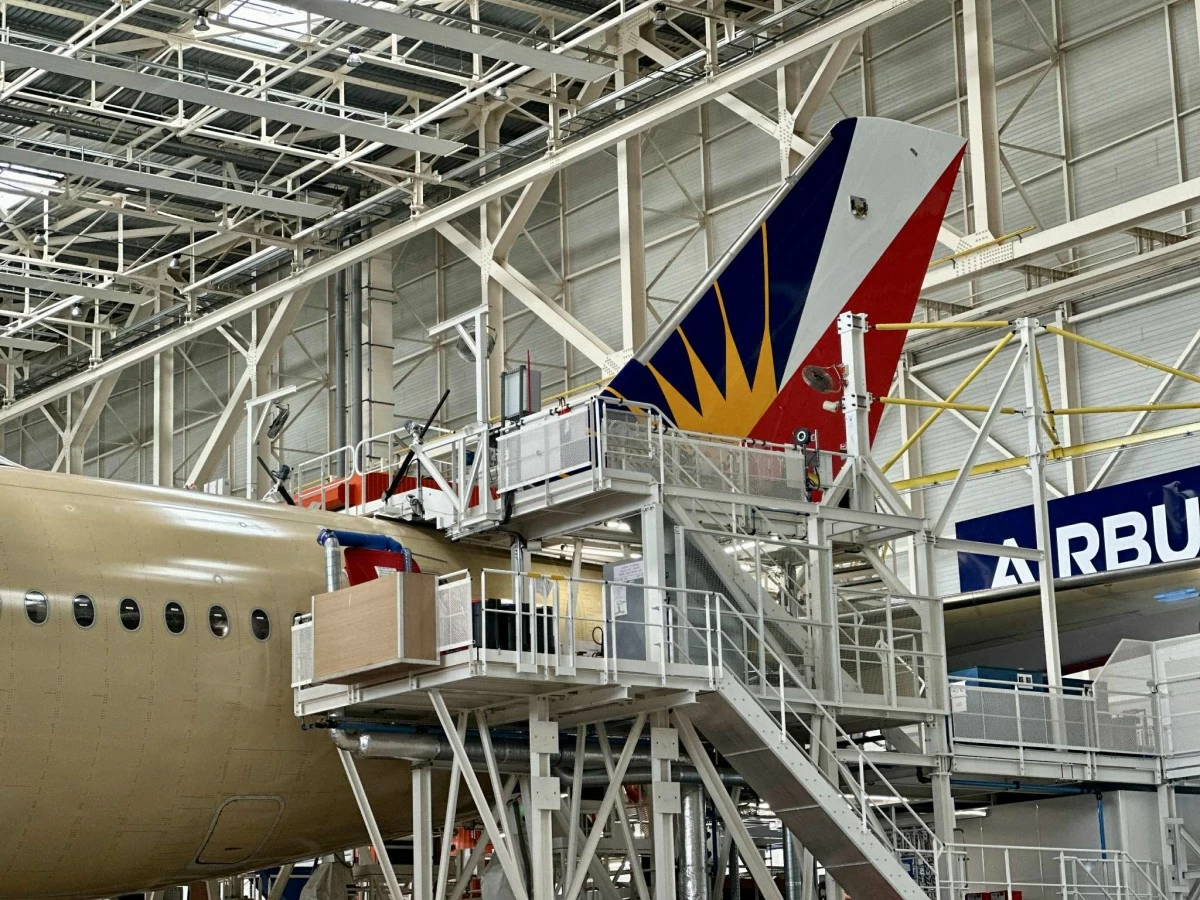
PAL's new A350-1000 at Airbus' final assembly line (Photo by Rey Ilagan/Manila Bulletin)
Fleet of the future
PAL has nine of the A350-1000 on order, with deliveries staggered until 2028. The first will be delivered in the fourth quarter of 2025, just in time for the holiday travel season. And while the A350-1000s are primarily intended to replace PAL’s Boeing 777s rather than expand its fleet, the aircraft’s ultra-long-range capability gives the airline valuable flexibility as demand shifts.
“Our new aircrafts–the A350-1000s–are not meant as incremental growth for us. It’s just replacing 777 aircrafts so we will maintain our current networks. But having said that, we continually look at potential new routes whether in Europe or in North America,” Fernandez said.
For now, that means maintaining PAL’s current network while refining the experience onboard. With aircraft that are already certified for the world’s longest commercial flights, PAL is positioning itself to respond to global demand swiftly, should the opportunity present itself.
Alongside the A350-1000s, PAL is also set to receive 13 new A321neo jets beginning in 2026, which will bolster its regional footprint. But the A350-1000 remains the heart of the long-haul vision—a quiet, fuel-efficient flagship built not just for speed or distance, but for the evolving needs of today’s traveler.