ADVERTISEMENT

BTS' Suga donates $3.62-M to establish treatment center for autism spectrum disorder

Published Jun 23, 2025 11:33 am  |  Updated Jun 23, 2025 03:50 pm
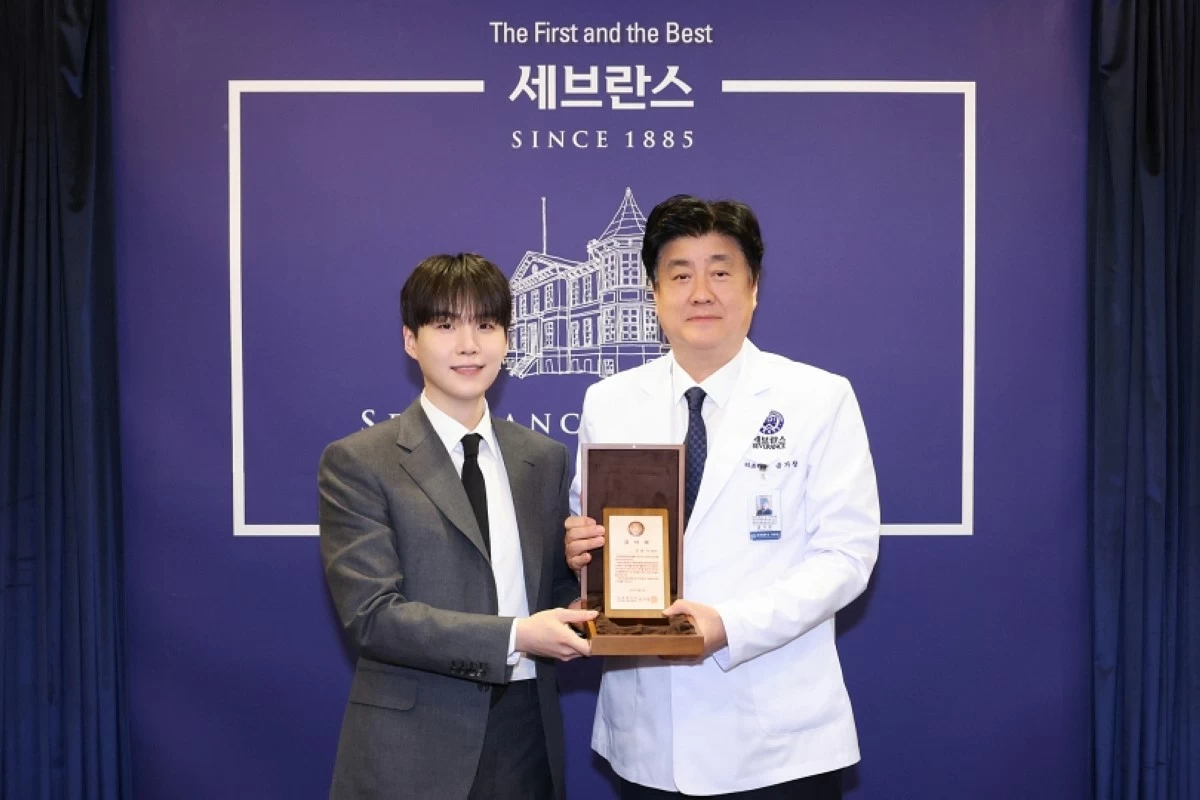
BTS member Suga (left) with Dr. Keum Ki Chang, president and CEO of the Yonsei University Health System, which owns Severance Hospital (Photo from Severance Hospital)
K-pop idol group BTS member Suga donated 5 billion won (about $3.62 million) to Severance Hospital in Seoul for the establishment of a treatment center for people with autism spectrum disorder.
With the donation, Suga and Severance Hospital will establish the Min Yoon-gi Treatment Center to support treatment and independence of children and adolescents with autism spectrum disorder.
Min Yoon-gi is Suga’s real name. Suga was discharged from the military on June 21.
“Autism spectrum disorder is a condition related to brain development that affects how people see others and socialize with them. This causes problems in communication and getting along with others socially,” according to the Mayo Clinic.
It added, “Autism spectrum disorder includes conditions that were once thought to be separate — autism, Asperger's syndrome, childhood disintegrative disorder and a form of widespread developmental disorder that isn't specified.”
On June 23, Severance Hospital held a groundbreaking ceremony for the Min Yoon-gi Treatment Center in Seoul.
The center will support the mental health of children and adolescents through language, psychology, and behavioral therapy, and will operate various programs that link clinical practice and research.
When it opens in September, regular program sessions will be expanded and newly established. Various treatment sessions will be operated, starting with social skills training using music for patients with autism spectrum disorder and developmental disabilities.
Existing ABA (Applied Behavior Analysis) and speech therapy will also be expanded. In addition, clinical research, academic paper presentations, and program manuals will be published to objectively prove the effectiveness of the MIND (Music, Interaction, Network and Diversity) program.
Last November, Suga met Professor Cheon Keun-ah of the Department of Pediatrics at Severance Hospital, an authority in pediatric psychiatry.
Through several meetings since then, he learned that patients with autism spectrum disorder need customized treatment that fits their life cycle, but that it is difficult to achieve with existing short-term therapeutic interventions.
In order to bring about positive changes in the symptoms of autism spectrum disorder, a specialized treatment center that can provide long-term treatment for more than 10 years is needed, so he expressed his intention to donate five billion won to Severance Hospital.
This is the largest donation ever made by an artist, not only to Severance Children’s Hospital but also to Yonsei Medical Center, according to Severance Hospital.
Afterwards, Professor Cheon and Suga discussed the establishment of a treatment center and social training using music for children and adolescents with autism spectrum disorder from the end of last year to the beginning of this year.
Based on this, they developed the ‘MIND’ program, a social group program that grafts musical content onto the existing social training program.
Under the MIND program, children who participate play instruments, sing songs, write songs to music, and express their emotions and thoughts through music and writing.
From March to June this year, Suga spent weekends meeting children with autism spectrum disorder and participated in the development of the program.
In the future, the Min Yoon-gi Treatment Center plans to further develop the MIND program and establish a self-reliant music project model.
Professor Cheon said, “Beyond financial support, I sincerely thank Suga for his sincere talent donation and volunteer work over the past several months. I was deeply impressed by Suga’s sincerity, which he has consistently shown with a serious and intellectual attitude.”
Suga said, “Through the program preparation and volunteer work with Professor Cheon Keun-ah over the past seven months, I deeply felt that music can be a valuable channel for expressing one’s feelings and communicating with the world. I was very grateful and happy to be able to participate in the treatment process for children with autism spectrum disorder, and I will continue to support more children so that they can become members of our society.”
ADVERTISEMENT
.most-popular .layout-ratio{ padding-bottom: 79.13%; } @media (min-width: 768px) and (max-width: 1024px) { .widget-title { font-size: 15px !important; } }

{{ articles_filter_1561_widget.title }}

.most-popular .layout-ratio{ padding-bottom: 79.13%; } @media (min-width: 768px) and (max-width: 1024px) { .widget-title { font-size: 15px !important; } }

{{ articles_filter_1562_widget.title }}

.most-popular .layout-ratio{ padding-bottom: 79.13%; } @media (min-width: 768px) and (max-width: 1024px) { .widget-title { font-size: 15px !important; } }

{{ articles_filter_1563_widget.title }}

{{ articles_filter_1564_widget.title }}

.mb-article-details { position: relative; } .mb-article-details .article-body-preview, .mb-article-details .article-body-summary{ font-size: 17px; line-height: 30px; font-family: "Libre Caslon Text", serif; color: #000; } .mb-article-details .article-body-preview iframe , .mb-article-details .article-body-summary iframe{ width: 100%; margin: auto; } .read-more-background { background: linear-gradient(180deg, color(display-p3 1.000 1.000 1.000 / 0) 13.75%, color(display-p3 1.000 1.000 1.000 / 0.8) 30.79%, color(display-p3 1.000 1.000 1.000) 72.5%); position: absolute; height: 200px; width: 100%; bottom: 0; display: flex; justify-content: center; align-items: center; padding: 0; } .read-more-background a{ color: #000; } .read-more-btn { padding: 17px 45px; font-family: Inter; font-weight: 700; font-size: 18px; line-height: 16px; text-align: center; vertical-align: middle; border: 1px solid black; background-color: white; } .hidden { display: none; }
function initializeAllSwipers() { // Get all hidden inputs with cms_article_id document.querySelectorAll('[id^="cms_article_id_"]').forEach(function (input) { const cmsArticleId = input.value; const articleSelector = '#article-' + cmsArticleId + ' .body_images'; const swiperElement = document.querySelector(articleSelector); if (swiperElement && !swiperElement.classList.contains('swiper-initialized')) { new Swiper(articleSelector, { loop: true, pagination: false, navigation: { nextEl: '#article-' + cmsArticleId + ' .swiper-button-next', prevEl: '#article-' + cmsArticleId + ' .swiper-button-prev', }, }); } }); } setTimeout(initializeAllSwipers, 3000); const intersectionObserver = new IntersectionObserver( (entries) => { entries.forEach((entry) => { if (entry.isIntersecting) { const newUrl = entry.target.getAttribute("data-url"); if (newUrl) { history.pushState(null, null, newUrl); let article = entry.target; // Extract metadata const author = article.querySelector('.author-section').textContent.replace('By', '').trim(); const section = article.querySelector('.section-info ').textContent.replace(' ', ' '); const title = article.querySelector('.article-title h1').textContent; // Parse URL for Chartbeat path format const parsedUrl = new URL(newUrl, window.location.origin); const cleanUrl = parsedUrl.host + parsedUrl.pathname; // Update Chartbeat configuration if (typeof window._sf_async_config !== 'undefined') { window._sf_async_config.path = cleanUrl; window._sf_async_config.sections = section; window._sf_async_config.authors = author; } // Track virtual page view with Chartbeat if (typeof pSUPERFLY !== 'undefined' && typeof pSUPERFLY.virtualPage === 'function') { try { pSUPERFLY.virtualPage({ path: cleanUrl, title: title, sections: section, authors: author }); } catch (error) { console.error('ping error', error); } } // Optional: Update document title if (title && title !== document.title) { document.title = title; } } } }); }, { threshold: 0.1 } ); function showArticleBody(button) { const article = button.closest("article"); const summary = article.querySelector(".article-body-summary"); const body = article.querySelector(".article-body-preview"); const readMoreSection = article.querySelector(".read-more-background"); // Hide summary and read-more section summary.style.display = "none"; readMoreSection.style.display = "none"; // Show the full article body body.classList.remove("hidden"); } document.addEventListener("DOMContentLoaded", () => { let loadCount = 0; // Track how many times articles are loaded const offset = [1, 2, 3, 4, 5, 6, 7, 8, 9, 10]; // Offset values const currentUrl = window.location.pathname.substring(1); let isLoading = false; // Prevent multiple calls if (!currentUrl) { console.log("Current URL is invalid."); return; } const sentinel = document.getElementById("load-more-sentinel"); if (!sentinel) { console.log("Sentinel element not found."); return; } function isSentinelVisible() { const rect = sentinel.getBoundingClientRect(); return ( rect.top < window.innerHeight && rect.bottom >= 0 ); } function onScroll() { if (isLoading) return; if (isSentinelVisible()) { if (loadCount >= offset.length) { console.log("Maximum load attempts reached."); window.removeEventListener("scroll", onScroll); return; } isLoading = true; const currentOffset = offset[loadCount]; window.loadMoreItems().then(() => { let article = document.querySelector('#widget_1690 > div:nth-last-of-type(2) article'); intersectionObserver.observe(article) loadCount++; }).catch(error => { console.error("Error loading more items:", error); }).finally(() => { isLoading = false; }); } } window.addEventListener("scroll", onScroll); });

Sign up by email to receive news.