







There are now eight Filipinos who have been injured by Iranian retaliatory missiles to Israel, the Philippine Embassy in Tel Aviv said.
Injured Pinoys in Israel rise to 8—embassy
Published Jun 22, 2025 11:15 am
|
Updated Jun 22, 2025 01:29 pm


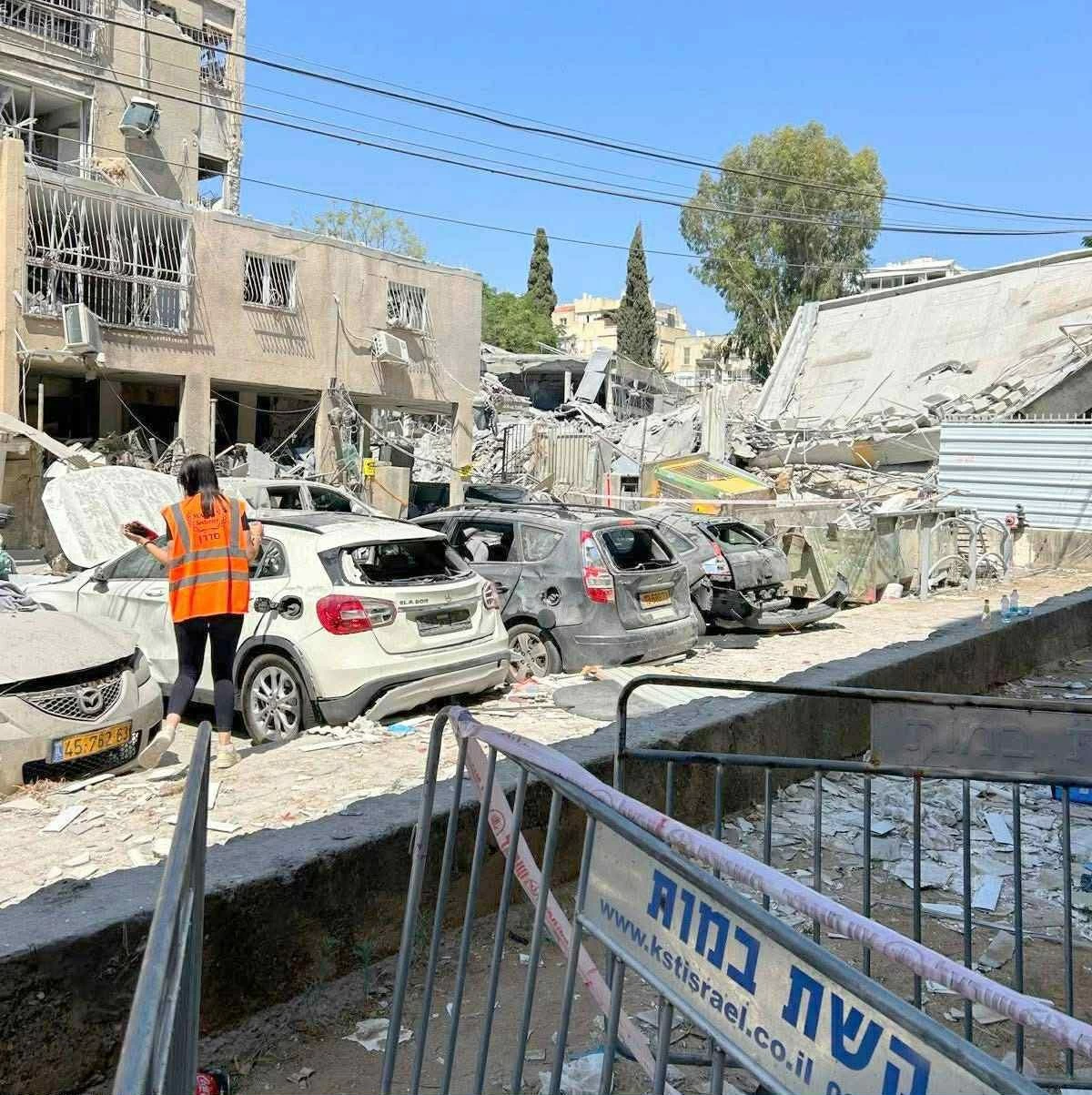
A member of the Philippine Rapid Response Team inspects the residence of 16 Filipinos hit by an Iranian missile in Bnei Brak. (Photo from the Philippine Embassy in Israel)
In a bulletin posted on its official Facebook page on Sunday, June 22, the embassy said that one Filipino who had “severe and life-threatening injuries” remains in critical condition, while another suffered from moderate to serious injuries and had been discharged and six already discharged from the hospital after receiving treatment for minor injuries.
The embassy shared that the Filipina in critical condition “underwent a major pulmonary surgery at Shamir Medical Center, one of Israel's most advanced hospitals,” but “she is still in the ICU and will need to undergo another surgery once stable.”
The now 10-day exchange of missiles between Israel and Iran also displaced 88 Filipinos since their homes were either hit or indirectly impacted by the attacks.
“They are currently being housed in temporary accommodations,” the embassy assured.
With crisis alert level 3 raised in both Israel and Iran, the embassy has received at least 223 initial requests for repatriation from Israel. However, only 26 of this number have confirmed and are now being processed for repatriation this week.
They will be crossing the King Hussein Border in Jordan, from where they can take flights back to Manila either via Dubai or Qatar.
The Philippine Embassy in Amman, in a separate statement, said it already welcomed a total of six Filipinos—one engineer on June 18 and four tourists and one worker on June 19–who crossed the Jordanian border.
‘One Country Team’ approach
“In anticipation of the arrival of more Filipino nationals through the Jordan-Israel border in the coming days, The Philippine Embassy in Amman is making necessary preparations for the next group of Overseas Filipino Workers (OFWs) set to cross. Ocular inspections of the border are currently being conducted,” the statement read.
In another statement, the embassy said that Philippine Ambassador to Jordan Wilfredo Santos activated the embassy’s Crisis Management Team (CMT) on Saturday, in response to the designation of Jordan as the primary exit point for Filipinos evacuating from Israel.
“The Philippine Embassy in Amman and the Migrant Workers Office in Jordan stand fully prepared to assist Filipinos and to provide all necessary support and repatriation assistance in line with the directive of President Ferdinand R. Marcos Jr. under Bagong Pilipinas,” Santos said as he and Labor Attaché Armi Evangel Peña called on embassy staff to adopt a unified response under the “One Country Team” approach.
Department of Foreign Affairs (DFA) Undersecretary Eduardo de Vega also assured during the Quezon City media forum on Saturday that agency personnel have adopted a “whole-of-government” approach and said that the DFA has called for the de-escalation of tension and “return to the path of peace to protect our millions of kababayans in the region.”
The official also underscored the importance of having “good relations with all the people in the Middle East” and expressed his gratitude to Jordan “which has been very generous to us, not prohibiting Filipino to crossover so that we can go home from Amman.”
He shared that no Filipino has been reported hurt in Iran as opposed to Israel because Israelis “know what their target is.”
“They know, very specific. The only casualties in Iran were deliberate,” De Vega furthered.
Most of the 1,180 Filipinos in Iran are residents and married to Iranian nationals, with only a handful of Filipinos who expressed their interest to be repatriated.
Filipinos who want to be repatriated from Iran might have to cross the border to Turkmenistan, which is 12 to 13 hours by car away from Tehran.
While the embassy prepares for the repatriation of Filipinos from Israel, it has also extended “various forms of assistance”—emergency financial assistance, provision of temporary shelter, to relief packages containing food, clothes, and hygiene products—to some 311 Filipinos.
'No need to panic'
Despite raising alert level 3 in Israel, DFA Assistant Secretary Robert Ferrer of the Office of Migrant Affairs told reporters that there’s no need for the public to panic.
Reading a message from Philippine Ambassador to Israel Aileen Mendiola-Rau, the DFA official said that there is currently no widespread disorder in Israel and that all essential services are still working, with the Israel Defense Forces (IDF) Homefront Command bringing down its security guidelines from “essential only” to “limited activity.”
“Bukas ang mga tanggapang naghahatid ng mahahalagang serbisyo. Bukas ang mga pamilihan ng pagkain at mahalagang pangangailangan, sapat ang kuryente, tubig at gasolina. Sa Israel, walang patid ang internet, telepono at iba pang utilities (Offices delivering essential services are open. Markets and other stores of basic needs are open, power supply, water, and fuel are sufficient. In Israel, internet connectivity, telephone, and other utilities are stable),” he quoted.
“Panatag at mahinaon naman ang mga mamamayan ng Israel kabilang ang mga Pilipino. Natutugunan din nang mabilis ang mga nasalanta at nangangailangan ng tulong. Bukas ang mga mall, restaurant at mga park (Israelites and Filipinos are calm and collected. The needs of those who are affected are also being addressed on time. Malls, restaurants, and parks are also open),” the official added.
Quoting Mendiola-Rau, Ferrer shared that the security guidelines may change every hour, but offices with existing bomb shelters are still open and 60 percent of public transportation is still operational.
Gatherings of up to 30 people are also allowed, although schools in all levels and public beaches remain closed.
However, Israelites have since returned to their normal outdoor activities, such as jogging, dog walking, and picnics, among others.