ADVERTISEMENT

The tech that mirrors us

The tech journey to a perfect selfie

Published Jun 21, 2025 10:45 am
Selfies, groufies, mirror shots, and now 0.5s— the various selfie styles have become an emblem of the digital age. Usually mocked for vanity yet praised for self-expression, selfies have been debated for their cultural value. But the selfie didn't appear out of nowhere. In fact, it's just the latest chapter in a long and winding story of self-portraiture, a practice rooted in art, experimentation, and the universal and timeless human impulse to preserve our image in time.
Origins in a Dark Room
The first self-portrait captured in a photograph is generally attributed to Robert Cornelius, who in 1839 entered the frame of his daguerreotype and wrote: “The first light picture ever taken.” While he was not the first individual to take a photo, Cornelius’s image holds importance. It showcases not merely a face, but also a desire to document oneself for future generations in this thrilling new medium.
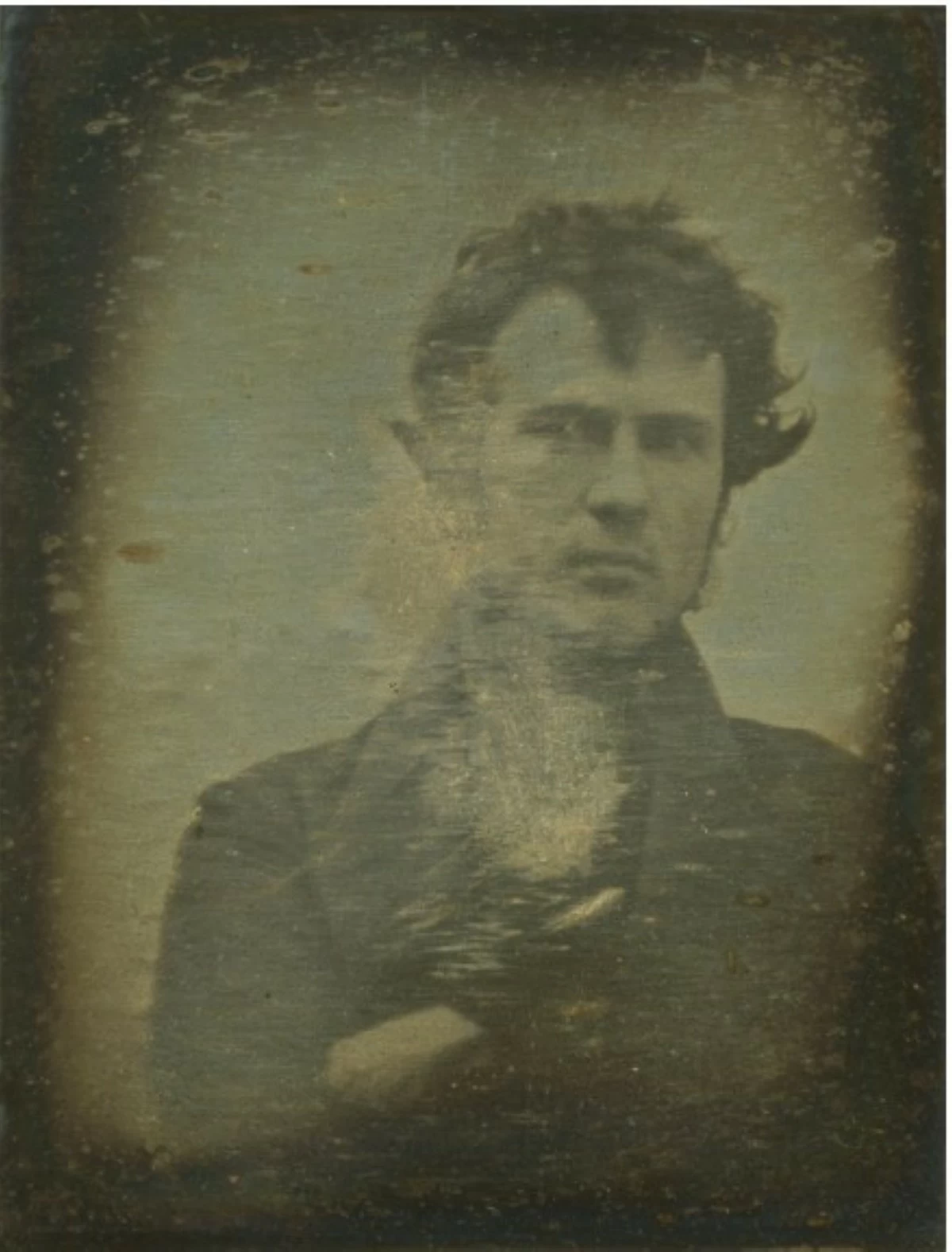
The first known photographic selfie was taken by Robert Cornelius in 1839.
From the outset, photographers directed the camera towards themselves. Whether for technical experimentation, sales purposes, or creative exploration, self-portraits played a crucial role in the early days of photography.
Art, Experimentation, and Identity
During the 20th century, self-portraiture transformed from mere documentation into a medium for artistic exploration. Photographers such as Alfred Stieglitz, Edward Steichen, Ilse Bing, whose self-portrait with a Leica is popular among today’s photographers and tech enthusiasts, as well as Walker Evans utilized self-portraits to experiment with techniques, delve into personal identity, or simply play with innovative tools. In 1927, Evans captured an experimental selfie in his studio and, subsequently, a series in a photo booth, foreshadowing Andy Warhol's famous strip-photo portraits.
In the mid-20th century, Man Ray and Berenice Abbott employed surrealism and abstraction to push the boundaries of self-representation.
From Street Life to Symbolic Selves
During the 1950s and 1960s, photographers such as Vivian Maier and Lee Friedlander focused on capturing candid and spontaneous moments. The 70s and 80s pushed the boundaries of self-portraiture further into the realms of personal experience, political themes, and conceptual exploration.
Enter the Smartphone (and the Word “Selfie”)
Although this word has a deep heritage, the term “selfie” was first introduced in 2002 on an Australian internet forum. However, it wasn’t until the advent of smartphones that selfies became a widespread social trend. By 2013, the term had garnered such popularity that it was recognized as Oxford Dictionary’s Word of the Year. Social media hastened the transition. MySpace in the 2000s made mirror selfies common (and often embarrassing). Facebook refined that representation. Instagram transformed it into a form of art. Now, TikTok combines selfies with movement, sound, and narrative.
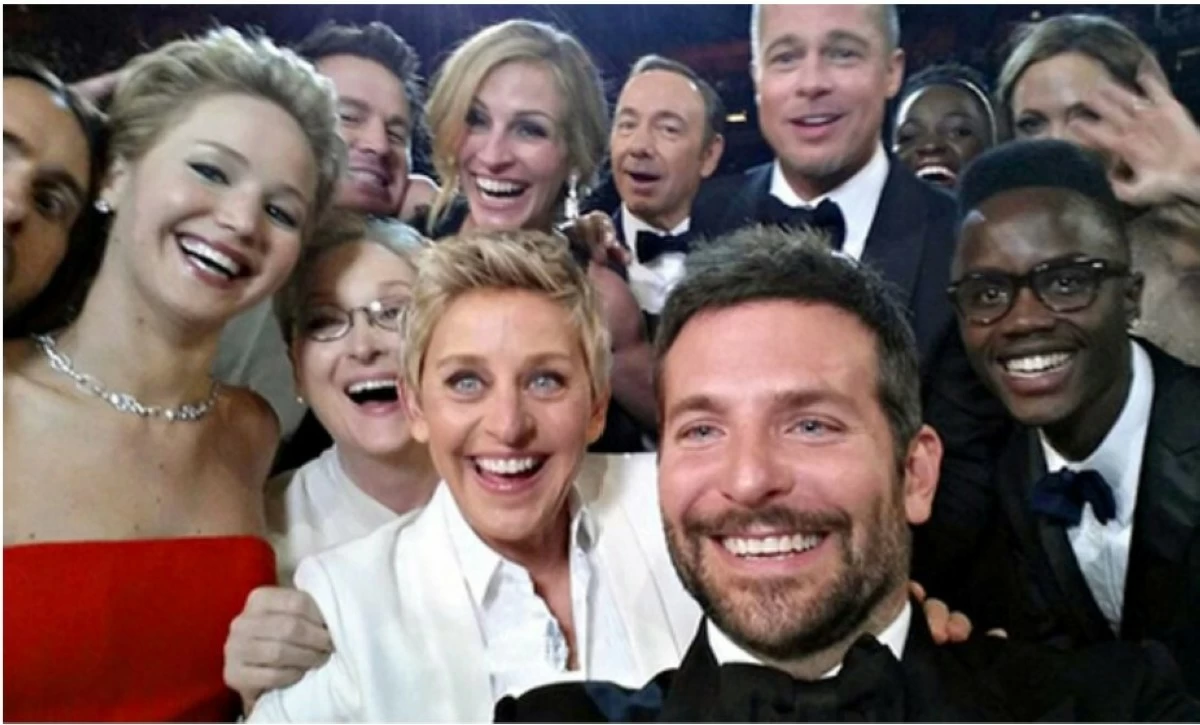
The famous (and most expensive) 2014 Oscars selfie.
However, this “progression” was not solely social—it was also technological. Selfies have become so integral to photography that the quality of phone cameras is now assessed based on how accurately they capture skin tones, facial shapes, and motion blur. The front-facing camera is no longer considered a secondary option—it has become the primary camera for many users.
Selfies as Art, Evidence, and Expression
So, what exactly is a selfie? It can serve as a piece of art. It can act as a social performance. It can signify a cry for help, a humorous moment, a record in time, a display of self-assurance, or a moment of vulnerability. They validate. They disclose. They mask. They challenge. They undermine. They document.
Certainly, there are poor-quality selfies. Too many, in fact. However, the act itself—capturing an image of oneself in a setting, an emotion, or a situation—is not inherently self-centered. In reality, it’s a profoundly human behavior. The urge to observe and be observed is as ancient as cave art. When you capture a selfie, it could be a quick update, or it could be your statement of existence and experience.
From the obscured likeness captured in Cornelius’s blurry daguerreotype to Sherman’s meticulously constructed personas, and even your fleeting selfie in a café bathroom, the essence of self-representation endures, morphing as the contexts evolve.
While it may be tempting to reserve the label of “art” for works of convention, perhaps it’s time to reevaluate our approach. Each selfie embodies a moment, a narrative, and a personal truth. So, embrace the act— capture your essence. Take the selfie.
ADVERTISEMENT
.most-popular .layout-ratio{ padding-bottom: 79.13%; } @media (min-width: 768px) and (max-width: 1024px) { .widget-title { font-size: 15px !important; } }

{{ articles_filter_1561_widget.title }}

.most-popular .layout-ratio{ padding-bottom: 79.13%; } @media (min-width: 768px) and (max-width: 1024px) { .widget-title { font-size: 15px !important; } }

{{ articles_filter_1562_widget.title }}

.most-popular .layout-ratio{ padding-bottom: 79.13%; } @media (min-width: 768px) and (max-width: 1024px) { .widget-title { font-size: 15px !important; } }

{{ articles_filter_1563_widget.title }}

{{ articles_filter_1564_widget.title }}

.mb-article-details { position: relative; } .mb-article-details .article-body-preview, .mb-article-details .article-body-summary{ font-size: 17px; line-height: 30px; font-family: "Libre Caslon Text", serif; color: #000; } .mb-article-details .article-body-preview iframe , .mb-article-details .article-body-summary iframe{ width: 100%; margin: auto; } .read-more-background { background: linear-gradient(180deg, color(display-p3 1.000 1.000 1.000 / 0) 13.75%, color(display-p3 1.000 1.000 1.000 / 0.8) 30.79%, color(display-p3 1.000 1.000 1.000) 72.5%); position: absolute; height: 200px; width: 100%; bottom: 0; display: flex; justify-content: center; align-items: center; padding: 0; } .read-more-background a{ color: #000; } .read-more-btn { padding: 17px 45px; font-family: Inter; font-weight: 700; font-size: 18px; line-height: 16px; text-align: center; vertical-align: middle; border: 1px solid black; background-color: white; } .hidden { display: none; }
function initializeAllSwipers() { // Get all hidden inputs with cms_article_id document.querySelectorAll('[id^="cms_article_id_"]').forEach(function (input) { const cmsArticleId = input.value; const articleSelector = '#article-' + cmsArticleId + ' .body_images'; const swiperElement = document.querySelector(articleSelector); if (swiperElement && !swiperElement.classList.contains('swiper-initialized')) { new Swiper(articleSelector, { loop: true, pagination: false, navigation: { nextEl: '#article-' + cmsArticleId + ' .swiper-button-next', prevEl: '#article-' + cmsArticleId + ' .swiper-button-prev', }, }); } }); } setTimeout(initializeAllSwipers, 3000); const intersectionObserver = new IntersectionObserver( (entries) => { entries.forEach((entry) => { if (entry.isIntersecting) { const newUrl = entry.target.getAttribute("data-url"); if (newUrl) { history.pushState(null, null, newUrl); let article = entry.target; // Extract metadata const author = article.querySelector('.author-section').textContent.replace('By', '').trim(); const section = article.querySelector('.section-info ').textContent.replace(' ', ' '); const title = article.querySelector('.article-title h1').textContent; // Parse URL for Chartbeat path format const parsedUrl = new URL(newUrl, window.location.origin); const cleanUrl = parsedUrl.host + parsedUrl.pathname; // Update Chartbeat configuration if (typeof window._sf_async_config !== 'undefined') { window._sf_async_config.path = cleanUrl; window._sf_async_config.sections = section; window._sf_async_config.authors = author; } // Track virtual page view with Chartbeat if (typeof pSUPERFLY !== 'undefined' && typeof pSUPERFLY.virtualPage === 'function') { try { pSUPERFLY.virtualPage({ path: cleanUrl, title: title, sections: section, authors: author }); } catch (error) { console.error('ping error', error); } } // Optional: Update document title if (title && title !== document.title) { document.title = title; } } } }); }, { threshold: 0.1 } ); function showArticleBody(button) { const article = button.closest("article"); const summary = article.querySelector(".article-body-summary"); const body = article.querySelector(".article-body-preview"); const readMoreSection = article.querySelector(".read-more-background"); // Hide summary and read-more section summary.style.display = "none"; readMoreSection.style.display = "none"; // Show the full article body body.classList.remove("hidden"); } document.addEventListener("DOMContentLoaded", () => { let loadCount = 0; // Track how many times articles are loaded const offset = [1, 2, 3, 4, 5, 6, 7, 8, 9, 10]; // Offset values const currentUrl = window.location.pathname.substring(1); let isLoading = false; // Prevent multiple calls if (!currentUrl) { console.log("Current URL is invalid."); return; } const sentinel = document.getElementById("load-more-sentinel"); if (!sentinel) { console.log("Sentinel element not found."); return; } function isSentinelVisible() { const rect = sentinel.getBoundingClientRect(); return ( rect.top < window.innerHeight && rect.bottom >= 0 ); } function onScroll() { if (isLoading) return; if (isSentinelVisible()) { if (loadCount >= offset.length) { console.log("Maximum load attempts reached."); window.removeEventListener("scroll", onScroll); return; } isLoading = true; const currentOffset = offset[loadCount]; window.loadMoreItems().then(() => { let article = document.querySelector('#widget_1690 > div:nth-last-of-type(2) article'); intersectionObserver.observe(article) loadCount++; }).catch(error => { console.error("Error loading more items:", error); }).finally(() => { isLoading = false; }); } } window.addEventListener("scroll", onScroll); });

Sign up by email to receive news.