







The Philippine government has called on Filipinos in Israel and Iran to avail of the government’s voluntary repatriation program amid plans to raise crisis alert level 3 in both countries because of the ongoing exchange of missile attacks.
PH mulls raising alert level in Israel, Iran
Published Jun 19, 2025 07:26 pm


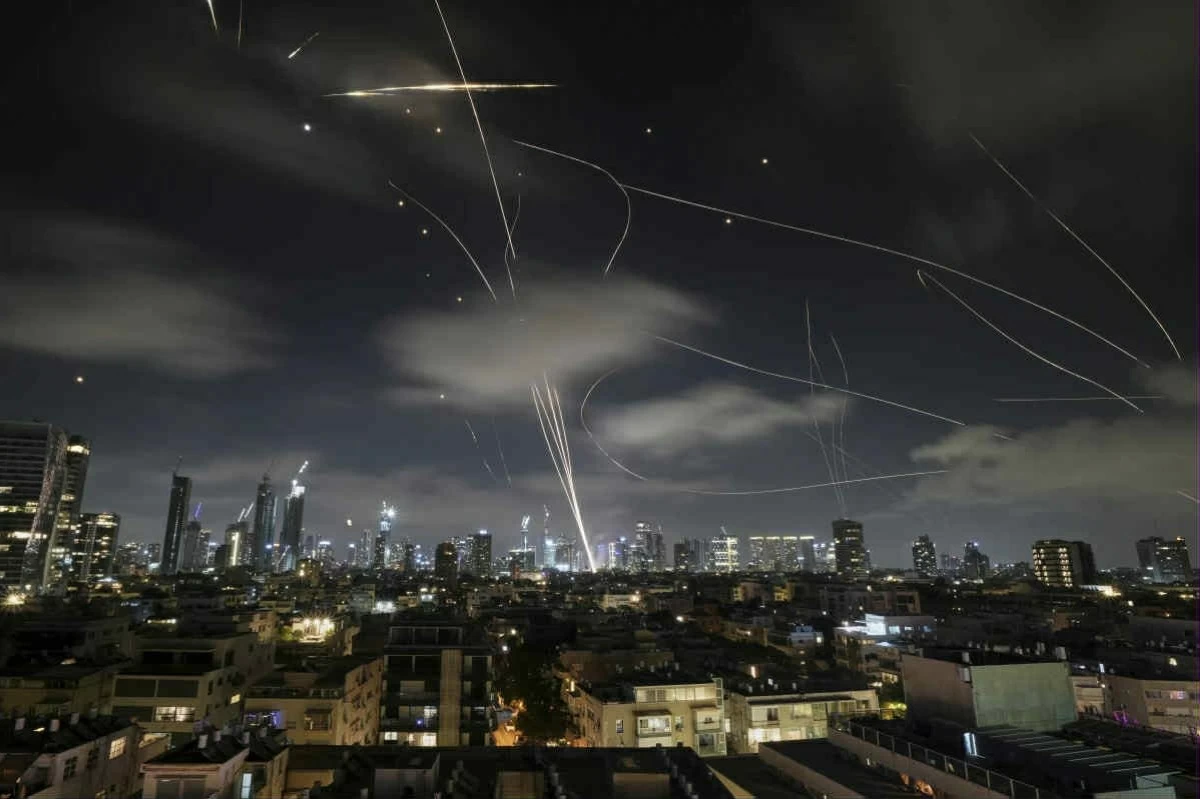
The Israeli Iron Dome air defense system fires to intercept missiles during an Iranian attack over Tel Aviv, Israel, early Wednesday, June 18, 2025. (AP Photo/Leo Correa)
During the Bagong Pilipinas Ngayon briefing, Department of Foreign Affairs (DFA) Undersecretary Eduardo de Vega said on Thursday, June 19, that they are currently waiting for DFA Secretary Enrique Manalo to sign the approval to raise alert level 3 in Israel and Iran.
Alert level 3 will activate the country’s voluntary repatriation program, which meant that Filipinos can opt to return to the Philippines, with the full expenses shouldered by the government.
“We expect Secretary of Foreign Affairs po na by today ay pipirmahan na niya ang approval ng pag-akyat, kasi gagawin natin for both countries ay voluntary repatriation para mas mapaalala natin sa mga kababayan natin na may repatriation program na kailangang pagsamantalahan nila (he will sign the approval of the raising, because we’re going to raise voluntary repatriation for both countries to remind Filipinos that they should take advantage of the repatriation program). So, today we expect,” he explained.
But even without Manalo’s approval yet, De Vega said that “we are going by the premise” that there’s an ongoing voluntary repatriation.
‘Israel is still functioning’
Asked why the DFA did not recommend to raise alert level four, or mandatory repatriation, in both countries, specifically in Israel where there are more than 30,000 Filipinos, De Vega explained that the war isn’t full-scale yet.
“Ngayon, bakit hindi mandatory? Kasi hindi pa full scale; puwede ka pang mabuhay sa Iran o sa Israel kahit na may giyera, hindi pa ito iyong untenable iyong situation (Now, why not mandatory? Because it is not yet full scale; you can still live in Iran or in Israel even though there’s a way, this is not yet an untenable situation),” the official said.
“Life goes on except for the firing of missile, iyong situation sa (the situation in) Israel is still that of a country which is functioning. Kapag failed state na, kapag hindi nagpa-function iyong bansa dahil talagang full scale war, doon tayo pupunta sa mandatory (When it is a failed state, when the country isn’t functioning because of full scale way, that’s when we will impose mandatory),” he added.
The DFA has only raised alert level 4, or mandatory repatriation, a handful of times—in Gaza because of the war between Israel and Hamas, in Libya during the Arab Spring, in Sudan, and in Afghanistan.
Ongoing repatriation
De Vega said that there has been an ongoing repatriation in Israel because of the conflict with Hamas in Gaza.
So far, 178 Filipinos in Israel have expressed their intent to go home, but only 26 will be processed for repatriation because they have ready passports.
Although only 1,300 Filipinos in Israel have availed of the repatriation program there since Oct. 7, 2023, the DFA official promised that they will bring all the 178 Filipinos who initially signed up for repatriation.
“We will bring them home,” he assured.
Similar to the 21 Philippine government officials who crossed the Israel-Jordan on Wednesday after they were stranded in Israel during a study program there, the DFA official said that Filipinos who will be repatriated from Israel will take the similar route.
But in Iran, De Vega doesn’t expect that many repatriates because “the vast majority of the 1,000 plus Filipinos there are Iranian residents” who are married to Iranian nationals.
“Pero may responsibility tayo sa mga OFWs, manageable number iyon (But we have a responsibility to the OFWs, that number is more manageable),” he added.
Jordan, Turkmenistan borders
The DFA official expressed confidence that the Philippine embassies in Tel Aviv and Amman will be able to bring Filipinos back home because of the land borders with Jordan and Turkmenistan.
While Filipinos in Israel would have to cross the Jordanian border, those in Iran will have to go to the border with Turkmenistan.
“So, mahusay ang ating pakikipag-ugnayan sa Israel at sa Jordan. So, mahusay naman at saka malapit lang po ang Jordan sa Israel. It’s a standard na isang paraan iyon for evacuation through Jordan (So, we have good coordination with Israel and Jordan. So, it’s good and Jordan is just near Israel. The evacuation to Jordan is standard),” he explained, adding that Jordan’s border, which is less than two hours away, is still open.
De Vega, however, admitted that there just might be logistical difficulties with transporting Filipinos from Iran to Turkmenistan as the border there is around 12 to 13 hours by car.
“We’ll update you, pero all the coordination is being done by our government via embassies,” he added.