







PCG leads coral reef restoration in Pag-asa, Kalayaan Islands
Floating aggregate devices installed in Hasa-Hasa, Kanduli Shoals
Published Jun 18, 2025 03:10 pm


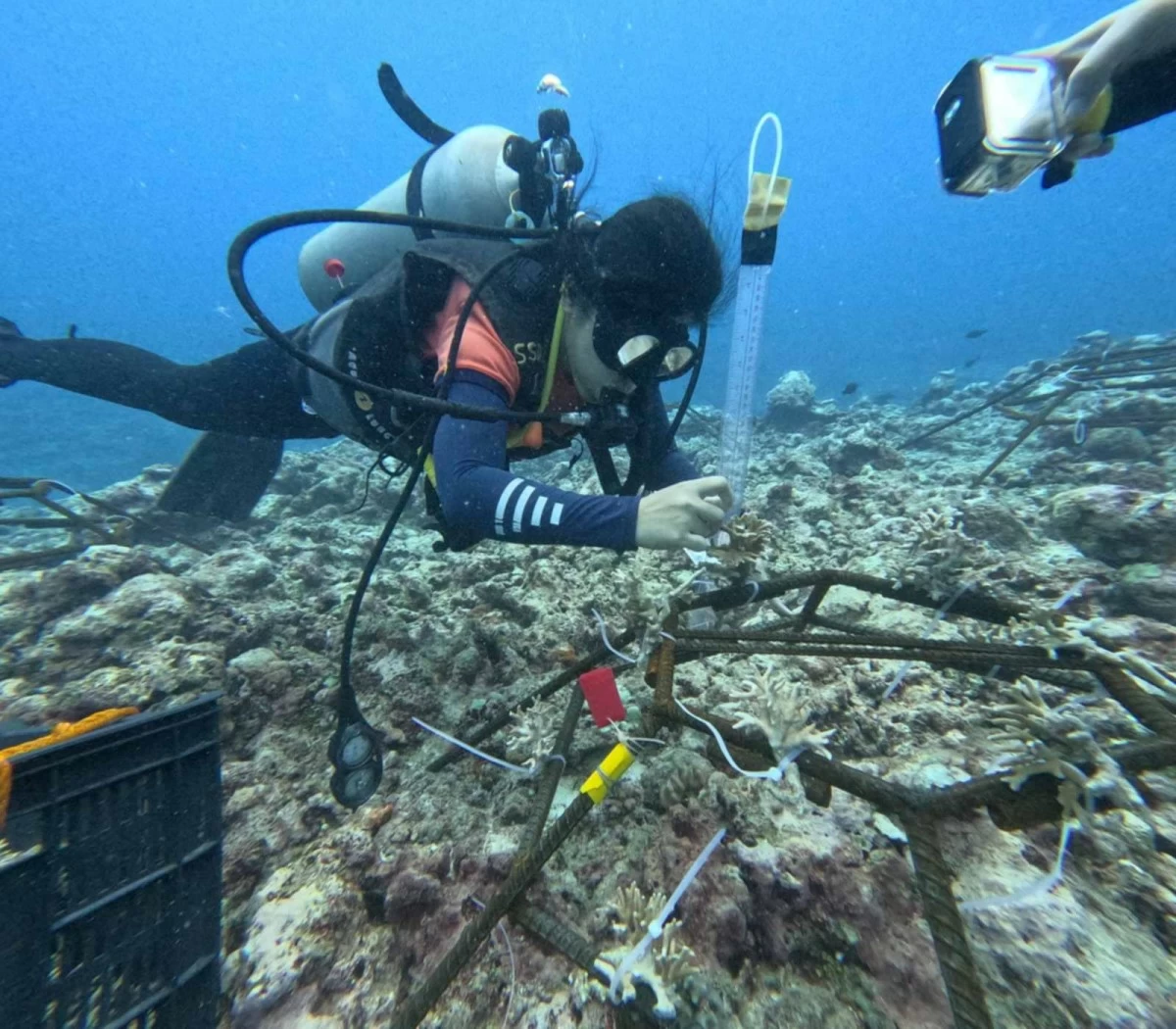
A Philippine Coast Guard personnel conducts coral reef restoration in the West Philippine Sea. (Photo: PCG)
The Philippine Coast Guard (PCG) said Wednesday, June 18, that it spearheaded a coral reef rehabilitation in Pagasa (Thitu) Island and the Kalayaan Island Group (KIG) as part of the government’s ongoing initiative to protect and conserve the marine environment in the West Philippine Sea (WPS).
The mission aims to restore coral reefs that are vital to the region’s marine biodiversity and coastal protection, according to the PCG.
The PCG Marine Science Group (MSG) conducted the mission. The team was headed by Commander James Barandino, assistant deputy chief of coast guard staff for marine environmental protection; and supported by the Palawan Council for Sustainable Development and marine scientists from Western Philippines University – Puerto Princesa Campus.
PCG Commandant, Admiral Ronnie Gil Gavan said the mission was carried out in line with President Marcos Jr.'s directive to protect and restore the “fragile ecosystems” in the WPS.
“The PCG MSG, through expert technical support, utilized methods such as selecting of coral fragment, handling and replanting procedures, and assisting biodiversity assessments and underwater surveys,” the coast guard noted.
The PCG has been conducting reef restoration and other sustainability initiatives in the WPS to protect its rich biodiversity, although some of the previous missions were marked by harassment from Chinese vessels and aircraft.
In January, the PCG reported that two civilian vessels of the Bureau of Fisheries and Aquatic Resources (BFAR) were subjected to aggressive maneuvers by three China Coast Guard vessels and a People’s Liberation Army-Navy (PLA-N) aircraft.
The BRP Datu Pagbuaya and BRP Datu Bankaw were on their way to Pag-asa Cays 2 and 3 in the WPS on Jan. 24 for a marine scientific survey and sampling when they were tailed by the Chinese vessels, while the Chinese aircraft hovered above them at unsafe altitude, which created hazardous conditions due to propeller wash.
The PCG has accused China of dumping crushed and dead corals in some features of the WPS, warning that this could be a prelude to possible reclamation activities.
Pag-asa Island, the largest of the nine Philippine-held features in the WPS, is home to a small civilian community and a strategic outpost for the country’s maritime operations while the Kalayaan Island Group (KIG), also known as the Spratly Islands, is a group of islands, reefs, and shoals claimed by the Philippines in the South China Sea.
Floating aggregate device
Meanwhile, the PCG and BFAR installed 20 floating aggregate devices (FADs) in Hasa Hasa (Half-Moon) Shoal and Kanduli (Royal Captain) Shoal in KIG.
“The primary objective of this initiative is to bolster the livelihoods of Filipino fishermen by improving their fish catch,” PCG spokesperson for WPS Commodore Jay Tarriela said.
The PCG deployed three 44-meter ships while the BFAR mobilized MV Mamalakaya, a fish carrier, for the three-day operation.
Tarriela said the installation of FADs also contributes to the national government's “Kadiwa para sa Bagong Bayaning Mangingisda (KBBM) program, which aims to ensure a sustainable and affordable supply of fish.
He said several Filipino fishing boats actively participated in supporting the deployment of FADs, “demonstrating the community’s commitment to enhancing local fisheries.”
But throughout the operation, Tarriela said the PCG and BFAR faced radio challenges and dangerous maneuvers from four CCG vessels, which attempted to hinder the deployment of FADs.
“Our crew, especially the radio operators, responded with professionalism and composure, successfully maintaining our maritime presence with dignity and courage,” he stated.