






Manila Bulletin
 Philippines
National
Despite fewer births, Philippines may still lack thousands of classrooms by 2040 — study
Philippines
National
Despite fewer births, Philippines may still lack thousands of classrooms by 2040 — study
Philippines
National
Despite fewer births, Philippines may still lack thousands of classrooms by 2040 — study
Despite fewer births, Philippines may still lack thousands of classrooms by 2040 — study
EDCOM 2–PIDS study warns the Philippines could lack 58,000–81,000 classrooms by 2040, even with lower birth rates, unless urgent construction begins
Published Jun 18, 2025 08:19 pm


At A Glance
- Projected classroom shortage despite fewer births: An EDCOM 2–PIDS study warns that the Philippines could face a shortage of 58,000 to 81,000 classrooms by 2040, even with declining birth rates, unless new construction efforts are implemented.
- Severe congestion in key regions: School overcrowding is most critical in NCR, CALABARZON, Region XII, and BARMM, where student-classroom ratios far exceed the national average, especially in public elementary schools.
- Need for urgent, multi-sector solutions: EDCOM 2 and DepEd propose public-private partnerships, LGU co-funding, and infrastructure investment strategies that consider aging buildings, disaster risks, and regional enrollment trends to address the classroom crisis.

Even with fewer births, the Philippines could still lack up to 81,000 classrooms by 2040 if no new ones are built after 2021 according to EDCOM 2-PIDS study released in June 2025 (MB file photo)
This year’s school opening was once again marred by one of the perennial problems of the public school system: student overcrowding due to a shortage of classrooms.
According to data from the Department of Education (DepEd), the nationwide classroom shortage currently stands at 165,000. In a May interview, Education Secretary Sonny Angara said the shortage is expected to grow because the current budget cannot support sufficient new construction.
“Buong bansa kasi ang kakulangan, especially in highly-populated areas, mataas ang backlog (The shortage affects the entire country, especially in highly populated areas, where the backlog is significant),” he added.
Angara, a former commissioner of EDCOM 2, said DepEd may pursue a proposed Public-Private Partnership (PPP) to fast-track the construction of 105,000 classrooms. The proposed PPP comes in response to a government report warning that it may take 55 years to fully address the classroom shortage.
What the study says
On Wednesday, June 18, the Second Congressional Commission on Education (EDCOM 2) highlighted key findings from the discussion paper “Low Fertility, Ageing Buildings, and School Congestion in the Philippines: Tailwinds, Headwinds, and Some Policy Options”, released by the Philippine Institute for Development Studies (PIDS).
The study, published this month, found that despite a declining birth rate, the Philippines could still face a shortage of 58,000 to 81,000 classrooms by 2040 if no new ones are built after 2021.
It emphasized the urgent need for sustained classroom construction to meet the country’s long-term educational needs.
Severely congested regions
Citing PIDS data, EDCOM 2 noted that severe congestion in elementary schools is most prevalent in four regions: the National Capital Region (NCR), Calabarzon (Region IV-A), Soccsksargen (Region XII), and the Bangsamoro Autonomous Region in Muslim Mindanao (BARMM).
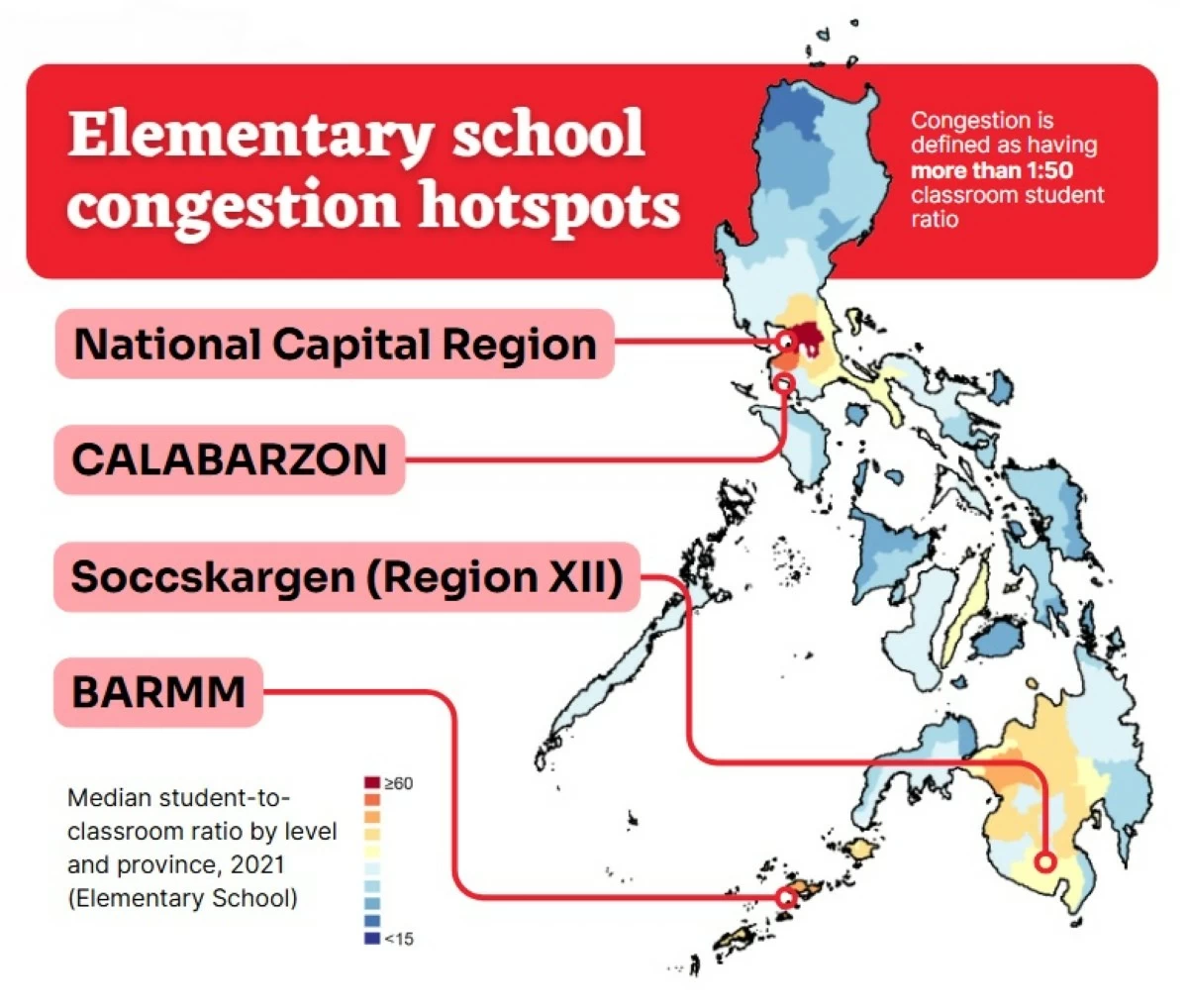
In which regions are elementary schools severely congested? According to the EDCOM 2–PIDS study, severe congestion is reported in elementary schools in NCR, CALABARZON, Region XII, and BARMM (Courtesy of EDCOM 2-PIDS)
While the Philippines’ declining fertility rate presents a potential tailwind for easing classroom congestion, EDCOM 2 said the PIDS study revealed that areas like Metro Manila, Regions IV-A, XII, and BARMM continue to suffer from persistent infrastructure backlogs and aging school buildings—requiring highly targeted interventions.
The PIDS Discussion Paper Series No. 2025-10 also projected a general decline in public school enrollment nationwide through 2040 and possibly up to 2060, primarily due to lower fertility rates. However, BARMM is a notable exception, with its school-age population expected to grow, increasing enrollment pressure.
The spatial analysis revealed that in 2021, public elementary schools in NCR, Region IV-A, Region XII, and BARMM had higher median student-classroom ratios than the national average.
In NCR, as much as 90 percent of public elementary school students in the Northern Manila District were enrolled in congested schools—with at least a 1:50 student-classroom ratio.
The Southern Manila District, which includes Las Piñas, Makati, Muntinlupa, Parañaque, Pasay, Pateros, and Taguig, had a congestion rate of 76.8 percent. The Eastern Manila District—comprising Mandaluyong, Marikina, Pasig, Quezon City, and San Juan—reported a rate of 60.1 percent.
Outside NCR, congestion levels were also above average in Rizal (66.0 percent) and Cavite (57.7 percent).
The study found that the classroom shortage is most prevalent at the elementary level, with junior high school and senior high school experiencing lesser but still significant deficits.
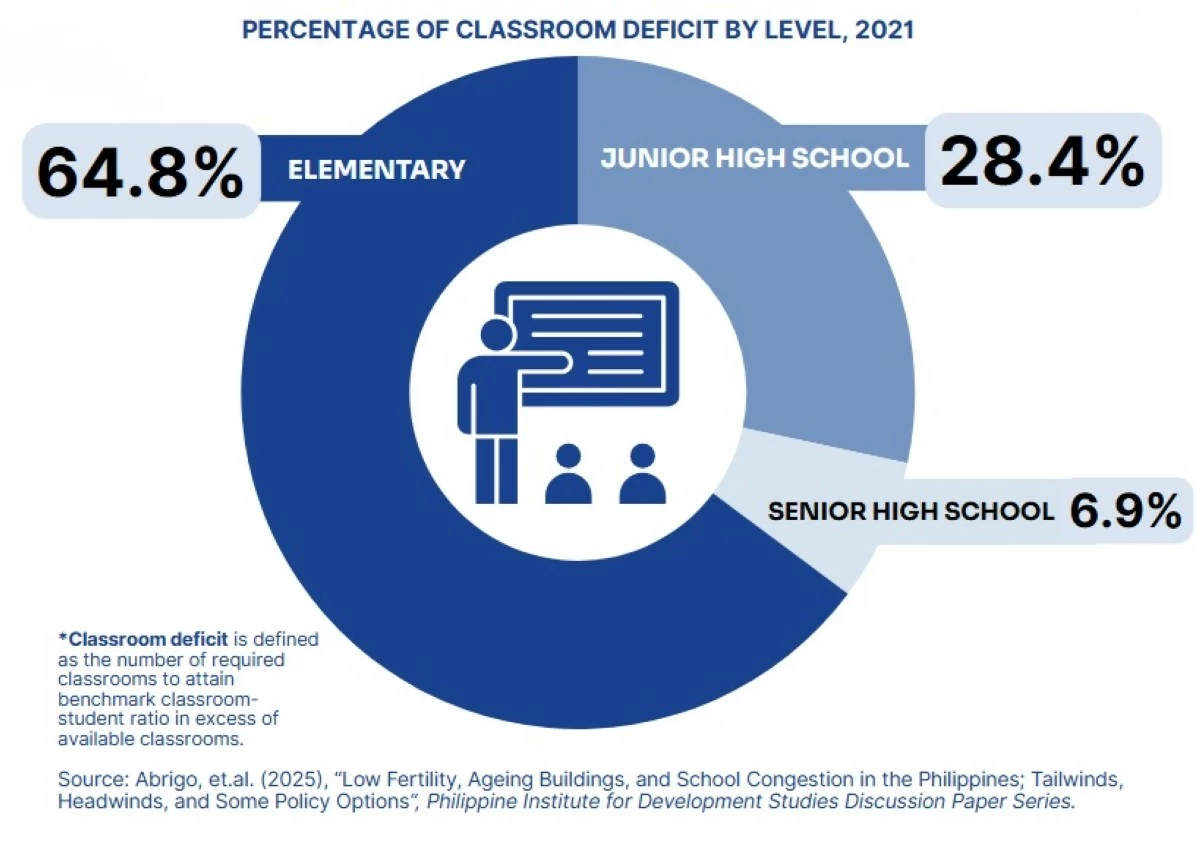
The study also identified that the majority of the classroom deficit is concentrated on the elementary level, followed by junior high school and senior high school. (Courtesy of EDCOM 2-PIDS)
Classroom shortage projections
The study projects that student-classroom ratios will remain highest in NCR and surrounding provinces at both elementary and secondary levels over the next 15 years. Similar trends are expected in Cebu, Occidental Mindoro, BARMM, and Soccsksargen.
“Even with fewer births, the Philippines could still lack 58,000 to 81,000 classrooms by 2040 if no new ones are built after 2021,” EDCOM 2 reiterated.
It also warned that while expanding infrastructure is crucial, DepEd must account for the deterioration of existing buildings. “Where, investments in new classrooms have often only been sufficient to replace dilapidated facilities rather than expanding the overall stock, thus failing to keep pace with enrollment increases,” EDCOM 2 noted.
Other considerations
EDCOM 2 pointed out that many classrooms have exceeded their estimated lifespan. By 2040, only 18.6 percent of classrooms built in 2023 are expected to remain in good condition without significant repair or reconstruction.
“The Philippines' vulnerability to disasters also necessitates substantial repair or condemnation of school infrastructure—even recently built ones,” EDCOM 2 explained.
According to Executive Director Dr. Karol Mark Yee, as DepEd works to address the 165,000-classroom backlog, it is imperative to consider four key factors: population growth, disaster risk, projected wear-and-tear of facilities, and available private school capacity.
“By looking at these factors collectively, we can diversify our interventions in addressing school congestion, break down silos in resourcing, and ensure that our efforts directly support improvement of learning outcomes of our students, Yee said.
Multiple solutions proposed
Meanwhile, EDCOM 2 Co-Chairperson Senator Sherwin Gatchalian emphasized the need for innovative approaches.
“One strategy I’m advocating is a counterpart program where local government units and the national government share the cost of building classrooms,” he said. “This way, multiple LGUs can construct classrooms simultaneously,” he added.
Gatchalian also proposed the use of public-private partnerships and an expanded Government Assistance to Students and Teachers in Private Education (GASTPE) program to ease congestion.
Co-Chairperson Rep. Roman Romulo has likewise raised concerns and supports aggressively building more classrooms or expanding the voucher system.
EDCOM 2, established under Republic Act 11899, is the Congressional body tasked with conducting a comprehensive national assessment of the Philippine education sector. Over the next three years, it will propose legislative solutions to address the country's education crisis.