






Manila Bulletin
 Philippines
National
AFP not worried by repositioning of US assets due to Middle East conflict
Philippines
National
AFP not worried by repositioning of US assets due to Middle East conflict
Philippines
National
AFP not worried by repositioning of US assets due to Middle East conflict
AFP not worried by repositioning of US assets due to Middle East conflict
Published Jun 17, 2025 12:53 pm
|
Updated Jun 17, 2025 02:06 pm


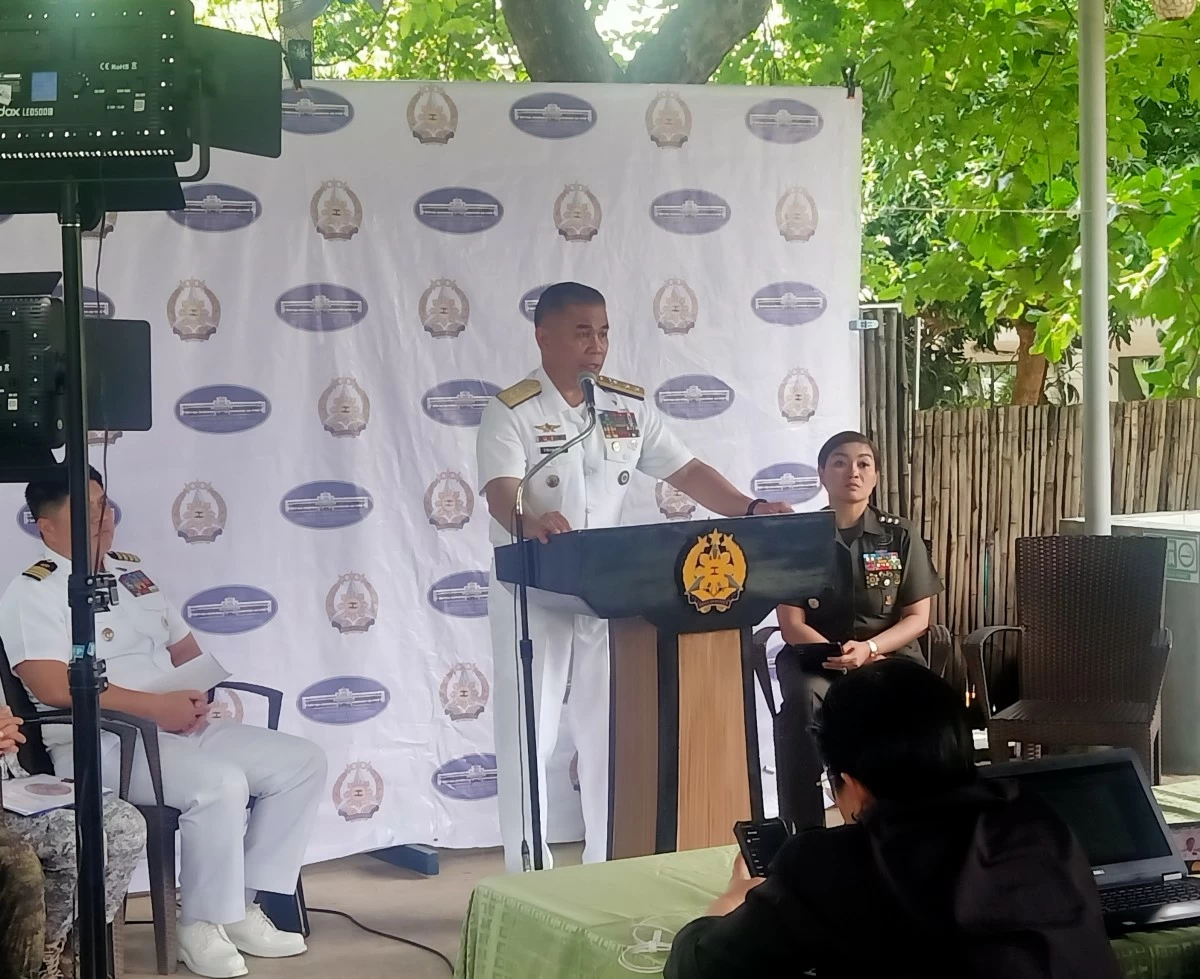
Philippine Navy (PN) spokesperson for West Philippine Sea (WPS) Rear Admiral Roy Vincent Trinidad answers questions from the media during a press conference at Camp Aguinaldo in Quezon City on June 17, 2025. (Photo: Martin Sadongdong / MANILA BULLETIN)
The Armed Forces of the Philippines (AFP) said it is not concerned about the United States shifting its military assets away from the South China Sea in response to the rapidly escalating conflict in the Middle East.
Rear Admiral Roy Vincent Trinidad, Philippine Navy (PN) spokesperson for the West Philippine Sea (WPS), said the AFP is capable of holding on its own even as its long-time treaty ally sets its sights on the Middle East situation.
“The beauty of maritime power is that it is not static, it is dynamic,” Trinidad told reporters in an interview at Camp Aguinaldo in Quezon City on Tuesday, June 17.
In the Philippine setting, Trinidad said the PN does not only stay in one particular vicinity of the country’s maritime domain as it conducts continuous patrols all over the archipelago.
“This is also the same approach of other navies, whether it is a conflict or potential hotspot. They move around their naval forces,” he stated.
Since June 13, Israel and Iran have traded missile firings which caused the deaths of top-ranking officials and civilians, and the destruction of properties.
According to reports, the US aircraft carrier USS Nimitz rerouted from the South China Sea to the Middle East on Monday as tension between Iran and Israel heats up.
“That is all part and parcel of having a naval force. We move them around where they are needed, when they are needed,” Trinidad said when asked about the US military’s strategy.
“But it has no effect on our maritime security in the West Philippine Sea,” the admiral added.
Chinese shadowing
In fact, the AFP conducted a bilateral maritime cooperative activity (MCA) with Japan in the WPS last June 14, specifically west of Zambales up to the west-northwest of Occidental Mindoro.
Trinidad said two Chinese vessels were spotted within the exercise area of the bilateral MCA: one tailed Japanese destroyer JS Takanami (DDG-110) at a close distance of 18 nautical miles, while the other was 30 nautical miles away from it. One of the Chinese ships even launched an aerial drone to capture the Philippines-Japan drill.
Further, the Chinese People’s Liberation Army – Navy (PLA-N) said it launched coordinated sea and air patrols in the South China Sea in response to the bilateral MCA of Japan and the Philippines, but Trinidad wouldn’t buy it.
“The Philippine Navy did not monitor any coordinated air and maritime patrols in our maritime zones conducted by the Southern Theater Command. What we have monitored is the continued illegal presence in our maritime zones of the PLA Navy and the Chinese Coast Guard,” he said.
The following day, June 15, Trinidad said two PLA-N warships and two CCG vessels were also spotted in the vicinity of Bajo de Masinloc, and another Chinese warship was located in Sabina Shoal.
Trinidad said the claims of China “are mere attempts at misinformation, disinformation, and malinformation to shape the internal and domestic narrative of the Chinese Communist Party's illegal claims in our maritime domain.”
China’s growing nuclear arsenal
Meanwhile, the AFP downplayed a report from an international think tank that China is slowly increasing its nuclear arsenal.
According to a report from the Stockholm International Peace Research Institute, China is producing about 100 new nuclear warheads per year since 2023. China has a total of 600 nuclear warheads at present, according to the think tank.
“The Philippines has been a signatory to the Non-Proliferation Treaty of Nuclear Weapons since 1968,” Trinidad said, referring to an international agreement that aims to prevent the spread of nuclear weapons and weapons technology.
“We have in our Constitution the statement that we do not adhere to war as an instrument of national policy. We are among the most freedom-loving and hospitable people in the world,” he added.
Trinidad said the AFP does not look at any country as a threat “unless this country would commence illegal, coercive, aggressive and deceptive actions against us.”
“Our modernization program is geared towards giving the AFP the wherewithal to be able to protect the Filipino people to ensure the integrity of our territory, protect our sovereignty, and look after the welfare of the Filipino people,” he concluded.