

ADVERTISEMENT

Gov't neglect, persistent shortages worsen education crisis as SY 2025–2026 opens, says group

Alliance of Concerned Teachers (ACT) Philippines holds 'sunrise protest' at Mendiola, shedding light on deteriorating school conditions nationwide

Published Jun 16, 2025 12:07 pm

At A Glance

  • As SY 2025–2026 opens, ACT Philippines warns of a worsening education crisis due to chronic shortages and government neglect, calling for urgent reforms and increased funding.

Persistent problems and government neglect worsen the education crisis as the new school year begins, according to the Alliance of Concerned Teachers (ACT) Philippines. (Photo from ACT Philippines)
A teachers’ group has sounded the alarm over what it calls a deepening education crisis, marked by chronic shortages in classrooms, teachers, and learning resources, as School Year (SY) 2025–2026 officially opens on Monday, June 16.
The Alliance of Concerned Teachers (ACT) blamed what it described as years of government neglect for the worsening conditions in public schools, warning that without urgent reforms and a significant increase in the education budget, millions of students will continue to suffer from inadequate access to quality education.
Members of ACT Philippines staged a sunrise protest at Mendiola to expose the “dismal state” of schools nationwide and call out the Marcos Jr. administration for its “chronic neglect”—which, they alleged, has resulted in a “further decline in education quality and deplorable school conditions.”
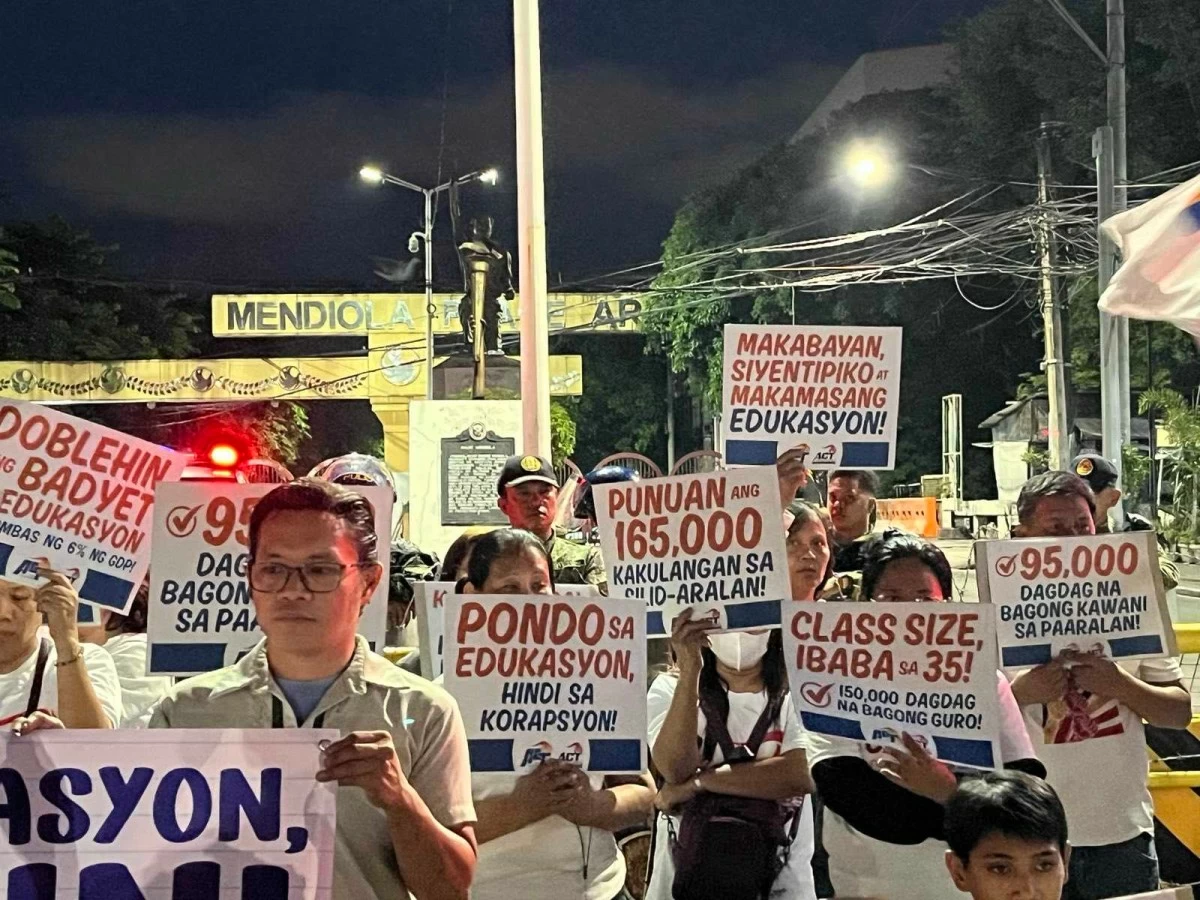
ACT Philippines has raised urgent concerns over a worsening education crisis, citing persistent shortages in classrooms, educators, and learning materials as the School Year (SY) 2025–2026 officially begins on June 16, 2025.  (Photo from ACT Philippines)
ACT Philippines has raised urgent concerns over a worsening education crisis, citing persistent shortages in classrooms, educators, and learning materials as the School Year (SY) 2025–2026 officially begins on June 16, 2025. (Photo from ACT Philippines)
Teachers and parents transformed Mendiola into a symbolic classroom, arranging monobloc chairs and holding cleaning supplies to highlight how communities are compelled to use their scarce resources to compensate for government shortcomings.
Another year, another burden
ACT Chairperson Vladimer Quetua said teachers and students are once again entering a school year under an education system severely lacking in funding—where shortages abound and quality continues to decline.
Quetua noted that with every school year opening, it is the teachers who end up covering the gaps in schools—from cleaning and repairs to providing for students' needs.
“We bear the brunt of this systemic neglect, and today’s protest is our call for the government to finally carry the heavier burden it owes to Filipino learners and educators,” Quetua said.
Filling in the gaps
The group emphasized that the country is grappling with a shortage of 165,000 classrooms—a gap that, given current funding trends, may take between 30 to 55 years to fully address.
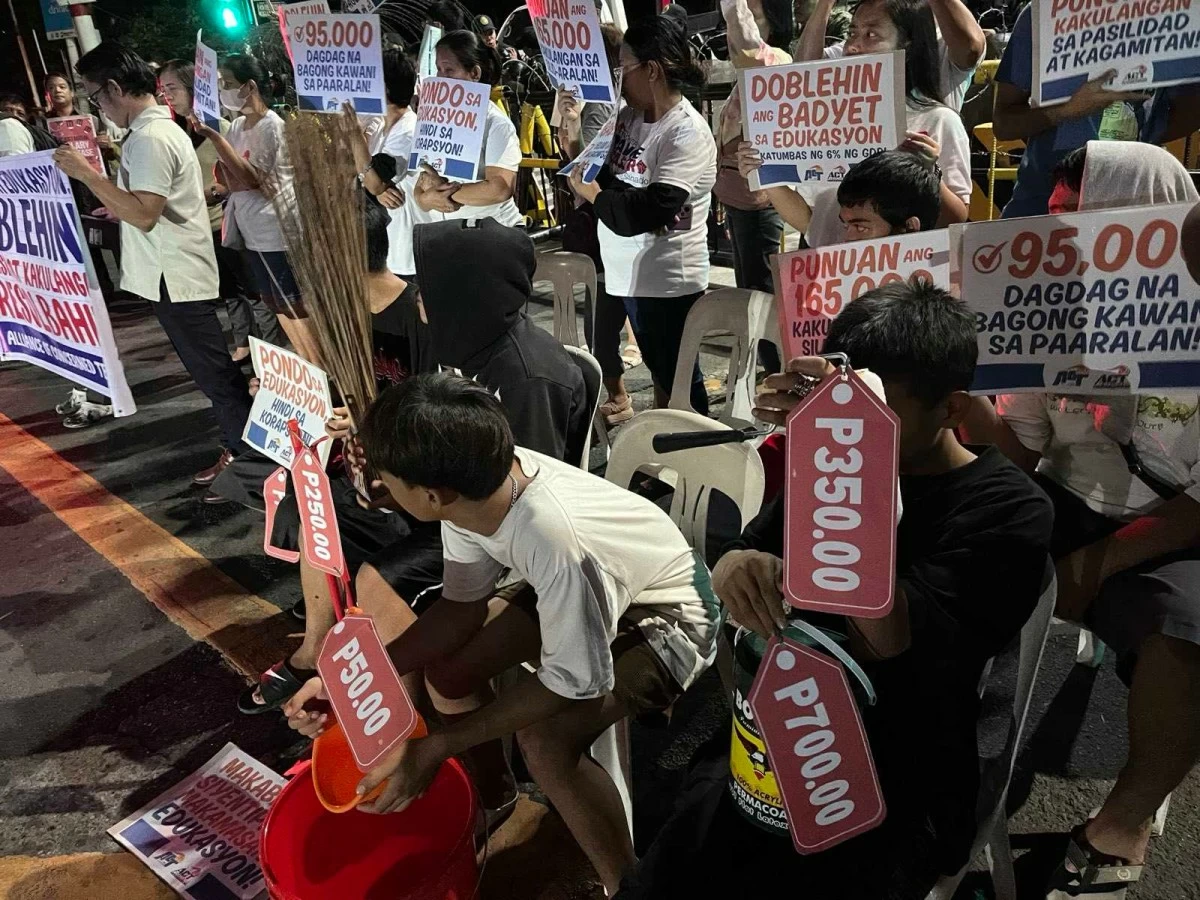
ACT attributed the deteriorating conditions in public schools to years of government neglect, cautioning that without urgent reforms and a substantial increase in the education budget, millions of students will remain deprived of adequate access to quality learning.  (Photo from ACT Philippines)
ACT attributed the deteriorating conditions in public schools to years of government neglect, cautioning that without urgent reforms and a substantial increase in the education budget, millions of students will remain deprived of adequate access to quality learning. (Photo from ACT Philippines)
ACT highlighted that due to this shortage, many schools are compelled to adopt double- or triple-shift class schedules, conduct lessons in makeshift classrooms, and institutionalize blended learning—measures that ultimately compromise the quality of education.
DepEd data indicate a shortage of over 56,000 teachers, yet ACT estimates that more than 150,000 are needed to bring class sizes down to the global standard of 35 students per class.
Meanwhile, the PSA’s 2024 FLEMMS survey reveals that approximately 18 million basic education graduates remain functionally illiterate.
“We have long argued that the gravity of education shortages necessitates a more ambitious and long-term plan,” Quetua said.
He pointed out that in 2023, the group had demanded that the national government hire 25,000 new teachers yearly until 2028 to eradicate the teacher shortage, plus an additional 5,000 annually to keep up with enrollment growth—totaling 30,000 new teachers each year.
The group also urged the Marcos-Duterte administration to build 50,000 classrooms annually until 2028 to eliminate the classroom backlog.
“But these demands fell on deaf ears—dismissed as unrealistic and impossible—while millions were squandered on confidential and intelligence funds,” Quetua said.
Urgent action and reform needed
ACT teacher leaders and ACT Teachers Party-list representatives have launched Bisita Eskwela in Metro Manila, aiming to assess on-the-ground realities and collect firsthand accounts from teachers, administrators, and communities.
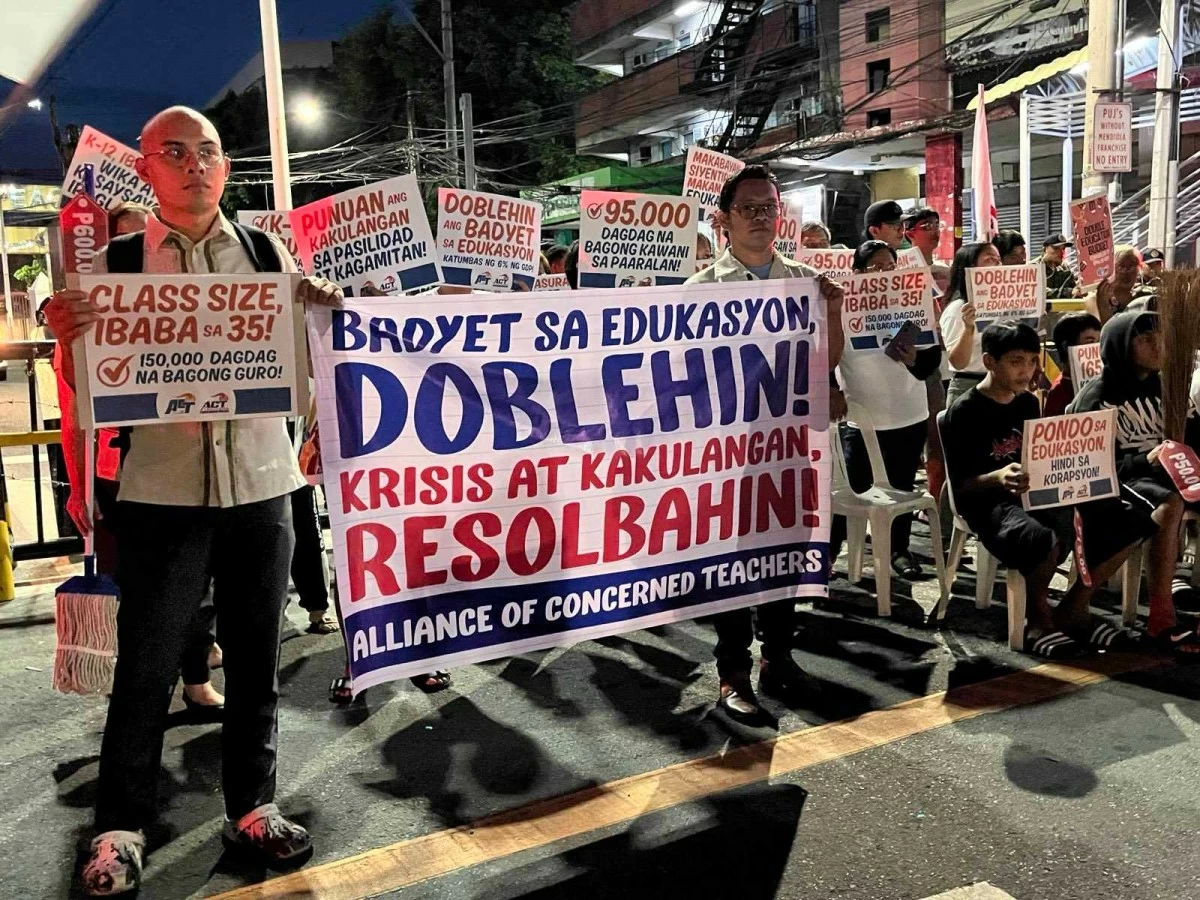
ACT Philippines warned that as the new school year begins, both teachers and students are once again grappling with an education system plagued by insufficient funding, widespread shortages, and a continuing decline in quality. (Photo from ACT Philippines)
Meanwhile, ACT has voiced concern over reports that DepEd officials are allegedly instructing teachers and school personnel to refrain from speaking to the media, while members of unions and organizations are being urged to exercise extreme discretion when discussing issues related to the school opening.
ACT cautioned that this represents a “blatant attempt” to fabricate an illusion of readiness while obscuring the severity of existing shortages—ultimately undermining public accountability and restricting teachers’ right to free expression.
“We can only solve our deep-seated problems by acknowledging them and compelling the government to act decisively,” Quetua said. “It is high time to double the education budget and end the long-standing state neglect of our education system,” he added.

Related Tags

education crisis Philippines 2025 ACT Philippines protest public school shortages 2025 school year 2025–2026 opening classroom and teacher shortage education budget increase Philippines
ADVERTISEMENT
.most-popular .layout-ratio{ padding-bottom: 79.13%; } @media (min-width: 768px) and (max-width: 1024px) { .widget-title { font-size: 15px !important; } }

{{ articles_filter_1561_widget.title }}

.most-popular .layout-ratio{ padding-bottom: 79.13%; } @media (min-width: 768px) and (max-width: 1024px) { .widget-title { font-size: 15px !important; } }

{{ articles_filter_1562_widget.title }}

.most-popular .layout-ratio{ padding-bottom: 79.13%; } @media (min-width: 768px) and (max-width: 1024px) { .widget-title { font-size: 15px !important; } }

{{ articles_filter_1563_widget.title }}

{{ articles_filter_1564_widget.title }}

.mb-article-details { position: relative; } .mb-article-details .article-body-preview, .mb-article-details .article-body-summary{ font-size: 17px; line-height: 30px; font-family: "Libre Caslon Text", serif; color: #000; } .mb-article-details .article-body-preview iframe , .mb-article-details .article-body-summary iframe{ width: 100%; margin: auto; } .read-more-background { background: linear-gradient(180deg, color(display-p3 1.000 1.000 1.000 / 0) 13.75%, color(display-p3 1.000 1.000 1.000 / 0.8) 30.79%, color(display-p3 1.000 1.000 1.000) 72.5%); position: absolute; height: 200px; width: 100%; bottom: 0; display: flex; justify-content: center; align-items: center; padding: 0; } .read-more-background a{ color: #000; } .read-more-btn { padding: 17px 45px; font-family: Inter; font-weight: 700; font-size: 18px; line-height: 16px; text-align: center; vertical-align: middle; border: 1px solid black; background-color: white; } .hidden { display: none; }
function initializeAllSwipers() { // Get all hidden inputs with cms_article_id document.querySelectorAll('[id^="cms_article_id_"]').forEach(function (input) { const cmsArticleId = input.value; const articleSelector = '#article-' + cmsArticleId + ' .body_images'; const swiperElement = document.querySelector(articleSelector); if (swiperElement && !swiperElement.classList.contains('swiper-initialized')) { new Swiper(articleSelector, { loop: true, pagination: false, navigation: { nextEl: '#article-' + cmsArticleId + ' .swiper-button-next', prevEl: '#article-' + cmsArticleId + ' .swiper-button-prev', }, }); } }); } setTimeout(initializeAllSwipers, 3000); const intersectionObserver = new IntersectionObserver( (entries) => { entries.forEach((entry) => { if (entry.isIntersecting) { const newUrl = entry.target.getAttribute("data-url"); if (newUrl) { history.pushState(null, null, newUrl); let article = entry.target; // Extract metadata const author = article.querySelector('.author-section').textContent.replace('By', '').trim(); const section = article.querySelector('.section-info ').textContent.replace(' ', ' '); const title = article.querySelector('.article-title h1').textContent; // Parse URL for Chartbeat path format const parsedUrl = new URL(newUrl, window.location.origin); const cleanUrl = parsedUrl.host + parsedUrl.pathname; // Update Chartbeat configuration if (typeof window._sf_async_config !== 'undefined') { window._sf_async_config.path = cleanUrl; window._sf_async_config.sections = section; window._sf_async_config.authors = author; } // Track virtual page view with Chartbeat if (typeof pSUPERFLY !== 'undefined' && typeof pSUPERFLY.virtualPage === 'function') { try { pSUPERFLY.virtualPage({ path: cleanUrl, title: title, sections: section, authors: author }); } catch (error) { console.error('ping error', error); } } // Optional: Update document title if (title && title !== document.title) { document.title = title; } } } }); }, { threshold: 0.1 } ); function showArticleBody(button) { const article = button.closest("article"); const summary = article.querySelector(".article-body-summary"); const body = article.querySelector(".article-body-preview"); const readMoreSection = article.querySelector(".read-more-background"); // Hide summary and read-more section summary.style.display = "none"; readMoreSection.style.display = "none"; // Show the full article body body.classList.remove("hidden"); } document.addEventListener("DOMContentLoaded", () => { let loadCount = 0; // Track how many times articles are loaded const offset = [1, 2, 3, 4, 5, 6, 7, 8, 9, 10]; // Offset values const currentUrl = window.location.pathname.substring(1); let isLoading = false; // Prevent multiple calls if (!currentUrl) { console.log("Current URL is invalid."); return; } const sentinel = document.getElementById("load-more-sentinel"); if (!sentinel) { console.log("Sentinel element not found."); return; } function isSentinelVisible() { const rect = sentinel.getBoundingClientRect(); return ( rect.top < window.innerHeight && rect.bottom >= 0 ); } function onScroll() { if (isLoading) return; if (isSentinelVisible()) { if (loadCount >= offset.length) { console.log("Maximum load attempts reached."); window.removeEventListener("scroll", onScroll); return; } isLoading = true; const currentOffset = offset[loadCount]; window.loadMoreItems().then(() => { let article = document.querySelector('#widget_1690 > div:nth-last-of-type(2) article'); intersectionObserver.observe(article) loadCount++; }).catch(error => { console.error("Error loading more items:", error); }).finally(() => { isLoading = false; }); } } window.addEventListener("scroll", onScroll); });

Sign up by email to receive news.