

ADVERTISEMENT

After the Air India flight crashed into a medical campus, the surviving doctors rushed to save lives

Published Jun 16, 2025 09:30 pm
AHMEDABAD, India (AP) — Navin Chaudhary had just begun eating his meal when a loud bang startled him. He turned back to see a massive fire taking over the dining area where he and other trainee doctors had assembled for lunch.
The blaze approaching him, he rushed toward a window and jumped.
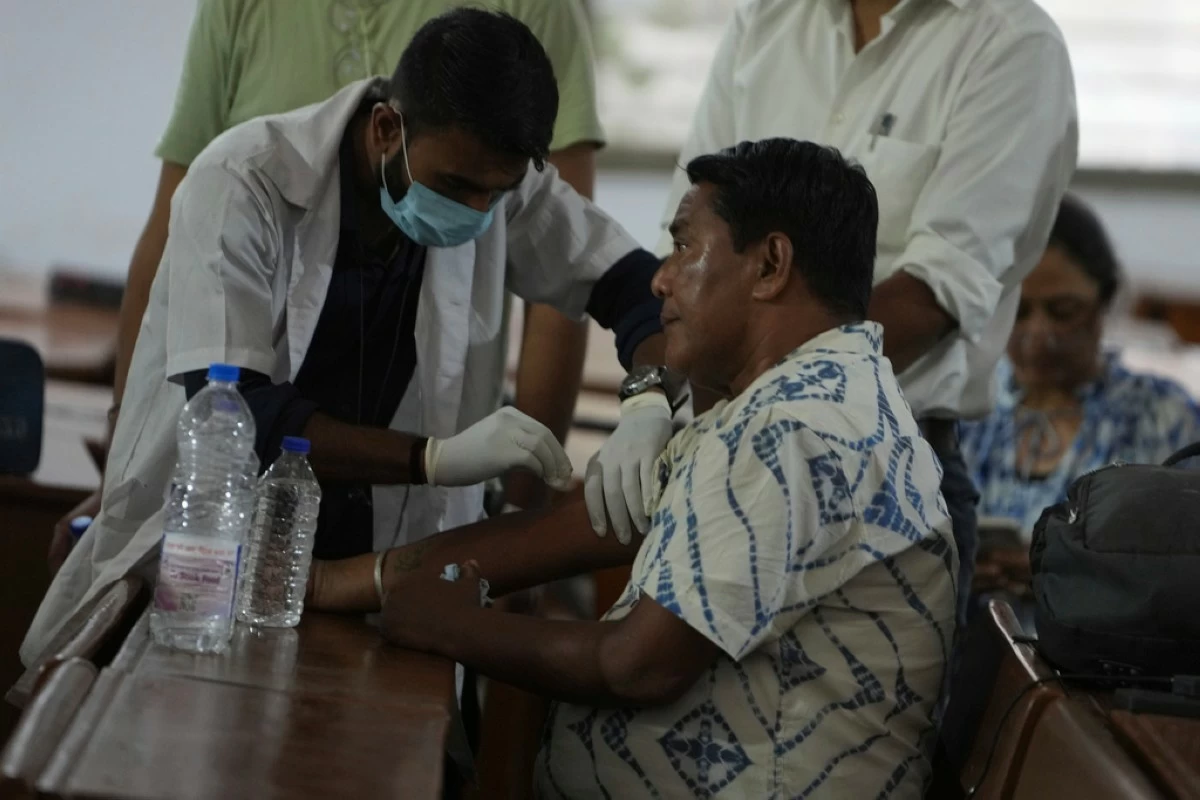
A health worker take DNA sample of a family member of a victim of an airplane that crashed in India's northwestern city of Ahmedabad in Gujarat state, Friday, June 13, 2025. (AP Photo/Ajit Solanki)
From the ground, looking upwards, the sight of the Air India plane's tail cone hanging from the burning building propelled Chaudhary and fellow medical students into action.
“There was fire and many were injured,” said Chaudhary.
He said he felt lucky to survive but knew he had a task at hand. He rushed to the hospital’s intensive care unit, where the injured, most of whom had burns, were wheeled in on stretchers.
“I felt that as a doctor I could save someone’s life,” he said. “I was safe. So I thought, whatever I can do, I should.”
At least 270 died when the Air India flight crashed into the campus of a medical college in Ahmedabad shortly after takeoff on Thursday. Only one passenger among the 242 aboard survived. At least 29 others on the ground, including five medical students inside the hostel, were also killed.
Many believe that the death toll would have been higher if it had not been for the intervention of the trainee doctors and students who emerged from the smouldering hostel and rushed to save their colleagues.
Akshay Zala, a senior medical student, said the crash felt “like an earthquake.”
“I could hardly see anything as thick plumes of smoke and dust engulfed everything. I was barely able to breathe,” he said.
Zala rushed to safety, running through dust and smoke. He cleaned and bandaged a wound on his left leg then joined others at the medical college’s trauma center to treat the injured.
On Monday, the crash site teemed with excavators and workers clearing the debris. Officials inspected the building in search of clues that could enable the investigators to figure out what led to the tragedy.
Barely a kilometer (less than a mile) away, trainee doctors who survived one of India's worst aviation disasters were still working to identify the victims through DNA testing.
Indian authorities have so far handed over the remains of 47 victims The bodies of 92 others have also been identified through DNA matching and will be transferred to relatives soon.
College dean Minakshi Parikh said that many of the doctors who pulled their colleagues out of the debris, later that day went back to their duties to save as many lives as they could. “They did that and that spirit has continued till this moment,” Parikh said.
Images of the hostel’s dining area shortly after the crash showed parts of the aircraft and pieces of luggage strewn on the floor. Dining plates still containing food lay on the few dusty tables that were left intact by the impact.
“So that is human nature, isn’t it? When our own people are injured, our first response is to help them, Parikh said. So the doctors who managed to escape ... the first thing that they did was they went back in and dug out their colleagues who were trapped inside.”
“They might not even have survived because the rescue teams take time coming, she added.

Related Tags

World news
ADVERTISEMENT
.most-popular .layout-ratio{ padding-bottom: 79.13%; } @media (min-width: 768px) and (max-width: 1024px) { .widget-title { font-size: 15px !important; } }

{{ articles_filter_1561_widget.title }}

.most-popular .layout-ratio{ padding-bottom: 79.13%; } @media (min-width: 768px) and (max-width: 1024px) { .widget-title { font-size: 15px !important; } }

{{ articles_filter_1562_widget.title }}

.most-popular .layout-ratio{ padding-bottom: 79.13%; } @media (min-width: 768px) and (max-width: 1024px) { .widget-title { font-size: 15px !important; } }

{{ articles_filter_1563_widget.title }}

{{ articles_filter_1564_widget.title }}

.mb-article-details { position: relative; } .mb-article-details .article-body-preview, .mb-article-details .article-body-summary{ font-size: 17px; line-height: 30px; font-family: "Libre Caslon Text", serif; color: #000; } .mb-article-details .article-body-preview iframe , .mb-article-details .article-body-summary iframe{ width: 100%; margin: auto; } .read-more-background { background: linear-gradient(180deg, color(display-p3 1.000 1.000 1.000 / 0) 13.75%, color(display-p3 1.000 1.000 1.000 / 0.8) 30.79%, color(display-p3 1.000 1.000 1.000) 72.5%); position: absolute; height: 200px; width: 100%; bottom: 0; display: flex; justify-content: center; align-items: center; padding: 0; } .read-more-background a{ color: #000; } .read-more-btn { padding: 17px 45px; font-family: Inter; font-weight: 700; font-size: 18px; line-height: 16px; text-align: center; vertical-align: middle; border: 1px solid black; background-color: white; } .hidden { display: none; }
function initializeAllSwipers() { // Get all hidden inputs with cms_article_id document.querySelectorAll('[id^="cms_article_id_"]').forEach(function (input) { const cmsArticleId = input.value; const articleSelector = '#article-' + cmsArticleId + ' .body_images'; const swiperElement = document.querySelector(articleSelector); if (swiperElement && !swiperElement.classList.contains('swiper-initialized')) { new Swiper(articleSelector, { loop: true, pagination: false, navigation: { nextEl: '#article-' + cmsArticleId + ' .swiper-button-next', prevEl: '#article-' + cmsArticleId + ' .swiper-button-prev', }, }); } }); } setTimeout(initializeAllSwipers, 3000); const intersectionObserver = new IntersectionObserver( (entries) => { entries.forEach((entry) => { if (entry.isIntersecting) { const newUrl = entry.target.getAttribute("data-url"); if (newUrl) { history.pushState(null, null, newUrl); let article = entry.target; // Extract metadata const author = article.querySelector('.author-section').textContent.replace('By', '').trim(); const section = article.querySelector('.section-info ').textContent.replace(' ', ' '); const title = article.querySelector('.article-title h1').textContent; // Parse URL for Chartbeat path format const parsedUrl = new URL(newUrl, window.location.origin); const cleanUrl = parsedUrl.host + parsedUrl.pathname; // Update Chartbeat configuration if (typeof window._sf_async_config !== 'undefined') { window._sf_async_config.path = cleanUrl; window._sf_async_config.sections = section; window._sf_async_config.authors = author; } // Track virtual page view with Chartbeat if (typeof pSUPERFLY !== 'undefined' && typeof pSUPERFLY.virtualPage === 'function') { try { pSUPERFLY.virtualPage({ path: cleanUrl, title: title, sections: section, authors: author }); } catch (error) { console.error('ping error', error); } } // Optional: Update document title if (title && title !== document.title) { document.title = title; } } } }); }, { threshold: 0.1 } ); function showArticleBody(button) { const article = button.closest("article"); const summary = article.querySelector(".article-body-summary"); const body = article.querySelector(".article-body-preview"); const readMoreSection = article.querySelector(".read-more-background"); // Hide summary and read-more section summary.style.display = "none"; readMoreSection.style.display = "none"; // Show the full article body body.classList.remove("hidden"); } document.addEventListener("DOMContentLoaded", () => { let loadCount = 0; // Track how many times articles are loaded const offset = [1, 2, 3, 4, 5, 6, 7, 8, 9, 10]; // Offset values const currentUrl = window.location.pathname.substring(1); let isLoading = false; // Prevent multiple calls if (!currentUrl) { console.log("Current URL is invalid."); return; } const sentinel = document.getElementById("load-more-sentinel"); if (!sentinel) { console.log("Sentinel element not found."); return; } function isSentinelVisible() { const rect = sentinel.getBoundingClientRect(); return ( rect.top < window.innerHeight && rect.bottom >= 0 ); } function onScroll() { if (isLoading) return; if (isSentinelVisible()) { if (loadCount >= offset.length) { console.log("Maximum load attempts reached."); window.removeEventListener("scroll", onScroll); return; } isLoading = true; const currentOffset = offset[loadCount]; window.loadMoreItems().then(() => { let article = document.querySelector('#widget_1690 > div:nth-last-of-type(2) article'); intersectionObserver.observe(article) loadCount++; }).catch(error => { console.error("Error loading more items:", error); }).finally(() => { isLoading = false; }); } } window.addEventListener("scroll", onScroll); });

Sign up by email to receive news.